Structured Manufacturing Data (2026)

Lens Barrel

Based on aggregated insights from structured factory profiles within the CNFX directory, the standard Lens Barrel used in the Computer, Electronic and Optical Product Manufacturing sector typically supports operational capacities ranging from standard industrial configurations to heavy-duty production requirements.

Technical Definition & Core Assembly

A canonical Lens Barrel is characterized by the integration of Mounting Threads and Focusing Helix. In industrial production environments, manufacturers listed on CNFX commonly emphasize Aluminum alloy construction to support stable, high-cycle operation across diverse manufacturing scenarios.

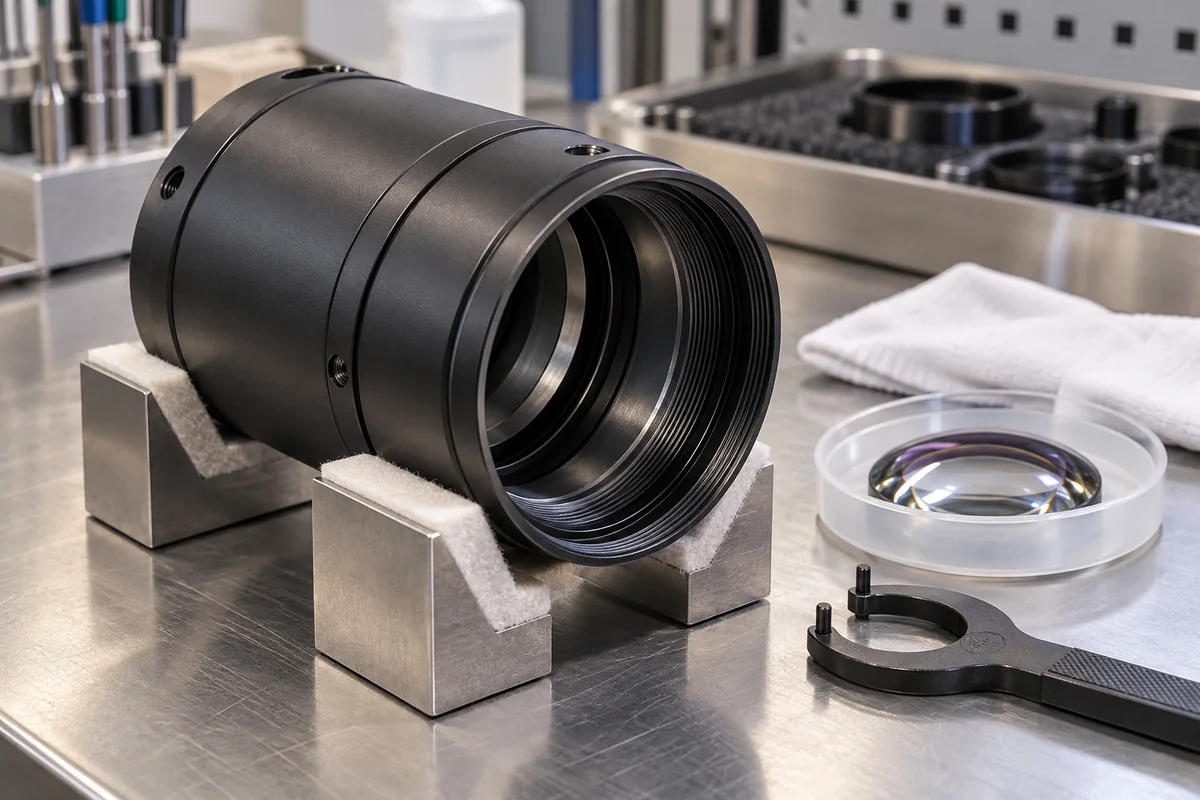
A cylindrical housing that holds and aligns optical lens elements within a lens assembly.
Product Specifications

Technical details and manufacturing context for Lens Barrel

Definition
The lens barrel is a critical mechanical component in optical systems that precisely positions and secures multiple lens elements along the optical axis. It maintains proper spacing between lenses, ensures alignment for optimal image quality, and often incorporates mechanisms for focusing, zooming, or aperture control. The barrel protects internal optics from environmental factors while providing mounting interfaces to cameras or other optical devices.
Working Principle
The lens barrel functions as a rigid structural framework that maintains precise mechanical alignment of optical elements. It typically features threaded or stepped internal surfaces where lenses are mounted at specific distances to achieve desired optical performance. Many barrels incorporate helicoid threads or cam mechanisms that allow controlled axial movement of lens groups for focusing or zooming functions. The barrel's dimensional stability and thermal properties are crucial for maintaining optical alignment under varying environmental conditions.
Common Materials
Aluminum alloy, Engineering plastic, Stainless steel
Technical Parameters
  • Inner diameter that determines maximum lens element size (mm) Customizable
Components / BOM
  • Mounting Threads Part
    Provides threaded interface for attaching lens elements and filters
    Material: Aluminum alloy or brass
  • Focusing Helix
    Helical groove mechanism that enables precise axial movement of lens groups for focusing
    Material: Engineering plastic or metal
  • Aperture Ring Part
    Rotating ring that controls the aperture mechanism within the barrel
    Material: Plastic or metal
  • Bayonet Mount Part
    Quick-release mounting interface for attaching the lens to camera bodies
    Material: Stainless steel or hardened alloy

Industry Taxonomies & Aliases

Commonly used trade names and technical identifiers for Lens Barrel.

Applied To / Applications

This component is essential for the following industrial systems and equipment:

Industrial Ecosystem & Supply Chain Structure

Complementary Systems
Downstream Applications
Specialized Tooling

Application Fit & Sizing Matrix

Operational Limits
pressure: Atmospheric to 1.5 bar
other spec: Humidity: 0-95% RH non-condensing
temperature: -40°C to 85°C
Media Compatibility
✓ Clean dry air ✓ Nitrogen gas ✓ Optical cleaning fluids
Unsuitable: Abrasive slurry environments
Sizing Data Required
  • Lens element diameter (mm)
  • Number of lens elements
  • Required optical alignment tolerance (microns)

Reliability & Engineering Risk Analysis

Failure Mode & Root Cause
Misalignment-induced wear
Cause: Improper installation or thermal expansion causing barrel components to shift, leading to uneven contact surfaces and accelerated degradation
Contamination ingress
Cause: Failed seals or improper assembly allowing dust, moisture, or particulates to enter barrel assembly, causing optical surface degradation and mechanical interference
Maintenance Indicators
  • Visible light scattering or haze when light passes through barrel assembly
  • Audible grinding or scraping during focus/zoom mechanism operation
Engineering Tips
  • Implement precision alignment verification during installation using laser alignment tools and maintain thermal expansion compensation in design
  • Establish regular seal integrity testing and controlled environment assembly procedures with particle counting verification

Compliance & Manufacturing Standards

Reference Standards
ISO 10110: Optical components and systems ANSI Z80.1: Ophthalmic lenses DIN 3140: Dimensions of optical lenses
Manufacturing Precision
  • Bore diameter: +/-0.01mm
  • Surface flatness: 0.05mm
Quality Inspection
  • Dimensional verification with coordinate measuring machine (CMM)
  • Surface quality inspection using interferometry

Factories Producing Lens Barrel

Manufacturer profiles with relevant production capability in China

Manufacturer listings support early research and capability understanding. They are not certification, ranking, or transaction guarantees.

Technical documentation
4/5
Manufacturing capability
4/5
Inspection readiness
5/5
Supplier transparency
3/5

These scores are example evaluation dimensions, not real customer ratings, country-specific buyer feedback, or live inquiry activity.

Supply Chain Compatible Machinery & Devices

Industrial IoT Gateway

Edge computing device connecting industrial equipment to cloud platforms.

Explore Specs →
Modular Industrial Edge Computing Device

Rugged computing platform for industrial data processing at the network edge

Explore Specs →
Industrial Smart Camera Module

Embedded vision system for industrial automation and quality inspection.

Explore Specs →
Industrial Wireless Power Transfer Module

Wireless power transfer module for industrial equipment applications

Explore Specs →

Frequently Asked Questions

What materials are commonly used for lens barrels in optical manufacturing?

Lens barrels are typically made from aluminum alloy for lightweight precision, engineering plastic for cost-effective applications, or stainless steel for maximum durability and corrosion resistance in demanding environments.

What are the key components of a lens barrel assembly?

A complete lens barrel assembly includes mounting threads for secure attachment, a focusing helix for precise adjustment, an aperture ring for light control, and a bayonet mount for quick lens changes in optical systems.

How does a lens barrel ensure optical performance in manufacturing applications?

The lens barrel maintains precise alignment of optical elements, prevents light leakage, provides mechanical protection, and enables accurate focusing adjustments—all critical for consistent optical performance in computer, electronic, and optical product manufacturing.

Can I contact factories directly on CNFX?

CNFX is an open directory, not a transaction platform. Each factory profile provides direct contact information and production details to help you initiate direct inquiries with Chinese suppliers.

Data Basis

CNFX manufacturer profiles, technical classification, publicly available product information, and ongoing plausibility checks.

Preliminary Technical Classification
This page supports structured research, RFQ preparation, and supplier evaluation. It does not replace buyer-led supplier qualification, standards review, or technical approval.

Request Manufacturing Insight for Lens Barrel

Ask for use case, specification boundaries, supplier type, and RFQ preparation information for Lens Barrel.

Your business information is used only to process this request.

Thank you! Your message has been sent. We'll respond within 1–3 business days.

Need to Manufacture Lens Barrel?

Compare manufacturer profiles with relevant product and process capability.

Create Manufacturer Profile Contact Us
Previous Product
Lens Assembly
Next Product
Lens Barrel/Housing