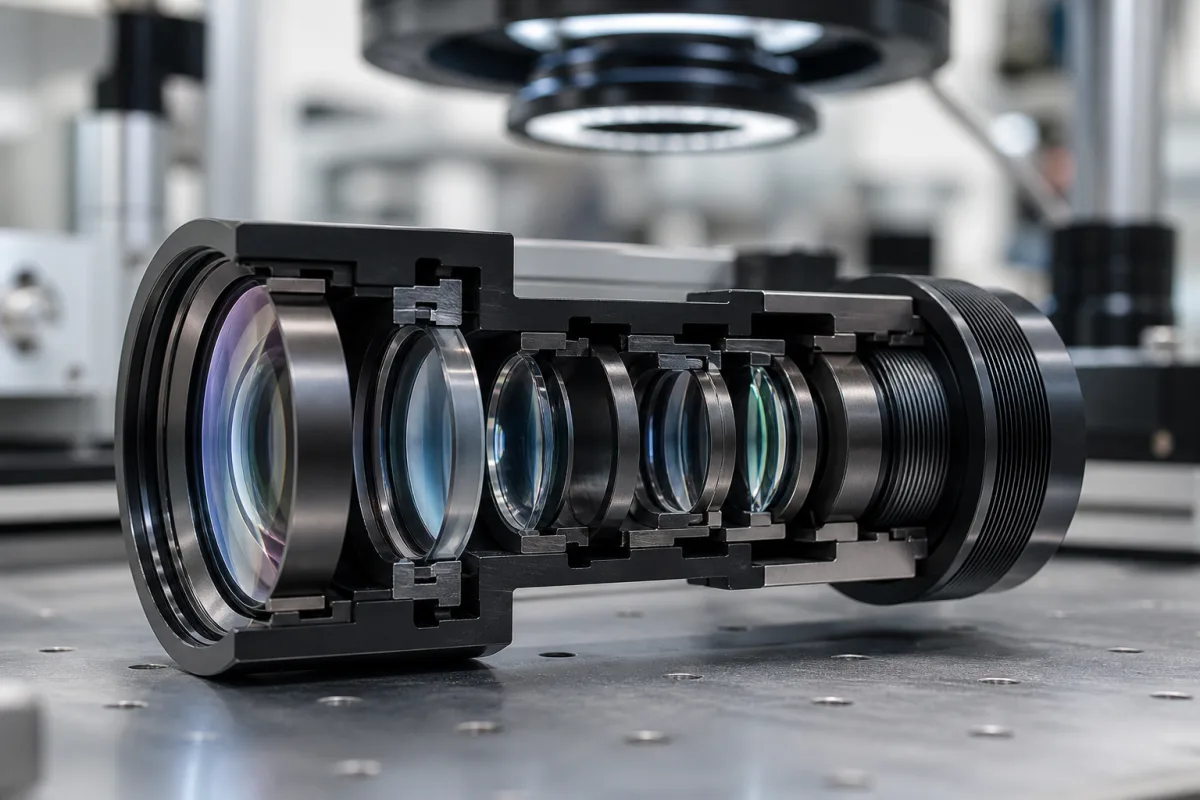
Multi-element imaging lens assembly (barrel-mounted, for cameras and OEM optics)
Multi-element imaging lens in a barrel · Barrel construction and centering accuracy, focal length, sensor format and C-mount
A multi-element imaging lens assembly is a set of glass lens elements fixed in a metal barrel so that their spacing, tilt and centring hold the optical design: seats and spacers set the axial positions, a retaining ring or adhesive holds the stack, and a mount thread such as C-mount attaches it to the camera. Ask three things first: how the barrel locates each element and to what accuracy, which focal length, aperture and sensor format the design covers, and which mount and back focal distance the camera needs.
Multi-element imaging lens assemblies built in a machined barrel: fixed-focal-length machine-vision and inspection camera lenses, and custom or build-to-print lens assemblies supplied to equipment makers. Microscope objectives, including infinity-corrected and interferometry objectives, are covered on the Objective lens for microscopes, inspection and interferometric heads page. Single lens elements, zoom lenses for photography and laser scanning lenses are outside this page.
CNFX editorial research · Sources checked October 12, 2026 · 4 sources
Choose the barrel construction for the centering accuracy you need
Jim Burge's lens-mounting course notes from the University of Arizona's College of Optical Sciences, drawing on Yoder's Mounting Optics in Optical Instruments, name centration and spacing tolerances as the key drivers of lens mount design. For a barrel bore, the notes advise keeping 0.001 in of radial clearance for assembly, which also limits interference from thermal effects, and state that this readily achieves 50 µm accuracy, or 25 µm with more effort. [1]
In the simplest barrel all lenses share one diameter and are separated by spacers: the bore is a low-cost operation and assembly is easy, but centration relies on the tolerances of the lenses and tilt and axial spacing rely on the spacers, which must be centred too, so the spacer stack accumulates tolerance. A stepped barrel takes lenses of different diameters with positions set by the machining. Higher precision comes from adjusting centration by rotation and optical measurement and then potting the lens, from choosing shims or custom spacers based on measurement, or from mounting each element in a subcell and stacking the subcells. [1]
The notes describe a two-part barrel with a toroidal interface that allows a tight fit of ±0.002 mm yet still assembles, a sharp-corner lens seat taken as about 0.002 in (50 µm) radius, and alignment accuracy of 5 µm in precision microscope objectives built with subcells. Barrels are machined in aluminium for ease of machining, or in 416 stainless steel for a better thermal-expansion match and thinner sections. [1] Editorial calculation: 0.001 in × 25.4 = 25.4 µm of radial clearance.
Give the supplier the optical prescription or performance target, the centration, tilt and spacing tolerances per element, the barrel material and finish, how elements are retained (threaded ring, adhesive or press fit), the mount type and flange distance, the sensor format, focal length and F-number range, the working distance, the environment, and the test report wanted (MTF, distortion, focus position).
02
Match focal length, sensor format and mount to the camera
Shanghai Optics lists stock fixed-focal-length C-mount lenses for 2/3, 1 and 4/3 inch sensors. Its 2/3 inch 3 MP series runs from 12 to 50 mm, all at F1.4, with filter thread M30.5 × 0.5 mm and closest focus from 0.15 m (12 mm) to 0.50 m (50 mm); its 4/3 inch 12 MP series runs from 8 to 65 mm with maximum apertures from F2.0 to F2.8, closing to F22, and filter threads from M37 × 0.5 to M67 × 0.75 mm. The same page states that some of its lenses focus from a working distance as short as 50 mm. [2]
The table shows that a larger sensor format raises the lens envelope at the same focal length: the 12 mm lens is listed at 37.9 × 34 × 38.5 mm for 2/3 inch and 3 MP, and 85 × 70 × 40 mm for 4/3 inch and 12 MP. [2] Computar's M1614-MP2, a 16 mm F1.4 lens for 2/3 inch sensors, is listed as a C-mount lens for C or CS mount cameras that needs a 5 mm adapter on a CS mount camera; Computar marks it discontinued with limited quantity. [3]
Editorial note: a C-mount lens on a CS-mount camera needs the 5 mm adapter Computar names, so state both the camera mount and any adapter in the order, and ask the supplier for the flange focal distance and back focal length of the assembly. [3]
03
Compare barrel constructions by accuracy and cost
Burge's notes rank lens mounting methods in order of increasing precision, complexity and cost. The figures are those quoted in the notes.
Burge notes that the lathe approach, customising each barrel for its as-built elements, makes parts non-interchangeable. [1] Editorial note: ask which of these constructions the supplier uses, because the stated accuracy and the price follow from it.
Construction
Assembly
Accuracy stated
Straight barrel with spacers and retaining ring
Easy, can be automated
Limited by element precision and the stack-up of errors [1]
4 companies list this product among what they make. Company figures are quoted from each
company's own website; every card states where the relationship came from.
Shanghai Optics
Manufacturing site to be confirmed for the order
Lists fixed-focal-length C-mount lenses for 2/3, 1 and 4/3 inch sensors among its lens assemblies.
Lists optical lens assemblies of spherical or aspherical lenses in a mechanical housing, in optical glass, fused silica, calcium fluoride and IR crystals.
Explore company information and manufacturing capabilities, then discuss the scope of your project with a relevant supplier.
Share this page
Compiled and source-reviewed by the CNFX editorial team.
Each manufacturer above links to the page on that company's own website where the product is listed, with the date we checked it. How we source and review
· Page last updated 13 October 2026
Buyer questions
How accurately can lens elements be centred in a barrel?
University of Arizona course notes give 50 µm for a bore with 0.001 in radial clearance (25 µm with more effort), 10 µm easily with rotation-based centration adjustment, and under 1 µm possible with subcells. [1]
Can a C-mount lens be used on a CS-mount camera?
Computar lists its M1614-MP2 C-mount lens for C or CS mount cameras, with a 5 mm adapter required on a CS mount camera. [3]
What focal lengths are offered for 4/3 inch sensors?
Shanghai Optics lists 12 MP C-mount lenses for 4/3 inch sensors from 8 to 65 mm, with maximum apertures from F2.0 to F2.8. [2]
Sources and what still needs a direct check
Sources checked 2026-10-12. Burge's notes are University of Arizona optomechanics course material; Shanghai Optics and Computar describe their own lenses; Tianjin Fushi Optical describes the lens assemblies it supplies.