Industry-Verified Manufacturing Data (2026)

Lens Barrel/Housing

Based on aggregated insights from multiple verified factory profiles within the CNFX directory, the standard Lens Barrel/Housing used in the Computer, Electronic and Optical Product Manufacturing sector typically supports operational capacities ranging from standard industrial configurations to heavy-duty production requirements.

Technical Definition & Core Assembly

A canonical Lens Barrel/Housing is characterized by the integration of Lens Seat and Retaining Ring. In industrial production environments, manufacturers listed on CNFX commonly emphasize Aluminum Alloy (e.g., 6061-T6) construction to support stable, high-cycle operation across diverse manufacturing scenarios.

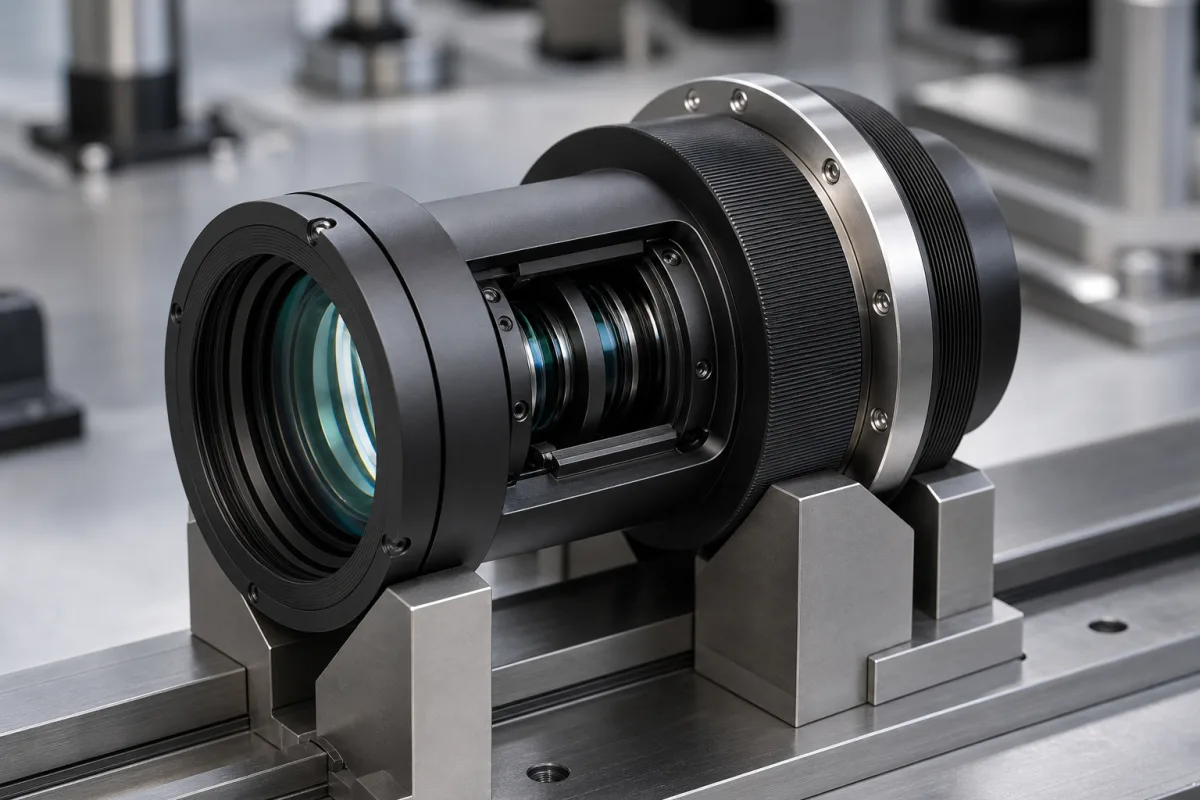
The structural component that holds and aligns optical lenses within an optical system.
Product Specifications

Technical details and manufacturing context for Lens Barrel/Housing

Definition
A lens barrel or housing is a precision mechanical component that securely contains, positions, and aligns one or more optical lenses along a common optical axis. It protects the delicate lens elements from physical damage, dust, and moisture while maintaining critical dimensional tolerances for optimal optical performance. The barrel often includes mounting threads, flanges, or other features for integration into larger assemblies like cameras, microscopes, telescopes, or projectors.
Working Principle
The lens barrel functions by providing a rigid, dimensionally stable enclosure. Internal features such as seats, spacers, and threads precisely locate each lens element at the correct axial position (vertex distance) and ensure concentricity. This mechanical alignment is crucial for maintaining the designed optical path, minimizing aberrations, and ensuring the system focuses light correctly onto the image plane or sensor.
Common Materials
Aluminum Alloy (e.g., 6061-T6), Stainless Steel, Engineering Plastic (e.g., PEEK, Ultem), Brass
Technical Parameters
  • Inner diameter (ID) and outer diameter (OD) are critical for lens fit and assembly integration. Length determines the spacing between lens elements. Thread pitch (e.g., M42x1, C-mount) is key for mounting. (mm) Per Request
Components / BOM
  • Lens Seat
    Precision-machined surface or ledge that supports and locates a lens element axially within the barrel.
    Material: Same as barrel (e.g., Aluminum Alloy)
  • Retaining Ring
    Threaded ring that secures a lens element against its seat, preventing axial movement.
    Material: Stainless Steel, Brass
  • Mounting Flange
    Interface feature (often with threads or bayonet lugs) for attaching the complete lens assembly to a camera or instrument.
    Material: Stainless Steel, Aluminum Alloy
  • Light Baffle
    Internal ridges or coated surfaces that reduce internal reflections and stray light (flare) within the barrel.
    Material: Anodized Aluminum, Blackened Metal
Engineering Reasoning
0-150°C temperature, 0-100% relative humidity, 0-50g vibration acceleration
Thermal expansion mismatch exceeding 15μm displacement, humidity-induced swelling exceeding 0.5% dimensional change, resonant vibration at 120-180Hz frequency range
Design Rationale: Coefficient of thermal expansion mismatch between aluminum housing (23.1×10⁻⁶/°C) and glass lenses (8.5×10⁻⁶/°C) causing mechanical stress; hygroscopic absorption in polymer components following Fick's second law; structural resonance at natural frequency causing fatigue crack propagation per Paris' law
Risk Mitigation (FMEA)
Trigger Thermal cycling between -40°C and 85°C at 10°C/min rate
Mode: Lens misalignment exceeding 0.01° angular deviation
Strategy: Thermal expansion compensation using Invar alloy (1.2×10⁻⁶/°C CTE) spacer rings with finite element analysis optimization
Trigger Cyclic torsional loading at 5Nm torque, 100Hz frequency
Mode: Thread stripping at M42×1mm mounting interface
Strategy: Double-start ACME thread design with 0.15mm root radius, hardened to 45HRC, analyzed per VDI 2230 bolted joint standard

Industry Taxonomies & Aliases

Commonly used trade names and technical identifiers for Lens Barrel/Housing.

Applied To / Applications

This component is essential for the following industrial systems and equipment:

Industrial Ecosystem & Supply Chain DNA

Complementary Systems
Downstream Applications
Specialized Tooling

Application Fit & Sizing Matrix

Operational Limits
pressure: Atmospheric to 2 bar absolute (sealed systems), vacuum compatible
other spec: Vibration: ≤5g RMS, Shock: ≤50g, Humidity: 0-95% non-condensing
temperature: -40°C to +85°C (operational), -55°C to +125°C (storage)
Media Compatibility
✓ Clean dry air/nitrogen environments ✓ Laboratory optical setups ✓ Precision imaging systems
Unsuitable: Abrasive particulate-laden atmospheres (sandstorms, industrial grinding)
Sizing Data Required
  • Lens diameter and quantity
  • Required optical alignment tolerance (±μm)
  • Mounting interface specifications (thread type, flange dimensions)

Reliability & Engineering Risk Analysis

Failure Mode & Root Cause
Thermal distortion
Cause: Uneven heat distribution during operation causing warping or misalignment of optical components
Corrosion and chemical degradation
Cause: Exposure to harsh environments, moisture ingress, or chemical contaminants compromising structural integrity
Maintenance Indicators
  • Visible condensation or moisture inside the housing indicating seal failure
  • Abnormal vibration or audible rattling during operation suggesting internal component loosening
Engineering Tips
  • Implement regular thermal cycling tests to identify early signs of thermal stress and distortion before catastrophic failure
  • Establish strict environmental monitoring and sealing integrity checks with scheduled replacement of gaskets and seals

Compliance & Manufacturing Standards

Reference Standards
ISO 10110-7:2017 - Surface imperfection tolerances ANSI Z80.1-2015 - Ophthalmic lenses - Prescription requirements DIN 3140-7:2016 - Optical components - Tolerances for centering
Manufacturing Precision
  • Bore diameter: +/-0.01mm
  • Surface flatness: 0.05mm over 50mm diameter
Quality Inspection
  • Coordinate Measuring Machine (CMM) dimensional verification
  • Interferometric surface flatness testing

Factories Producing Lens Barrel/Housing

Verified manufacturers with capability to produce this product in China

✓ 93% Supplier Capability Match Found

T Technical Director from Germany Feb 03, 2026
★★★★★
"Found 16+ suppliers for Lens Barrel/Housing on CNFX, but this spec remains the most cost-effective."
Technical Specifications Verified
P Project Engineer from Brazil Jan 31, 2026
★★★★☆
"The technical documentation for this Lens Barrel/Housing is very thorough, especially regarding technical reliability. (Delivery took slightly longer than expected, but technical support was excellent.)"
Technical Specifications Verified
S Sourcing Manager from Canada Jan 28, 2026
★★★★★
"Reliable performance in harsh Computer, Electronic and Optical Product Manufacturing environments. No issues with the Lens Barrel/Housing so far."
Technical Specifications Verified
Verification Protocol

“Feedback is collected from verified sourcing managers during RFQ (Request for Quote) and factory evaluation processes on CNFX. These reports represent historical performance data and technical audit summaries from our B2B manufacturing network.”

5 sourcing managers are analyzing this specification now. Last inquiry for Lens Barrel/Housing from Vietnam (14m ago).

Supply Chain Compatible Machinery & Devices

Industrial Smart Camera Module

Embedded vision system for industrial automation and quality inspection.

Explore Specs →
Industrial Wireless Power Transfer Module

Wireless power transfer module for industrial equipment applications

Explore Specs →
Industrial Smart Sensor Module

Modular industrial sensor with embedded processing and wireless connectivity

Explore Specs →
Surface Mount Resistor

Passive electronic component for current limiting and voltage division in circuits

Explore Specs →

Frequently Asked Questions

What materials are best for lens barrels in high-temperature applications?

For high-temperature environments, engineering plastics like PEEK or Ultem offer excellent thermal stability and resistance, while stainless steel provides durability and corrosion resistance.

How does a lens barrel ensure proper optical alignment?

A lens barrel maintains precise alignment through components like the lens seat and retaining ring, which securely position lenses along the optical axis, minimizing deviations and ensuring optimal system performance.

Can lens barrels be customized for specific optical systems?

Yes, lens barrels can be custom-designed with specific dimensions, materials, and BOM components (e.g., mounting flanges, light baffles) to meet the exact requirements of computer, electronic, or optical product applications.

Can I contact factories directly on CNFX?

CNFX is an open directory, not a transaction platform. Each factory profile provides direct contact information and production details to help you initiate direct inquiries with Chinese suppliers.

Get Quote for Lens Barrel/Housing

Request technical pricing, lead times, or customized specifications for Lens Barrel/Housing directly from verified manufacturing units.

Your business information is encrypted and only shared with verified Lens Barrel/Housing suppliers.

Thank you! Your message has been sent. We'll respond within 1–3 business days.

Need to Manufacture Lens Barrel/Housing?

Connect with verified factories specializing in this product category

Add Your Factory Contact Us
Previous Product
Lens Barrel
Next Product
Lens Chuck Assembly