Industry-Verified Manufacturing Data (2026)

Optical Lens Assembly

Based on aggregated insights from multiple verified factory profiles within the CNFX directory, the standard Optical Lens Assembly used in the Computer, Electronic and Optical Product Manufacturing sector typically supports operational capacities ranging from standard industrial configurations to heavy-duty production requirements.

Technical Definition & Core Assembly

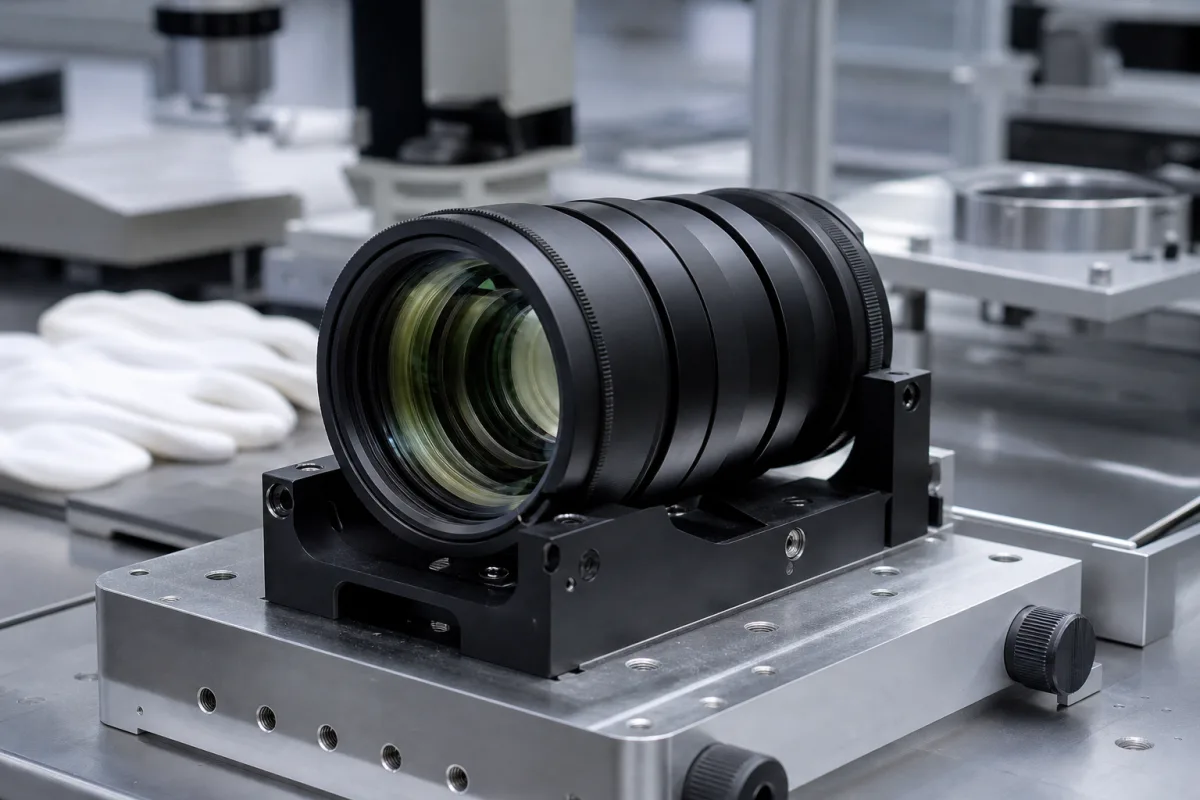
A canonical Optical Lens Assembly is characterized by the integration of Lens Elements and Lens Barrel/Housing. In industrial production environments, manufacturers listed on CNFX commonly emphasize Optical Glass (e.g., BK7, Fused Silica) construction to support stable, high-cycle operation across diverse manufacturing scenarios.

A precision optical component system that focuses light onto the sensor in a line scan camera.

Product Specifications

Technical details and manufacturing context for Optical Lens Assembly

Definition
The optical lens assembly in a line scan camera is a critical component responsible for collecting and focusing incoming light onto the linear sensor array. It ensures high-resolution image capture by precisely controlling the optical path, minimizing aberrations, and maintaining consistent focus across the entire scan line. Its performance directly impacts the camera's resolution, contrast, and overall image quality in industrial inspection and measurement applications.
Working Principle
The assembly consists of multiple lens elements arranged to correct optical aberrations (like chromatic and spherical aberration). Light from the target passes through these elements, which bend (refract) the light rays to converge them precisely onto the linear sensor's photodiodes, forming a sharp, focused image of a single line of the object being scanned.
Common Materials
Optical Glass (e.g., BK7, Fused Silica), Aluminum (for housing/mount)
Technical Parameters
  • Focal Length - Determines the field of view and working distance. (mm) Customizable
Components / BOM
  • Lens Elements
    Refract light to focus it onto the sensor. Multiple elements correct for optical aberrations.
    Material: Optical Glass (e.g., BK7, SF11)
  • Lens Barrel/Housing
    Holds all lens elements in precise alignment and provides mounting interface to the camera.
    Material: Aluminum (often black anodized)
  • Aperture Stop/Iris
    Controls the amount of light entering the lens and affects depth of field (may be fixed in many line scan lenses).
    Material: Stainless Steel or Aluminum
  • Mounting Flange
    Standardized interface (e.g., C-mount, F-mount) for attaching the lens assembly to the line scan camera body.
    Material: Stainless Steel
Engineering Reasoning
0.1-1000 lux illumination intensity, -40°C to +85°C ambient temperature, 0-95% relative humidity (non-condensing)
Surface deformation exceeding λ/4 (157.5 nm at 630 nm wavelength), temperature gradient >15°C/mm across lens elements, relative humidity >95% for >24 hours
Design Rationale: Thermal expansion coefficient mismatch between borosilicate glass (3.25×10⁻⁶/K) and aluminum housing (23.1×10⁻⁶/K) causing mechanical stress, hygroscopic swelling of optical adhesives at >95% RH, photon-induced material degradation at >1000 lux continuous exposure
Risk Mitigation (FMEA)
Trigger Differential thermal expansion between lens elements and mounting structure at ΔT>50°C
Mode: Decentration error >5 μm causing MTF reduction below 0.3 at 50 lp/mm
Strategy: Kinematic mounting with invar alloy (1.2×10⁻⁶/K CTE) compensation rings and active thermal control with ±0.5°C stability
Trigger Cyclic mechanical vibration at 120-200 Hz resonance frequency with >0.5 g acceleration
Mode: Lens element displacement >2 μm RMS causing wavefront error >0.25 λ RMS
Strategy: Viscoelastic damping mounts with loss factor η>0.3 and finite element optimized ribbed housing structure with natural frequency >400 Hz

Industry Taxonomies & Aliases

Commonly used trade names and technical identifiers for Optical Lens Assembly.

Applied To / Applications

This component is essential for the following industrial systems and equipment:

Industrial Ecosystem & Supply Chain DNA

Complementary Systems
Downstream Applications
Specialized Tooling

Application Fit & Sizing Matrix

Operational Limits
pressure: Atmospheric to 1.5 bar
other spec: Humidity: 0-85% RH non-condensing, Vibration: <5g RMS
temperature: -20°C to +80°C
Media Compatibility
✓ Clean dry air ✓ Nitrogen purge environments ✓ Controlled cleanroom atmospheres
Unsuitable: Abrasive particulate-laden air or corrosive chemical vapors
Sizing Data Required
  • Sensor pixel size (μm)
  • Required working distance (mm)
  • Desired field of view (mm)

Reliability & Engineering Risk Analysis

Failure Mode & Root Cause
Surface contamination and adhesion
Cause: Accumulation of dust, oils, or residues from handling or environmental exposure, leading to reduced optical clarity and potential chemical degradation of coatings.
Coating delamination or degradation
Cause: Exposure to UV radiation, thermal cycling, or improper cleaning agents causing anti-reflective or protective coatings to peel, crack, or lose effectiveness.
Maintenance Indicators
  • Visible haze, streaks, or permanent spots on lens surfaces that persist after cleaning
  • Audible clicking or grinding during assembly/disassembly indicating misalignment or particulate contamination in mechanical interfaces
Engineering Tips
  • Implement strict cleanroom protocols for handling and storage, using only approved lens-grade cleaning materials and controlled environments to prevent contamination.
  • Establish regular optical performance monitoring using calibrated test equipment to detect early coating degradation before visible defects appear.

Compliance & Manufacturing Standards

Reference Standards
ISO 10110: Optical elements and systems ANSI Z80.1: Ophthalmic lenses - Prescription requirements DIN 3140: Optical elements and systems - Tolerances
Manufacturing Precision
  • Surface figure error: λ/4 at 632.8nm
  • Centering tolerance: ±0.02mm
Quality Inspection
  • Interferometric surface testing
  • Modulation Transfer Function (MTF) measurement

Factories Producing Optical Lens Assembly

Verified manufacturers with capability to produce this product in China

✓ 97% Supplier Capability Match Found

P Project Engineer from Canada Feb 14, 2026
★★★★★
"Reliable performance in harsh Computer, Electronic and Optical Product Manufacturing environments. No issues with the Optical Lens Assembly so far."
Technical Specifications Verified
S Sourcing Manager from United States Feb 11, 2026
★★★★★
"Testing the Optical Lens Assembly now; the technical reliability results are within 1% of the laboratory datasheet."
Technical Specifications Verified
P Procurement Specialist from United Arab Emirates Feb 08, 2026
★★★★★
"Impressive build quality. Especially the technical reliability is very stable during long-term operation."
Technical Specifications Verified
Verification Protocol

“Feedback is collected from verified sourcing managers during RFQ (Request for Quote) and factory evaluation processes on CNFX. These reports represent historical performance data and technical audit summaries from our B2B manufacturing network.”

9 sourcing managers are analyzing this specification now. Last inquiry for Optical Lens Assembly from Brazil (1h ago).

Supply Chain Compatible Machinery & Devices

Industrial IoT Gateway

Edge computing device connecting industrial equipment to cloud platforms.

Explore Specs →
Modular Industrial Edge Computing Device

Rugged computing platform for industrial data processing at the network edge

Explore Specs →
Industrial Smart Camera Module

Embedded vision system for industrial automation and quality inspection.

Explore Specs →
Industrial Wireless Power Transfer Module

Wireless power transfer module for industrial equipment applications

Explore Specs →

Frequently Asked Questions

What are the key applications for this optical lens assembly?

This optical lens assembly is designed for line scan cameras used in industrial inspection, document scanning, quality control systems, and machine vision applications requiring precise light focusing onto linear sensors.

What materials are used in the construction of this lens assembly?

The assembly uses high-quality optical glass (BK7 or fused silica) for lens elements to ensure minimal distortion and excellent light transmission, with precision aluminum housing and mounting components for durability and thermal stability.

How does this lens assembly improve imaging performance in line scan cameras?

The precision-engineered lens elements and aperture control ensure optimal light focusing onto the sensor array, reducing chromatic aberration and maintaining consistent image quality across the entire scan line for accurate data capture.

Can I contact factories directly on CNFX?

CNFX is an open directory, not a transaction platform. Each factory profile provides direct contact information and production details to help you initiate direct inquiries with Chinese suppliers.

Get Quote for Optical Lens Assembly

Request technical pricing, lead times, or customized specifications for Optical Lens Assembly directly from verified manufacturing units.

Your business information is encrypted and only shared with verified Optical Lens Assembly suppliers.

Thank you! Your message has been sent. We'll respond within 1–3 business days.

Need to Manufacture Optical Lens Assembly?

Connect with verified factories specializing in this product category

Add Your Factory Contact Us
Previous Product
Optical Isolators
Next Product
Optical Lens System