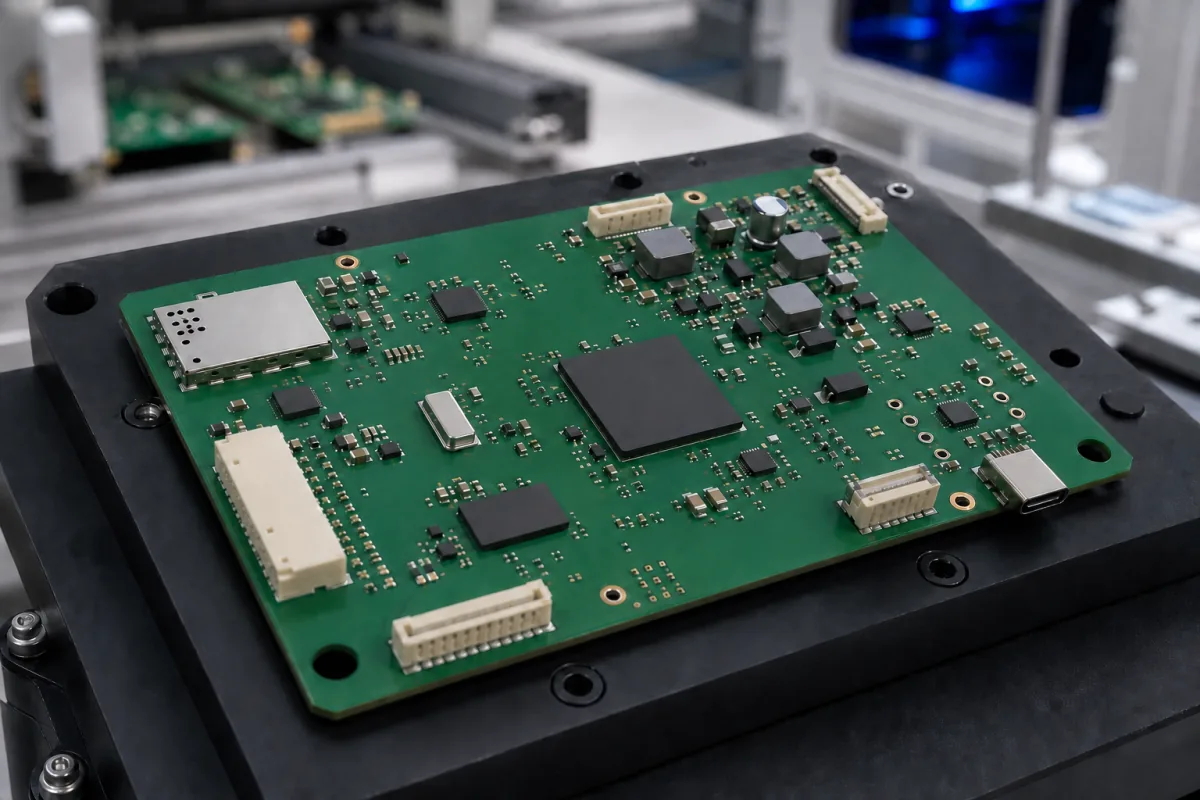
Main control board for an appliance or machine: the custom MCU board that runs the product
Custom MCU board that runs one appliance · I/O count, relay ratings, RS-485 and wireless module, FCC emission limits
A main control board is the printed circuit assembly designed for one product, such as a heat pump, an air-quality monitor or a lift, that reads its sensors, switches its loads, talks to its other boards and, in connected products, carries a wireless module. Unlike a general-purpose computer board, its inputs, outputs, firmware and connectors are fixed by the product it runs. Pin down three things with the board maker: the exact I/O and relay ratings the product needs, how the wireless module is powered and certified, and which emission limits the finished product must pass.
Product-specific main control boards: the microcontroller, power regulation, sensor inputs, relay and driver outputs, field-bus ports, wireless module and connectors on one PCBA designed for a particular appliance or machine, supplied with its firmware. General-purpose single board computers are covered on the Single board computer page, and add-in Ethernet, SFP and serial cards on the Communication interface board page; bare PCBs and contract assembly as a service are outside this page.
CNFX editorial research · Sources checked October 12, 2026 · 4 sources
Heat pump example: 12 analog inputs, 12 relays and three RS-485 ports on one board
Yichwan's general heat pump main control board shows how far an appliance board's I/O is set by the machine it runs. It uses a Renesas 16-bit MCU running a fuzzy control algorithm and is published with the following resources. [1]
Editorial calculation: three address bits give 2³ = 8 combinations, consistent with Yichwan's statement that the board addresses up to 8 slaves. [1]
The 4G option shows a trade-off to settle before ordering: fitting the module takes one of the three RS-485 ports, leaving two for the host PC, drivers, fan board or wired controller. [1] Ask the maker to confirm which loads each relay is rated for and whether the 30 A contact switches the compressor or another high-current load directly.
Item
Published value
Supply
Single-phase 220 VAC, input range 220 V ±20%, 50/60 Hz ±5%
12 relays (one rated 30 A), 2 electronic expansion valve drivers, 1 variable-speed water pump, 1 analog 0–10 V
Communication
3 RS-485 ports; one is occupied if the optional 4G IoT module is fitted
Addressing
4-bit DIP switch, bits 1–3 for address, bit 4 reserved
Environment
Operating −30 to +60 °C, storage −45 to +85 °C, altitude below 2,000 m
Size
160 × 130 × 33.5 mm
Send the board maker the product's sensor list and signal types, every load with its voltage and current, the field-bus and display connections, supply voltage and tolerance, ambient temperature range, enclosure size, wireless and remote-update needs, firmware ownership, and the markets the product will be certified for.
02
A Wi-Fi/Bluetooth module on the board: 3.3 V supply sized for transmit peaks and a modular approval
Espressif's ESP32-C3-MINI-1, a 13.2 × 16.6 × 2.4 mm Wi-Fi and Bluetooth LE module, runs from 3.0–3.6 V and its datasheet asks for an external supply able to deliver at least 0.5 A. Peak current on Wi-Fi transmit reaches 350 mA (802.11b at 20.5 dBm) and 340 mA on Bluetooth LE at 20 dBm, against 82–86 mA on receive. [2]
The same module carries a 160 MHz RISC-V core, 384 KB ROM, 400 KB SRAM, up to 8 MB flash and up to 15 GPIOs; its two 12-bit SAR ADCs give 5 factory-calibrated channels on ADC1 and 1 uncalibrated channel on ADC2. It comes in −40 to 85 °C and −40 to 105 °C versions, and the PCB-antenna version needs an antenna keepout zone on the base board. [2]
Editorial calculation: a 350 mA transmit peak at 3.3 V is about 1.16 W drawn in bursts, so the board's 3.3 V regulator and bulk capacitance must hold up during those bursts on top of the MCU and sensor load; the 0.5 A supply figure in the datasheet is the floor, not the total for the board. [2]
For the US market, 47 CFR 15.212 lets a host product rely on a module's own approval only if the module's radio elements have their own shielding, it has buffered data inputs and its own power-supply regulation, and its antenna is permanently attached or uses a unique coupler. If the module's FCC ID is hidden once installed, the outside of the product must carry a label such as "Contains FCC ID: …". [3] Ask which module, which FCC ID and which antenna the board uses, and whether the layout follows the module maker's keepout drawing.
03
The finished product is a digital device: Class B radiated limits from 100 to 500 µV/m at 3 m
47 CFR 15.109 sets the radiated emission limits for unintentional radiators such as a product run by a clocked control board. Class B limits apply at 3 m and Class A limits at 10 m, with the tighter limit at each band edge. [4]
Editorial calculation: in decibel terms the Class B limits are 20·log₁₀(100) = 40.0, 43.5, 46.0 and 54.0 dBµV/m for the four bands. [4]
Section 15.109(g) also allows digital devices to show compliance with CISPR 22 limits instead, with the FCC limits still applying above 1,000 MHz; the rule gives 150 µV/m at 10 m as the Class B limit above 1,000 MHz when extrapolated at 20 dB per decade. [4] Editorial note: whether a household appliance falls under Class B depends on where it is marketed; ask the board maker for pre-compliance scan results of the board in its enclosure, not of a bare board on a bench.
Frequency (MHz)
Class B at 3 m (µV/m)
Class A at 10 m (µV/m)
30–88
100
90
88–216
150
150
216–960
200
210
Above 960
500
300
04
Main control board brief
Paste it into your enquiry below or into an email to a maker, then replace every bracket.
Product: [appliance or machine; market]
Inputs: [sensors; signal types; count]
Outputs: [relays with load ratings; valve and pump drivers; analog outputs]
Buses: [RS-485; CAN; UART to display; addressing]
Radio: [Wi-Fi; Bluetooth; 4G; module and FCC ID]
Power: [supply voltage and tolerance; frequency]
Environment: [operating and storage temperature; altitude]
Mechanical: [board size; connectors; mounting]
Firmware: [source ownership; remote update]
Compliance: [FCC Part 15 class; other markets]
Yichwan publishes heat pump, refrigeration and energy-storage thermal main boards with full I/O tables; PCBWay shows a lift CPU main control board among the boards it has assembled.
Yichwan
Manufacturing site to be confirmed for the order
Lists heat pump main control boards (Renesas 16-bit MCU, 12 analog inputs, 12 relays, 3 RS-485, optional 4G), plus refrigeration and energy-storage thermal management boards.
Explore company information and manufacturing capabilities, then discuss the scope of your project with a relevant supplier.
Share this page
Compiled and source-reviewed by the CNFX editorial team.
Each manufacturer above links to the page on that company's own website where the product is listed, with the date we checked it. How we source and review
· Page last updated 13 October 2026
Buyer questions
How is a main control board different from a single board computer?
It is designed for one product, with I/O and firmware fixed by that product. Yichwan's heat pump board, for example, has 12 analog inputs, 12 relays and EEV drivers. [1]
How much supply current does a Wi-Fi module on the board need?
Espressif asks for at least 0.5 A for the ESP32-C3-MINI-1, whose Wi-Fi transmit peak is 350 mA at 3.3 V. [2]
Can a product use the wireless module's FCC approval?
Under 47 CFR 15.212 a modular approval needs a shielded radio, buffered inputs, its own regulation and a fixed or unique antenna, with an exterior "Contains FCC ID" label if needed. [3]
What emission limits apply to the finished product?
FCC Class B radiated limits at 3 m are 100, 150, 200 and 500 µV/m from 30 MHz upward. [4]
Sources and what still needs a direct check
Sources checked 2026-10-12. Yichwan and Espressif publish data for their own board and module; the two FCC rules are 47 CFR Part 15 sections read from the eCFR.