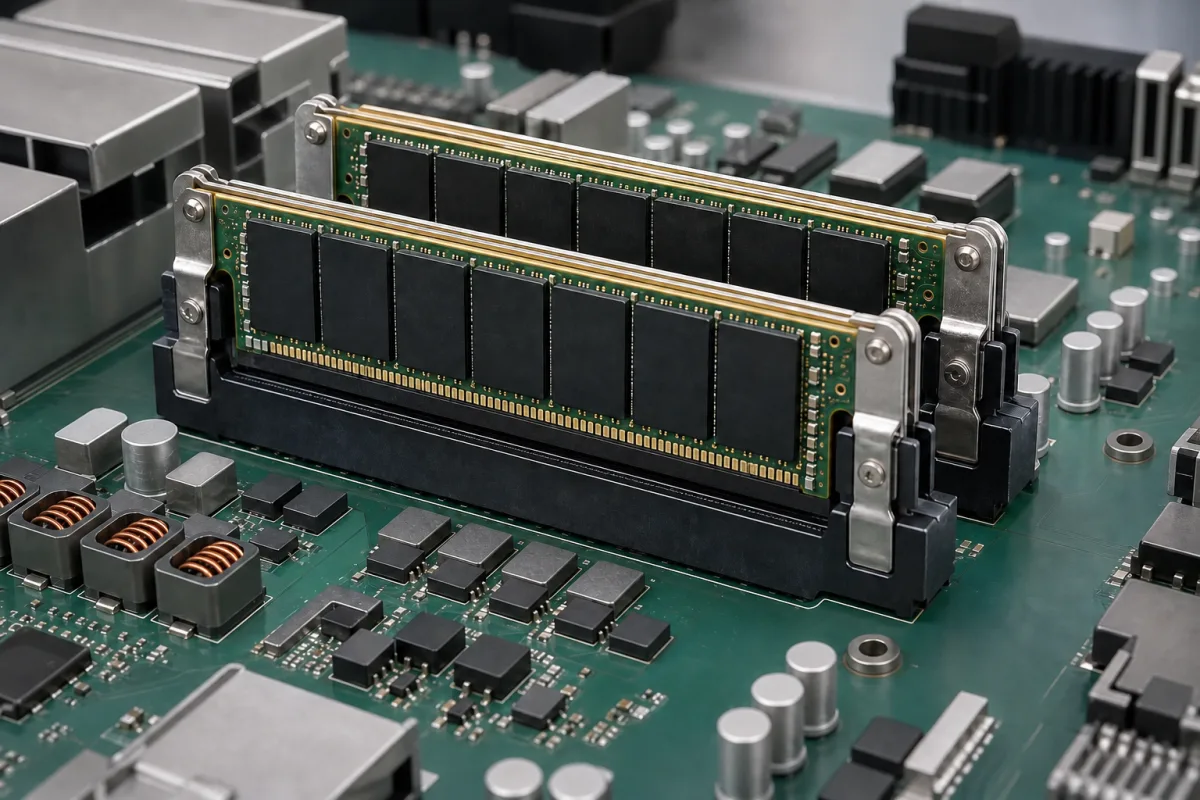
DDR4 memory modules as a matched set: channel population, mixing rules and module outlines
DDR4 DIMMs bought as a set for one board · slot order across channels, one or two DIMMs per channel, what may share a channel, 288-pin, 260-pin and very-low-profile outlines
Memory modules on this page are DDR4 DIMMs ordered in quantity to fill a particular motherboard or server: unbuffered UDIMMs and SODIMMs, ECC UDIMMs, registered RDIMMs and very-low-profile (VLP) versions. With more than one module per system, the questions change from 'which module' to 'how many, in which slots, and which modules may sit together'. Check three things first: how many channels the processor has and how many slots each channel carries, which module types, ranks and densities the platform lets you mix in a channel, and which height and pin count the chassis and slots accept.
DDR4 memory modules supplied as sets for a given board: slot population order across channels, one versus two DIMMs per channel, mixing rules for type, rank, density, data width and vendor, and DDR4 module outlines and timings (UDIMM, SODIMM, ECC UDIMM, RDIMM, VLP). DDR5 modules, their data rates, on-die and module ECC and the RCD/PMIC chipset are covered on the High-speed memory module (DDR5 DIMM) page. Single DRAM chips, flash storage and memory soldered to the board are outside this page.
CNFX editorial research · Sources checked October 12, 2026 · 4 sources
Eight channels, two slots each: the order DDR4 RDIMMs go into a server board
Lenovo's ThinkSystem SR645 has 8 memory channels per processor and 2 DIMMs per channel, slots 1–16 for CPU 1 and 17–32 for CPU 2. It takes TruDDR4 RDIMMs of 16, 32 and 64 GB at 3200 MHz, Performance+ RDIMMs of 32 and 64 GB, and 3DS RDIMMs of 128 and 256 GB at 3200 or 2933 MHz, all at 1.2 V; Lenovo adds that operating speed and total capacity depend on the processor model and UEFI settings. [1]
Editorial calculation: 16 slots per CPU × 64 GB = 1,024 GB, matching Lenovo's 1 TB per CPU maximum for RDIMMs; 16 × 256 GB = 4,096 GB, matching its 4 TB per CPU for 3DS RDIMMs. Reaching either figure means filling both slots of every channel. [1]
Lenovo's population rules say the server runs with a single DIMM, but full memory bandwidth needs one DIMM in each of the eight channels (A–H); where a channel holds only one DIMM, it goes in slot 1, physically farthest from the CPU. For best performance every channel should carry the same capacity, and capacity should be balanced per channel pair and per socket. For one third-generation AMD EPYC (7003) processor Lenovo gives a performance-optimized 6-DIMM order of slots 1, 3, 7, 10, 14 and 16. [2]
Supermicro's X11SRL-F, a single-socket DDR4 board with eight slots, lists the fill order DIMMA1, then B1, C1 and D1, then the second slot of each channel A2 to D2. It accepts 1, 3, 5 or 7 modules but marks those counts as unbalanced and not recommended. [3]
Before quoting, the supplier needs the board or server model, processor model and count, the number of modules and how they will be spread (one or two per channel), the target capacity per CPU, and whether the set must match modules already installed.
02
What may share a channel: rank, DRAM density, data width, vendor and module type
Lenovo's general mixing table for the SR645 allows DIMMs of different rank, of different DRAM density (8 Gbit and 16 Gbit) and from different vendors in the same channel; DIMMs of different data width (x4 and x8) may share the system but not a channel. Standard RDIMMs and Performance+ RDIMMs, 3DS RDIMMs and any other type, and 128 GB and 256 GB 3DS RDIMMs may not be combined, and the server takes only 1.2 V ECC DIMMs. [2]
Where mixing is allowed, Lenovo installs the module with the higher density, and the one with the higher rank, first. Of its listed RDIMMs, the 16 GB x8 8 Gbit and 32 GB x8 16 Gbit options may share a channel, as may the 32 GB x4 8 Gbit and 64 GB x4 16 Gbit options; Performance+ RDIMMs give a speed gain only when modules of the same capacity fill two DIMMs per channel. [2]
Supermicro asks for DDR4 modules of the same type, size and speed on the X11SRL-F; mixed speeds will run, but every DIMM then runs at the speed of the slowest one. The board reaches DDR4-2933 only with selected Xeon W-2200 processors, and supports 16 Gb DRAM density with the W-2200 series. [3]
Editorial note: when adding modules to a populated system, give the supplier the part number, rank, data width and DRAM density of the installed modules so the new set falls inside the platform's mixing table, or replace the whole set.
03
288-pin at 31.25 mm, 260-pin at 30 mm, VLP at 18.8 mm: DDR4 outlines and CAS timings
Powev's DDR4 range shows how one module family branches into outlines that fit different slots and chassis. All are 1.2 V parts rated 0 °C to 85 °C at 2666 or 3200 MT/s, with timings of 19-19-19-43 and 22-22-22-52 respectively. [4]
Editorial calculation: a VLP UDIMM at 18.8 mm stands 31.25 − 18.8 = 12.45 mm lower than the standard 288-pin outline in the same range; check it against the chassis height limit. [4]
Editorial calculation: CAS latency in nanoseconds is the CL count divided by the clock, which is half the data rate. At 2666 MT/s, 19 ÷ 1.333 GHz ≈ 14.3 ns; at 3200 MT/s, 22 ÷ 1.6 GHz ≈ 13.8 ns. The faster grade carries more cycles of latency but slightly less time. [4]
Powev lists the ECC UDIMM at 31.3 mm in its industrial line and 31.25 mm in its other DDR4 line; ask for the module drawing where height clearance is tight.
Send the platform, population plan and installed modules together
Paste it into your enquiry below or into an email to a maker, then replace every bracket.
Platform: [board or server model; processor model and count; BIOS/UEFI version]
Population: [number of modules; one or two per channel; target capacity per CPU]
Module: [UDIMM, SODIMM, ECC UDIMM, RDIMM, 3DS RDIMM or VLP; capacity; rank; x4 or x8; DRAM density]
Speed and timing: [MT/s; CL]
Installed modules: [part numbers, if adding to a populated system]
Environment: [operating temperature; height limit]
1 company lists this product among what they make. Company figures are quoted from each
company's own website; every card states where the relationship came from.
Powev Electronic Technology Co., Ltd.
Manufacturing site to be confirmed for the order
Lists DDR4 UDIMM, SODIMM, RDIMM, ECC UDIMM, ECC SODIMM and ECC VLP UDIMM modules at 2666 and 3200 MT/s, 1.2 V, in domestic and industrial lines.
Explore company information and manufacturing capabilities, then discuss the scope of your project with a relevant supplier.
Share this page
Compiled and source-reviewed by the CNFX editorial team.
Each manufacturer above links to the page on that company's own website where the product is listed, with the date we checked it. How we source and review
· Page last updated 13 October 2026
Buyer questions
Can two DDR4 RDIMMs of different rank share a channel?
On Lenovo's SR645 yes, with the higher-rank module installed first; modules of different x4/x8 data width may share the system but not a channel. [2]
What happens if DDR4 modules of different speeds are installed together?
Supermicro states for its X11SRL-F that mixed speeds will run but all DIMMs then run at the speed of the slowest DIMM. [3]
How much lower is a VLP DDR4 module?
Powev lists its ECC VLP UDIMM at 18.8 mm against 31.25 mm for its standard 288-pin modules, about 12.45 mm lower. [4]
Why fill every channel before adding a second DIMM to one?
Lenovo states that full memory bandwidth requires one DIMM in each of the eight channels per CPU, and that a lone DIMM in a channel goes in slot 1. [2]
Sources and what still needs a direct check
Sources checked 2026-10-12. Lenovo and Supermicro data are platform rules for the named server and board; other platforms set their own population and mixing tables. Powev's figures are its own module listings.