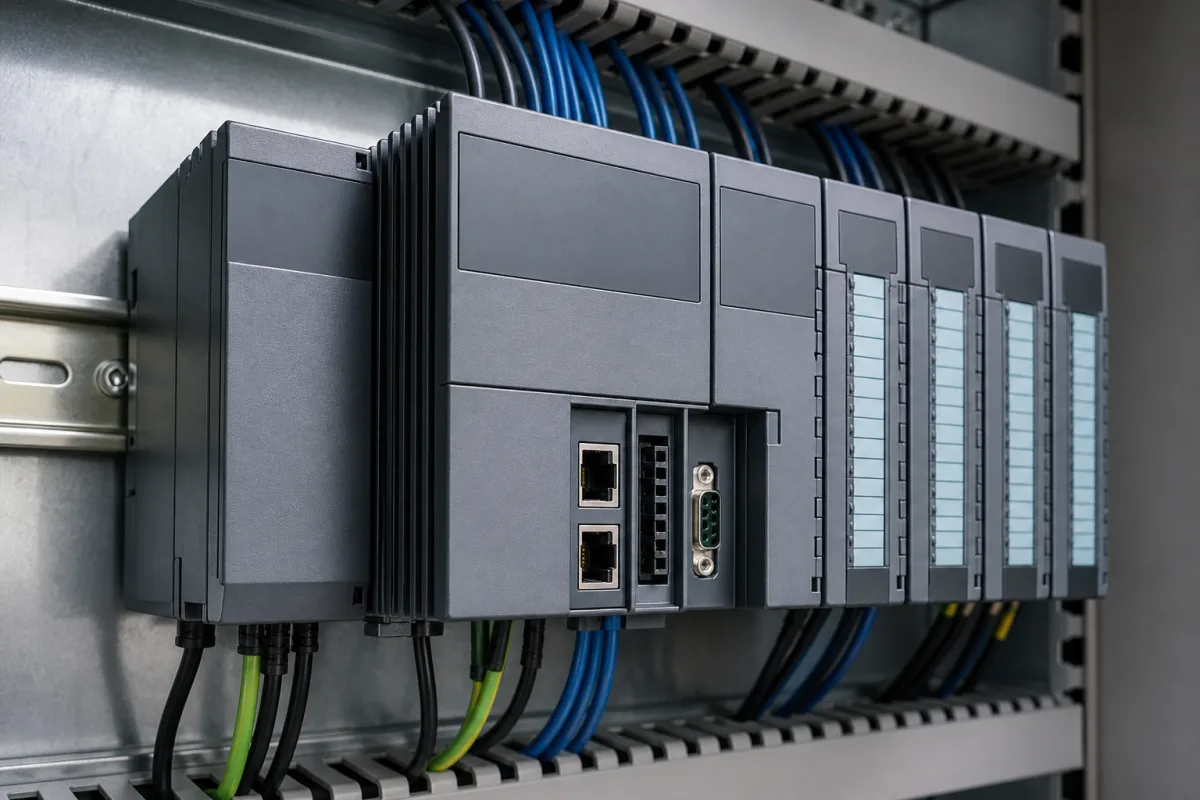
PLC CPU module (processor unit): instruction times, program and data memory, retentive memory and clock backup compared across three controllers
The CPU module that sits between the power supply and the I/O cards on a PLC rail · compared by how many nanoseconds an instruction takes, how its memory is split between program, data and retained values, and how long its clock survives a power cut
In a modular PLC the processor unit is one module on the rail: it runs the control program cycle after cycle, holds the program, the data and the values that have to survive a power cut, and carries the network ports to the HMI and to remote I/O. Two CPU modules that both list Ethernet and a memory card can still differ in how long each kind of instruction takes, in how much program fits, and in whether the real-time clock is backed up for weeks or for days.
CPU modules (processor units) of modular and compact PLCs: instruction execution times, program, data and retentive memory, memory cards, real-time clock backup, onboard ports, power draw and mounting limits. Choosing a complete PLC, counting expansion I/O and budgeting the 24 V supply are covered on the Programmable logic controller page; EtherCAT master controllers on the Central PLC controller page; redundant dual-rack CPUs on the Large-scale modular PLC with redundant CPUs page; safety CPUs on the Safety programmable controller page; and I/O cards on the Digital input module and Output module for PLCs pages.
CNFX editorial research · Sources checked October 13, 2026 · 3 sources
Nanoseconds per instruction: 60 ns bit and 384 ns floating point on a CPU 1511-1 PN, 34 ns LD on an FX5U
Both makers state instruction time per operation type; Siemens marks its figures as typ. values, and Mitsubishi ties its figure to the program capacity setting.
Editorial calculation: on the Siemens figures, 10,000 bit operations take about 0.6 ms of processing and 10,000 floating-point operations about 3.8 ms, so a program heavy in scaled analog values and PID arithmetic needs up to 6.4 times the processing time of the same number of bit operations (384 ÷ 60). [1] On the Mitsubishi figure, 64,000 steps of LD or MOV at 34 ns each would take about 2.2 ms, before the I/O refresh and communication that also take time in each cycle. [2]
These are processing times only. The cycle time a machine sees also includes reading inputs, writing outputs and serving communication, so ask for a measured cycle time with your program size and network load rather than multiplying instruction counts.
Operation
Siemens CPU 1511-1 PN (6ES7511-1AK02-0AB0, FW V2.5)
Give the program size, the share of floating-point and analog-scaling code, the cycle time the process needs and the number of networked devices; ask the supplier for a measured cycle time on a comparable program.
02
Program, data and retained memory, memory cards and how long the clock survives a power cut
Memory is split differently on each CPU, and the split matters more than the total: program space limits the code, data space the recipes and logs, and retentive space what survives a power failure.
Mitsubishi notes that the capacitor holding the FX5U clock discharges faster at higher ambient temperature, so the 10-day figure shortens in a hot cabinet. [2] Editorial calculation: Siemens's maximum clock deviation of 10 s a day is up to 300 s in 30 days, against Mitsubishi's ±45 s per month (typ.); one is a maximum and the other a typ. value, so they are not a like-for-like comparison. [1][2]
Editorial note: a flash limit of 20,000 writes matters if a program writes recipes or counters to flash ROM on every batch or shift; at 50 writes a day, for example, that limit is reached in about 400 days.
List the values that must survive a power cut and their size, how often the program writes to non-volatile memory, whether the clock time-stamps records, and how long the cabinet may stay unpowered.
03
Ports, power and mounting: a 35 mm, 5.7 W Siemens CPU and an 80 mm Inovance CPU with EtherCAT, CAN and two RS-485
The CPU module also carries the network ports and sets the cabinet limits for the whole rack.
Editorial calculation: 0.7 A at 24 V is 16.8 W drawn from the supply at rated current, against 5.7 W (typ.) dissipated in the CPU itself; the data sheet also lists 10 W fed by the CPU into the backplane bus for the modules beside it, which is why the CPU's current figure belongs in the 24 V budget. [1] The Siemens CPU loses 20 °C of allowed ambient temperature when mounted vertically instead of horizontally. [1]
Item
Siemens CPU 1511-1 PN
Inovance AM600 CPU1608TP
Network ports
One PROFINET interface with a 2-port switch; PROFINET IO controller and IO device [1]
Ethernet, EtherCAT, CANopen/CANlink, two RS-485 with Modbus; Modbus TCP master/slave; EtherNet/IP scanner/adapter [3]
On-board I/O
None
16 high-speed inputs, 8 high-speed outputs; 8 A/B counter channels up to 200 kHz [3]
Supply and power
24 V DC; 0.7 A rated, 0.95 A max.; power loss 5.7 W (typ.) [1]
State the networks the CPU must speak natively, any high-speed inputs or counters needed on the CPU itself, the cabinet temperature and mounting orientation, and the 24 V supply available.
04
What to send for a PLC CPU module
Paste it into your enquiry below or into an email to a maker, then replace every bracket.
Program: [size; share of floating point; target cycle time]
Memory: [data size; retained values; recipes or logs]
Clock: [time-stamping needed; maximum unpowered time]
Networks: [PROFINET, EtherCAT, EtherNet/IP, Modbus, CAN]
CPU I/O: [high-speed inputs, outputs, counters]
Cabinet: [ambient temperature; mounting orientation; 24 V supply]
Explore company information and manufacturing capabilities, then discuss the scope of your project with a relevant supplier.
Share this page
Compiled and source-reviewed by the CNFX editorial team.
Each manufacturer above links to the page on that company's own website where the product is listed, with the date we checked it. How we source and review
· Page last updated 13 October 2026
Buyer questions
How fast does a PLC CPU execute instructions?
Siemens gives 60 ns (typ.) per bit operation and 384 ns (typ.) per floating-point operation for the CPU 1511-1 PN; Mitsubishi gives 34 ns for LD X0 on the FX5U-32MT/ES at 64 k steps. [1][2]
How long does a PLC keep its clock without power?
The CPU 1511-1 PN buffers its hardware clock for 6 weeks at 40 °C (typ.); the FX5U holds clock data on a capacitor for 10 days at 25 °C. [1][2]
How much program memory does a PLC CPU have?
150 kbyte on the CPU 1511-1 PN, 64 k or 128 k steps (128 or 256 kbytes) on the FX5U-32MT/ES and 4 Mbytes on the Inovance AM600 CPU1608TP. [1][2][3]
Sources and what still needs a direct check
Sources checked 2026-10-13. Each figure comes from the maker's own sheet for one model: Siemens's German data sheet for the CPU 1511-1 PN (FS01, V2.5, 2018), Mitsubishi Electric's specification sheet for the FX5U-32MT/ES and Inovance's AM600 brochure V2.0.