Editorial Technical Reference

Microcontroller / DSP Unit

This page explains how Microcontroller / DSP Unit is classified within Computer, Electronic and Optical Product Manufacturing. Technical values and manufacturer relationships are research references; confirm the current specification and supplier evidence for each order.

Technical Definition & Core Assembly

Embedded computing unit that processes sensor data and controls measurement functions within a measurement module.
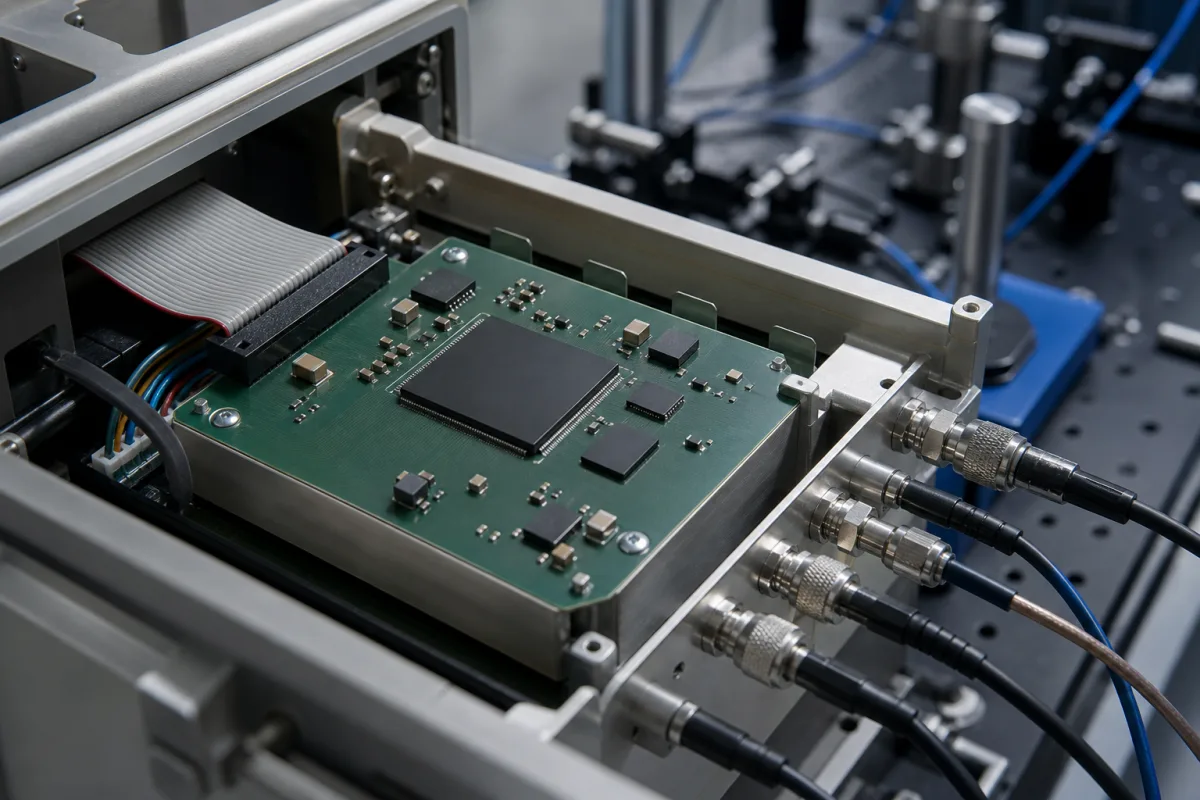
Representative product image. Confirm appearance and specifications with the manufacturer.

Product Specifications

Technical details and manufacturing context for Microcontroller / DSP Unit

Definition
This component is the computational core of a measurement module, combining microcontroller capabilities for system control with Digital Signal Processor (DSP) functionality for real-time signal processing, data analysis, and measurement algorithm execution. It receives analog or digital signals from sensors, processes them through embedded algorithms such as filtering, FFT, and calibration, executes measurement logic, and outputs processed data or control signals to other module components. The unit is typically built on semiconductor silicon with copper interconnects and ceramic packaging, and it operates within a supply voltage range of 3.3–5 V DC (per IEC 61131-2), with clock frequencies from 16 to 200 MHz. It includes flash memory of 32–1024 KB for firmware and calibration data, SRAM of 4–256 KB for working memory, and an ADC resolution of 12–16 bits (per IEC 60751). The operating temperature range is -40 to 85 °C (per IEC 60068-2-1), and ingress protection is rated IP54–IP65 (per IEC 60529). Power consumption ranges from 0.5 to 2.5 W. It offers 8–48 configurable digital I/O channels (per IEC 61131-2) and 2–6 communication interfaces including UART, SPI, I2C, CAN, and Ethernet (per IEC 61784). Physical characteristics include a weight of 10–50 g and dimensions from 20×15×5 mm to 50×40×10 mm. These values are directory reference ranges; actual specifications must be confirmed with the legal manufacturer or supplier for the specific model and application. The unit is designed for integration into measurement modules used in industrial environments, where it manages sensor data acquisition, processing, and output. It is not a standalone product but a part that requires proper integration and configuration. Verification of compliance with relevant standards and performance parameters is essential before deployment.
Working Principle
The unit receives analog or digital signals from sensors. Analog signals are converted to digital via an ADC with 12–16 bit resolution. Embedded algorithms perform filtering, FFT, and calibration to condition the data. The microcontroller executes measurement logic, while the DSP accelerates real-time processing. Processed data is output via communication interfaces (UART, SPI, I2C, CAN, Ethernet) or digital I/O. The unit operates within specified voltage, temperature, and power limits, and its performance depends on clock frequency and memory resources.
Common Materials
Semiconductor silicon, Copper interconnects, Ceramic packaging
Technical Parameters
ParameterTypical rangeNotes & selection driver
Supply Voltage3.3–5 V DCOperating range for logic and I/OIEC 61131-2
Clock Frequency16–200 MHzHigher frequency increases processing speed
Flash Memory32–1024 KBStores firmware and calibration data
SRAM4–256 KBWorking memory for data processing
ADC Resolution12–16 bitDetermines measurement precisionIEC 60751
Operating Temperature-40–85 °CExtended range for industrial environmentsIEC 60068-2-1
Ingress ProtectionIP54–IP65Protection against dust and water jetsIEC 60529
Power Consumption0.5–2.5 WAffects thermal management and battery life
Digital I/O Count8–48Number of configurable digital channelsIEC 61131-2
Communication Interfaces2–6Includes UART, SPI, I2C, CAN, EthernetIEC 61784
Weight10–50 gDepends on board size and connectors
Dimensions (L×W×H)20×15×5–50×40×10 mmCompact form factor for integration

Ranges are indicative industry figures for RFQ preparation, not a supplier commitment. Confirm every value and standard with the legal manufacturer before ordering.

Components / BOM
  • CPU Core Part
    Executes control algorithms and measurement logic
    Material: Semiconductor
  • DSP Core Part
    Performs real-time signal processing and mathematical computations
    Material: Semiconductor
  • Memory Unit
    Stores measurement programs, calibration data, and temporary results
    Material: Semiconductor
  • I/O Interface
    Connects to sensors, displays, and communication modules
    Material: Copper, Gold plating
  • Analog-to-Digital Converter
    Digitises the incoming sensor signal at 12-16 bit before the algorithms run.

Applied To / Applications

This component is essential for the following industrial systems and equipment:

Industrial Ecosystem & Supply Chain Structure

Complementary Systems
Downstream Applications
Specialized Tooling

Application Fit & Sizing Matrix

Operational Limits
pressure: Not applicable (sealed unit)
other spec: Humidity: 5-95% non-condensing, Vibration: 5g RMS, Shock: 50g peak
temperature: -40°C to +85°C (industrial grade), -40°C to +105°C (extended)
Media Compatibility
✓ Clean air environments ✓ Dry industrial enclosures ✓ Non-corrosive gas atmospheres
Unsuitable: Direct exposure to conductive fluids or corrosive chemicals
Sizing Data Required
  • Required processing speed (MIPS/MHz)
  • Number of I/O channels needed
  • Memory requirements (RAM/Flash)

Reliability & Engineering Risk Analysis

Failure Mode & Root Cause
Thermal overstress
Cause: Excessive heat generation due to inadequate cooling, high ambient temperatures, or prolonged operation beyond thermal design limits, leading to solder joint fatigue, material degradation, or semiconductor junction failure.
Electrostatic discharge (ESD) damage
Cause: Accumulation and sudden discharge of static electricity during handling, installation, or maintenance, resulting in immediate or latent damage to sensitive semiconductor components, such as gate oxide breakdown or metalization burnout.
Maintenance Indicators
  • Intermittent or complete loss of functionality, such as erratic program execution, unexpected resets, or failure to boot, indicating potential power supply instability, clock signal issues, or memory corruption.
  • Abnormal thermal behavior, such as excessive heat emission detected via thermal imaging or touch, or audible signs like component popping or hissing, suggesting overheating, short circuits, or capacitor failure.
Engineering Tips
  • Implement robust thermal management by ensuring adequate airflow, using heat sinks or fans as specified, and monitoring operating temperatures with embedded sensors to prevent thermal overstress and extend component lifespan.
  • Apply strict ESD protection protocols during all handling and maintenance activities, including the use of grounded workstations, anti-static mats, and wrist straps, and store units in shielded containers to minimize electrostatic damage risks.

Indicative industry ranges for design and RFQ preparation. Confirm the exact figures and applicable standard with the manufacturer before specifying.

Compliance & Manufacturing Standards

Applicable Standards
IEC 60730-1:2013 Automatic Electrical Controls RoHS Directive 2011/65/EU (CE marking for hazardous substances)

Quoted from the published standard.

Manufacturing Precision
  • Package dimension tolerance: +/-0.15mm
  • Lead coplanarity: 0.10mm maximum
Quality Inspection
  • Automated Optical Inspection (AOI) for solder joints and component placement
  • Environmental Stress Screening (ESS) including temperature cycling and vibration testing

Manufacturers of Microcontroller / DSP Unit

Manufacturer profiles associated with Microcontroller / DSP Unit.

Sourcing Microcontroller / DSP Unit from China?
Tell us your specification and target quantity — we will match it against manufacturer records and come back with the factories that fit.
Request manufacturers We manufacture this

Manufacturer listings support early research and capability understanding. They are not certification, ranking, or transaction guarantees.

Technical documentation
Request current drawings, revision history, and a signed specification sheet.
Manufacturing capability
Verify equipment lists, process limits, capacity, and representative production evidence.
Inspection readiness
Confirm test methods, calibrated equipment, sampling plans, and traceable reports.
Supplier transparency
Check the legal entity, factory address, ownership, certifications, and direct contacts.

CNFX does not score or rank suppliers. Buyers must verify all claims and documents with the legal manufacturer before ordering.

Supply Chain Compatible Machinery & Devices

Industrial Smart Camera Module

The Industrial Smart Camera Module is a compact, self-contained vision processing unit designed for integration into industrial machinery and production lines.

Explore Specs →
Surface Mount Resistor

Passive electronic component for current limiting and voltage division in circuits

Explore Specs →
Surface Mount Capacitor

A surface mount capacitor is a fundamental electronic component used for energy storage, filtering, coupling, and decoupling in electronic circuits.

Explore Specs →
Surface Mount Technology (SMT) Pick-and-Place Machine

Automated machine that precisely places electronic components onto printed circuit boards.

Explore Specs →

Frequently Asked Questions

What is the role of this microcontroller/DSP unit in a measurement module?

It serves as the computational core, processing sensor data, executing measurement algorithms, and controlling module functions. It combines microcontroller and DSP capabilities for real-time signal processing and system control.

What are the key electrical specifications to consider?

Supply voltage is 3.3–5 V DC, clock frequency 16–200 MHz, ADC resolution 12–16 bits, and power consumption 0.5–2.5 W. These are reference ranges; confirm exact values for your model.

Which communication interfaces are supported?

The unit supports 2–6 interfaces including UART, SPI, I2C, CAN, and Ethernet, per IEC 61784. The exact number and types depend on the specific configuration.

How should I verify compliance with standards?

Check the manufacturer's documentation for compliance with IEC 61131-2, IEC 60751, IEC 60068-2-1, and IEC 60529. These standards are references; actual certification must be confirmed with the supplier.

Data Basis

Editorial classification, named public sources where available, and source-reviewed manufacturer records.

Preliminary Technical Classification
This page supports structured research, RFQ preparation, and supplier evaluation. It does not replace buyer-led supplier qualification, standards review, or technical approval.
Buyer enquiry

Request manufacturing insight for Microcontroller / DSP Unit

Ask for use case, specification boundaries, supplier type, and RFQ preparation information for this product.

Where it goes
Straight to the CNFX editorial desk, and to the manufacturer if this product is linked to a claimed profile. Nothing is broadcast to a supplier list.
Your details stay here
We do not sell or rent enquiry data, and we do not add you to a mailing list. Used only to answer this request.
No commission, no middleman
CNFX is a directory. We take no cut of any order and never negotiate on a supplier's behalf.
What we don't claim
A listing is not an endorsement. Qualify every supplier and verify every figure yourself before ordering.

Your business information is used only to process this request.

Thank you! Your message has been sent. We'll respond within 1–3 business days.
Sorry, we couldn't send your message. Please try again, or email us at contact@cnfx.com.

Need to Manufacture Microcontroller / DSP Unit?

Compare manufacturer profiles with relevant product and process capability.

Previous Product
XY Positioning Stage
Last Product
Get QuotesChat