Humidity Sensor & Controller
View system integration details
This page explains how Microcontroller / Processor is classified within Computer, Electronic and Optical Product Manufacturing. Technical values and manufacturer relationships are research references; confirm the current specification and supplier evidence for each order.
Integrated circuit that serves as the central processing unit for controlling and managing the operations of a humidity sensor and controller system.
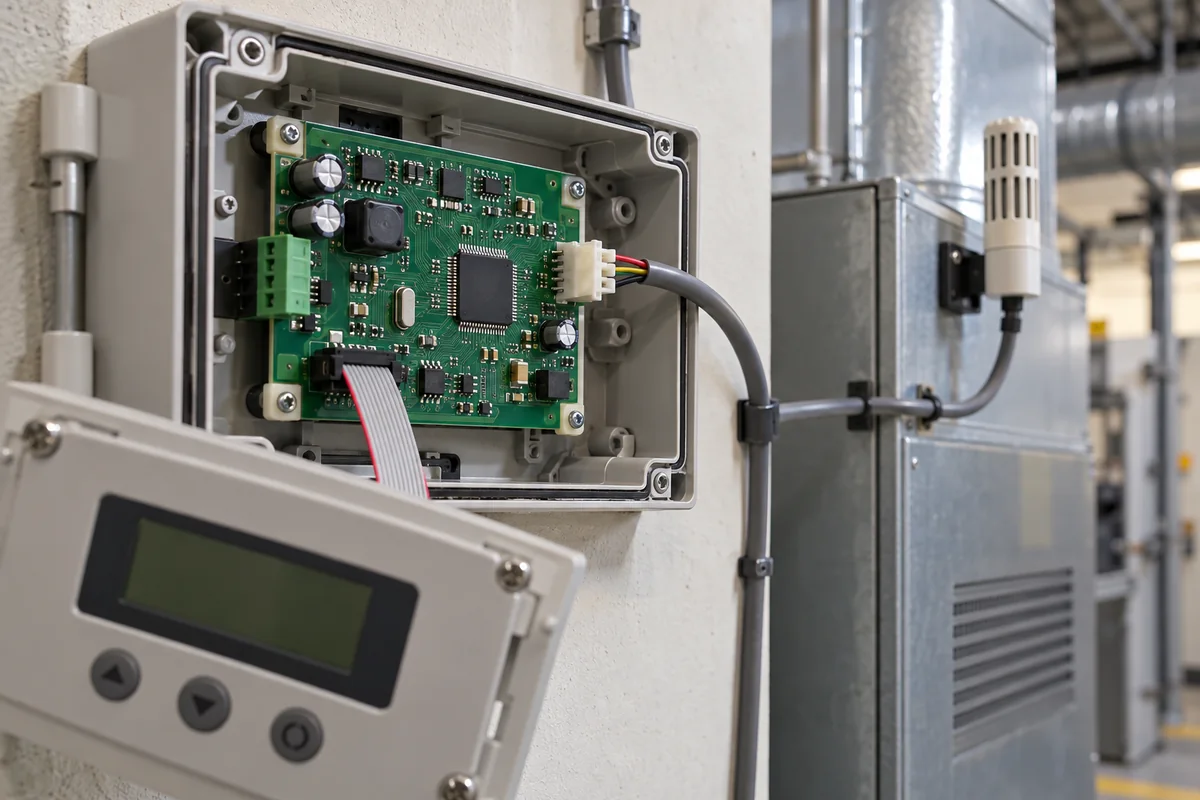
Technical details and manufacturing context for Microcontroller / Processor
| Parameter | Typical range | Notes & selection driver |
|---|---|---|
| Supply Voltage | 3.3–5 V DC | Typical for logic and sensor interface |
| Clock Frequency | 8–80 MHz | Higher frequency improves processing speed |
| Flash Memory | 16–512 KB | Stores firmware and calibration data |
| SRAM | 2–64 KB | For runtime data and buffering |
| ADC Resolution | 10–12 bit | Determines sensor reading precision |
| Operating Temperature | -40–85 °C | Industrial grade rangeIEC 60068-2-1 |
| Supply Current | 1–100 mA | Active mode; lower in sleep |
| GPIO Pins | 8–48 pins | For sensor and actuator interfacing |
| Communication Interfaces | 1–3 types | I2C, SPI, UART typical |
| Package Type | QFN-32–LQFP-64 | Surface mount for compact designJEDEC MS-026 |
| Power Dissipation | 0.1–0.5 W | At max clock and load |
| ESD Protection | 2–4 kV | HBM modelIEC 61000-4-2 |
Ranges are indicative industry figures for RFQ preparation, not a supplier commitment. Confirm every value and standard with the legal manufacturer before ordering.
| pressure: | Not applicable (electronic component, not exposed to process pressure) |
| other spec: | Operating voltage: 1.8V to 3.6V typical, Clock frequency: up to 200 MHz, I/O voltage tolerance: 5V tolerant |
| temperature: | -40°C to +85°C (industrial grade), -40°C to +125°C (extended automotive/industrial) |
Indicative industry ranges for design and RFQ preparation. Confirm the exact figures and applicable standard with the manufacturer before specifying.
Quoted from the published standard.
A practical evidence checklist for RFQ preparation and supplier evaluation.
Compare the published product scope and source details, then include your specifications and quantity in an enquiry.
Manufacturer profiles associated with Microcontroller / Processor.
Explore company information and manufacturing capabilities, then discuss the scope of your project with a relevant supplier.
Ask for use case, specification boundaries, supplier type, and RFQ preparation information for this product.
It executes firmware to read sensor data, process humidity measurements, implement control algorithms, manage user interfaces, and communicate with external devices, enabling real-time monitoring and regulation of humidity.
Typical supply voltage is 3.3–5 V DC, and clock frequency ranges from 8–80 MHz. These are reference ranges; confirm exact values with the manufacturer.
Common interfaces include I2C, SPI, and UART, with 1–3 types available. The specific interfaces depend on the model.
Operating temperature range is -40 to 85 °C per IEC 60068-2-1, and ESD protection is 2–4 kV (HBM) per IEC 61000-4-2. These are verification references, not certifications.
This component is essential for the following industrial systems and equipment:
Editorial classification, named public sources where available, and source-reviewed manufacturer records.
Compare manufacturer profiles with relevant product and process capability.