Industry-Verified Manufacturing Data (2026)

Control Circuit

Based on aggregated insights from multiple verified factory profiles within the CNFX directory, the standard Control Circuit used in the Electrical Equipment Manufacturing sector typically supports operational capacities ranging from standard industrial configurations to heavy-duty production requirements.

Technical Definition & Core Assembly

A canonical Control Circuit is characterized by the integration of Microcontroller / Processor and Signal Conditioning Circuit. In industrial production environments, manufacturers listed on CNFX commonly emphasize Printed Circuit Board (PCB) construction to support stable, high-cycle operation across diverse manufacturing scenarios.

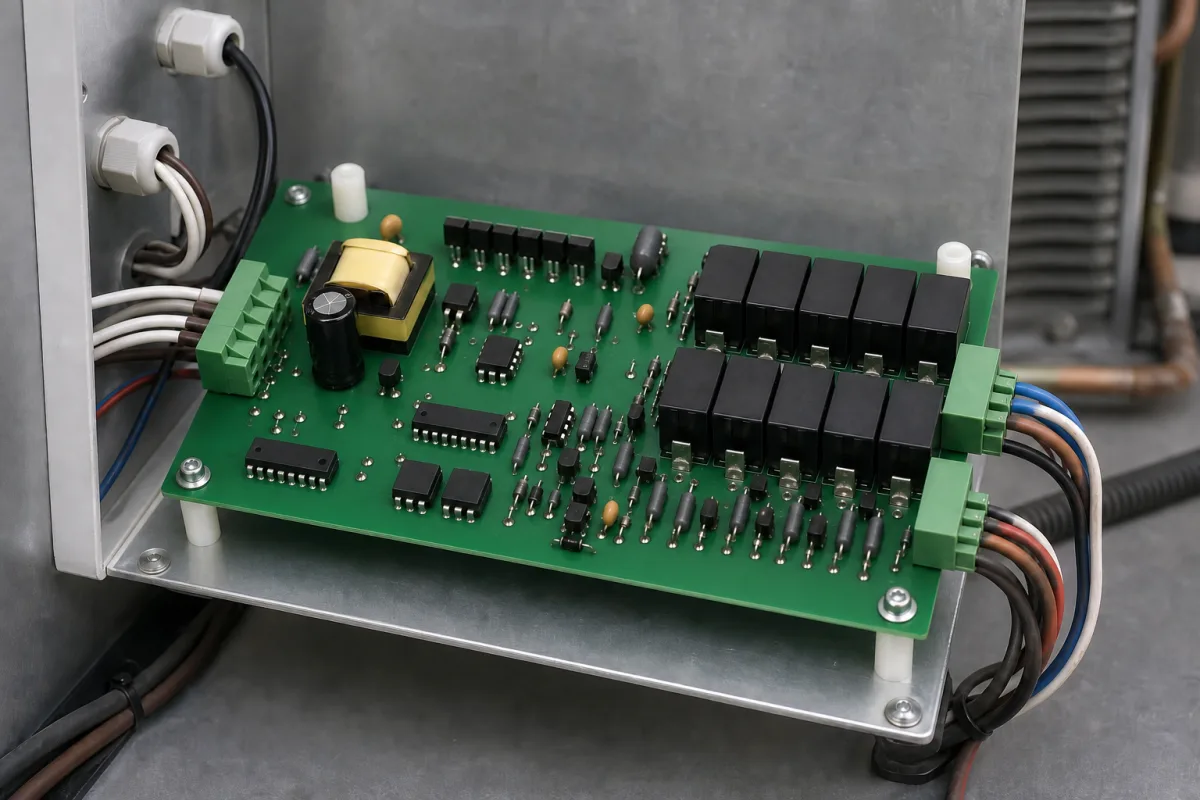
Electronic circuit within a control unit or thermostat that processes input signals and generates output commands to regulate system operation.
Product Specifications

Technical details and manufacturing context for Control Circuit

Definition
A control circuit is the electronic subsystem within a control unit or thermostat responsible for the logic and signal processing functions. It receives input signals from sensors (e.g., temperature, pressure, position) and user interfaces, processes these signals according to programmed logic or algorithms, and outputs command signals to actuators (e.g., relays, valves, motors) to maintain desired system parameters. It serves as the 'brain' of the control unit, enabling precise regulation, sequencing, and safety functions.
Working Principle
The control circuit operates by continuously monitoring input signals. It compares these signals to setpoints or reference values. Based on the difference (error) and its internal control algorithm (e.g., PID, on/off, logic sequence), it calculates and generates an appropriate output signal. This output typically modulates power to an actuator, which in turn adjusts the physical process (like heating, cooling, or motion) to achieve the target state. Modern circuits often use microcontrollers or programmable logic controllers (PLCs) for this function.
Common Materials
Printed Circuit Board (PCB), Semiconductors (ICs, transistors), Passive components (resistors, capacitors), Connectors
Technical Parameters
  • Operating voltage range (e.g., 5V DC, 24V AC) (V) Standard Spec
Components / BOM
  • Microcontroller / Processor
    Executes the control program, processes input data, and calculates output commands.
    Material: Semiconductor (Silicon)
  • Signal Conditioning Circuit
    Amplifies, filters, or converts raw sensor signals to levels suitable for the processor.
    Material: PCB with resistors, capacitors, op-amps
  • Output Driver Stage
    Amplifies the processor's low-power output signals to levels capable of driving actuators (relays, solenoids).
    Material: PCB with transistors, MOSFETs, or relay components
  • Power Supply Section
    Converts and regulates the incoming power to stable voltages required by the circuit's components.
    Material: PCB with voltage regulators, transformers, capacitors
Engineering Reasoning
3.3-5.0 VDC, -40 to 85°C ambient temperature, 0-95% relative humidity non-condensing
Voltage drop below 2.7 VDC or surge above 5.5 VDC for >10 ms, junction temperature exceeding 125°C, moisture ingress causing leakage current >1 μA
Design Rationale: Electromigration at current densities >10⁶ A/cm² causing open circuits, dielectric breakdown at electric fields >10⁷ V/m, thermal cycling fatigue from ΔT>60°C causing solder joint fracture
Risk Mitigation (FMEA)
Trigger Transient voltage spike exceeding 8 kV/μs from inductive load switching
Mode: Gate oxide breakdown in MOSFET switching elements, measured as drain-source short circuit with resistance <5 Ω
Strategy: TVS diode clamping at 6.8 V with response time <1 ns, ferrite bead filtering with impedance >100 Ω at 100 MHz
Trigger Electrochemical migration from chloride contamination >50 ppm at >70% RH
Mode: Conductive filament growth between adjacent traces, measured as insulation resistance drop below 10⁶ Ω
Strategy: Conformal coating with polyurethane thickness 25-50 μm, hermetic sealing with helium leak rate <1×10⁻⁸ atm·cc/s

Industry Taxonomies & Aliases

Commonly used trade names and technical identifiers for Control Circuit.

Applied To / Applications

This component is essential for the following industrial systems and equipment:

Industrial Ecosystem & Supply Chain DNA

Complementary Systems
Downstream Applications
Specialized Tooling

Application Fit & Sizing Matrix

Operational Limits
pressure: Atmospheric to 1.5 bar (typical enclosure rating)
other spec: Humidity: 5-95% RH non-condensing, Vibration: 5g max, EMI/RFI: IEC 61000-4-2/3/4/5/6 compliant
temperature: -40°C to +85°C (operating), -55°C to +125°C (storage)
Media Compatibility
✓ Clean dry air environments ✓ HVAC control cabinets ✓ Industrial automation panels
Unsuitable: High-concentration corrosive gas atmospheres (e.g., chlorine, ammonia processing)
Sizing Data Required
  • Input signal type/range (e.g., 4-20mA, 0-10V, thermistor)
  • Output load requirements (relay rating, voltage/current capacity)
  • Power supply specifications (voltage, frequency, isolation requirements)

Reliability & Engineering Risk Analysis

Failure Mode & Root Cause
Contact Welding/Sticking
Cause: Excessive inrush current, frequent switching under load, or contamination causing contacts to fuse together, preventing proper circuit operation.
Coil Burnout
Cause: Overvoltage, undervoltage, excessive ambient temperature, or moisture ingress leading to insulation breakdown and open circuit in the electromagnetic coil.
Maintenance Indicators
  • Audible buzzing or chattering from relays/contactors indicating loose connections or failing coils
  • Visible arcing/sparks, discoloration, or overheating marks on contactors, terminals, or wiring
Engineering Tips
  • Implement regular infrared thermography inspections to detect abnormal heating in components before failure occurs
  • Use proper contact protection (RC snubbers, surge suppressors) and ensure control voltage stability to prevent electrical stress on switching devices

Compliance & Manufacturing Standards

Reference Standards
ISO 13849-1: Safety of machinery - Safety-related parts of control systems ANSI/UL 508A: Standard for Industrial Control Panels DIN EN 60204-1: Safety of machinery - Electrical equipment of machines
Manufacturing Precision
  • Wire termination torque: +/-10% of specified value
  • Component placement accuracy: +/-0.5mm on PCB
Quality Inspection
  • Dielectric withstand test (hipot test)
  • Functional safety performance level verification

Factories Producing Control Circuit

Verified manufacturers with capability to produce this product in China

✓ 96% Supplier Capability Match Found

P Project Engineer from Australia Feb 10, 2026
★★★★★
"Great transparency on the Control Circuit components. Essential for our Electrical Equipment Manufacturing supply chain."
Technical Specifications Verified
S Sourcing Manager from Singapore Feb 07, 2026
★★★★★
"The Control Circuit we sourced perfectly fits our Electrical Equipment Manufacturing production line requirements."
Technical Specifications Verified
P Procurement Specialist from Germany Feb 04, 2026
★★★★★
"Found 49+ suppliers for Control Circuit on CNFX, but this spec remains the most cost-effective."
Technical Specifications Verified
Verification Protocol

“Feedback is collected from verified sourcing managers during RFQ (Request for Quote) and factory evaluation processes on CNFX. These reports represent historical performance data and technical audit summaries from our B2B manufacturing network.”

12 sourcing managers are analyzing this specification now. Last inquiry for Control Circuit from Thailand (1h ago).

Supply Chain Compatible Machinery & Devices

Circuit Breaker Trip Unit

Protective control module for electrical circuit breakers

Explore Specs →
Circuit Breaker Arc Chute

Electrical component that extinguishes arcs in circuit breakers

Explore Specs →
Medium Voltage Switchgear Assembly Line

Automated production system for assembling medium voltage electrical switchgear.

Explore Specs →
Motor Terminal Block

Electrical connection interface for motor windings

Explore Specs →

Frequently Asked Questions

What is the primary function of a control circuit in electrical equipment?

A control circuit processes input signals from sensors or user interfaces and generates output commands to regulate system operation, ensuring precise control of electrical equipment functions.

What are the key components in a control circuit BOM?

Essential components include a microcontroller/processor for logic, signal conditioning circuits for input processing, output driver stages for command execution, and power supply sections for stable operation.

How do control circuits differ from power circuits in electrical systems?

Control circuits handle low-power signal processing and logic commands, while power circuits manage high-current loads. Control circuits regulate operation, whereas power circuits execute the actual work.

Can I contact factories directly on CNFX?

CNFX is an open directory, not a transaction platform. Each factory profile provides direct contact information and production details to help you initiate direct inquiries with Chinese suppliers.

Get Quote for Control Circuit

Request technical pricing, lead times, or customized specifications for Control Circuit directly from verified manufacturing units.

Your business information is encrypted and only shared with verified Control Circuit suppliers.

Thank you! Your message has been sent. We'll respond within 1–3 business days.

Need to Manufacture Control Circuit?

Connect with verified factories specializing in this product category

Add Your Factory Contact Us
Previous Product
Control Cabinet
Next Product
Control Circuit Board (PCB)