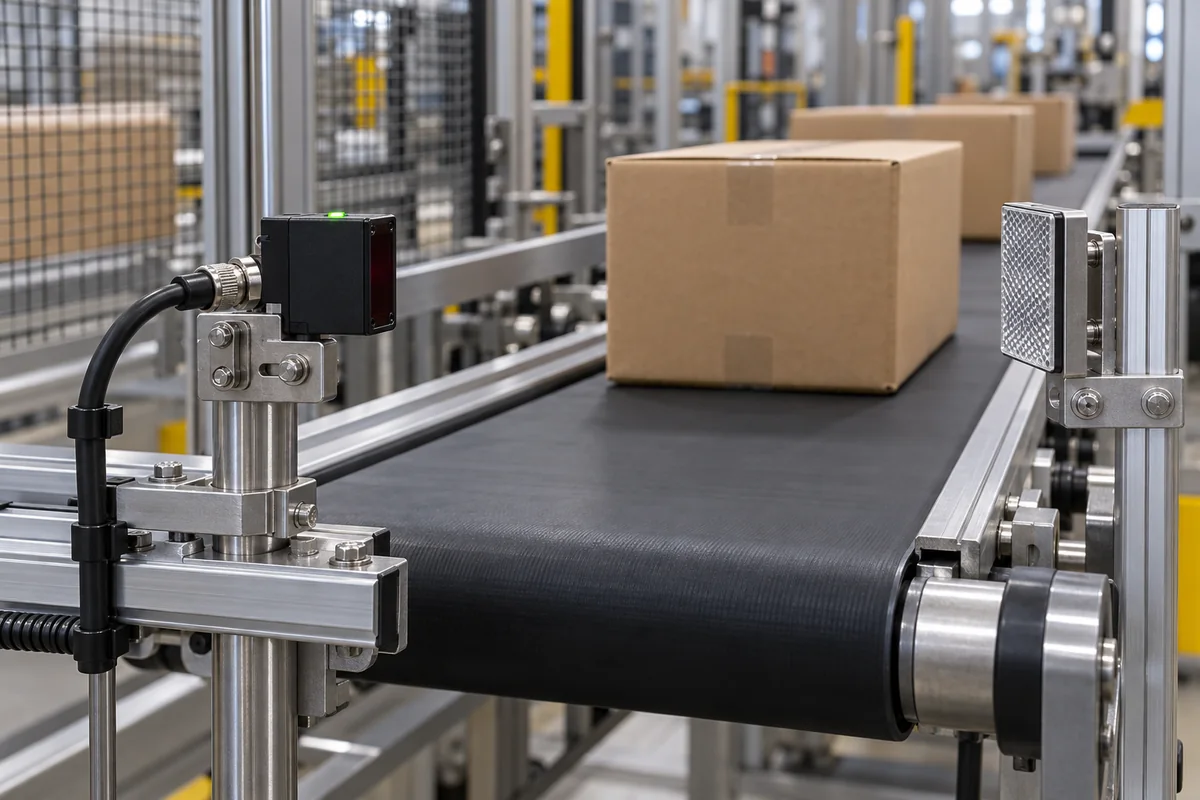
Clear-object optical sensor: polarised retro-reflective sensor and reflector for transparent PET, glass and film
Polarised retro-reflective sensors set up to see clear bottles, glass and film on a conveyor · reflector size and range, minimum distance, switching points and clearance
A clear PET bottle or a sheet of film takes only a little light out of a beam, so detecting it means switching on a small signal difference. Clear-object sensors are retro-reflective: they send polarised red light to a prismatic reflector and switch on a small drop in the returned signal, set by a fine sensitivity adjustment. What has to be specified is the object (its material, colour and wall), the reflector that fixes the usable range, the minimum and maximum distances to that reflector, and where the switching threshold sits between clear, coloured and opaque objects.
Retro-reflective optical sensors with polarisation filters and low switching hysteresis, built or set up to detect transparent and translucent objects such as PET and glass bottles, trays and film, together with the prismatic reflectors and reflective tapes they are rated with. Photoelectric sensors of all sensing modes for presence and counting are covered on the Photoelectric sensor page, and ambient-light sensing components on the Light sensor (ambient light sensing component) page. Photodiodes and other detector components, safety light curtains and vision sensors are outside this page.
CNFX editorial research · Sources checked October 12, 2026 · 3 sources
Detecting 500 ml to 2 l clear plastic bottles: polarised red light, a 1 ms response and 500 mm of clearance
Datalogic explains the principle: a polarisation filter puts the emitted light on a vertical plane, the prismatic reflector rotates it by 90°, and a filter at the receiver passes only the rotated light, ignoring light reflected from other sources; for transparent objects such as PET bottles or Mylar sheets, a low-hysteresis polarised retro-reflective model that detects small signal differences can be used. [3] Omron's E3Z-B is built for clear plastic bottles from 500 ml to 2 l, from single bottles to stocked sets; its standard sensing object is a 500 ml, 65 mm diameter transparent round bottle. [1]
The E3Z-B senses at 500 mm (with at least 80 mm between sensor and reflector) or, in the long-range models, 2 m (with at least 500 mm), both with the E39-R1S reflector, which is ordered separately. [1] Omron asks for bottles to pass at least 500 mm from the sensor, gives a response time of 1 ms maximum, a red LED light source printed as '680 mm' in the specification table (read as 680 nm), IP67, and an operating range of −25 to 55 °C. [1] It warns that detection may not be stable for some bottle shapes or passing positions and that the sensor's location and inclination may need adjusting. [1]
Editorial note: test with the actual bottles, fill level and line spacing before fixing the mounting; Omron's own precaution is to verify stable detection on the line.
02
The reflector sets the range: 2.4 m on a 100 × 100 mm prism, 0.8 m on a 20 × 40 mm one
Leuze rates its PRK 18 polarised sensor for transparent media (clear glass, PET, foil) at 0 to 3 m as a typical operating-range limit with a TK(S) 100 × 100 reflector, and separately lists a recommended operating range, with performance reserve, for each reflector. [2] Datalogic links the operating distance of retro-reflective sensing to the reflector's dimensions. [3]
Leuze's ranges are given for sensitivity set to operating point 3 (opaque objects). [2] It adds that the light spot must not exceed the reflector, that MTK(S) reflectors or tape 6 are preferred, and that with foil 6 the sensor's side edge has to be aligned parallel to the edge of the tape. [2] The PRK 18 uses autocollimation, which Leuze says lets it work over the whole range from 0 to maximum; Omron's E3Z-B by contrast states a minimum sensor-to-reflector distance of 80 mm or 500 mm. [2][1]
Three switching points on one 12-turn adjuster: clear glass, PET and foil; coloured glass; opaque
Leuze sets the PRK 18 to the object with a 12-turn potentiometer and a green LED that marks three operating points: operating point 1 for clear glass, PET and foil (green LED changing from fast to slow flashing), point 2 for coloured glass, and point 3 for opaque objects. [2] The transparent-media models list foils thicker than 5 µm as detectable. [2]
The sensor switches at 1500 Hz with a 0.333 ms response time, emits polarised 660 nm red light, runs from 10–30 VDC with a 100 mA PNP or NPN output, and is rated IP 67 and IP 69K to IEC 60947-5-2 in a die-cast zinc housing with glass optics. [2] For reflecting objects, Leuze specifies mounting the RK 18/4 and RKR 18 versions about 5° angled towards the object. [2] Omron's E3Z-B sets sensitivity with a one-turn adjuster and lists 3,000 lx incandescent and 10,000 lx sunlight as the ambient-light limits at the receiver. [1]
04
Data for a clear-object sensor enquiry
Paste it into your enquiry below or into an email to a maker, then replace every bracket.
Objects: [material: PET, glass, film; colour; size; wall or film thickness; single or stacked]
Line: [conveyor speed; gap between objects; distance from sensor to object path]
Geometry: [sensor-to-reflector distance; space for the reflector]
Reflector: [prism size or tape; mounting]
Output: [PNP or NPN; light- or dark-on; response time]
Environment: [washdown and IP rating; ambient light; temperature]
Explore company information and manufacturing capabilities, then discuss the scope of your project with a relevant supplier.
Share this page
Compiled and source-reviewed by the CNFX editorial team.
Each manufacturer above links to the page on that company's own website where the product is listed, with the date we checked it. How we source and review
· Page last updated 13 October 2026
Buyer questions
How does a sensor see a clear bottle?
A polarised retro-reflective sensor sends polarised light to a prismatic reflector and switches on the small signal loss a transparent object causes; Datalogic says a low-hysteresis polarised model is used for PET bottles and Mylar sheets. [3]
How far can the reflector be?
It depends on the reflector: Leuze's PRK 18 works to 2.4 m with a 100 × 100 mm reflector but 0.8 m with a 20 × 40 mm one; Omron's E3Z-B reads at 500 mm or 2 m with its E39-R1S. [2][1]
Is there a minimum distance to the reflector?
For Omron's E3Z-B, yes: 80 mm for the 500 mm models and 500 mm for the 2 m models, and bottles should pass at least 500 mm from the sensor. Leuze's autocollimating PRK 18 is rated from 0 m. [1][2]
Can it detect film?
Leuze lists foils thicker than 5 µm as detectable by its transparent-media PRK 18 models at operating point 1. [2]
Sources and what still needs a direct check
Sources checked 2026-10-12. Bottle detection, reflector distances and ratings come from Omron's E3Z-B data sheet; reflector-dependent ranges, switching points and ratings from Leuze's PRK 18 data sheet; the polarisation principle from Datalogic's photoelectric sensor guide. Values apply to the models named.