Industry-Verified Manufacturing Data (2026)

Optical Sensor Head

Based on aggregated insights from multiple verified factory profiles within the CNFX directory, the standard Optical Sensor Head used in the Computer, Electronic and Optical Product Manufacturing sector typically supports operational capacities ranging from standard industrial configurations to heavy-duty production requirements.

Technical Definition & Core Assembly

A canonical Optical Sensor Head is characterized by the integration of Lens Assembly and Light Source (e.g., Laser Diode). In industrial production environments, manufacturers listed on CNFX commonly emphasize Optical-grade glass (lenses) construction to support stable, high-cycle operation across diverse manufacturing scenarios.

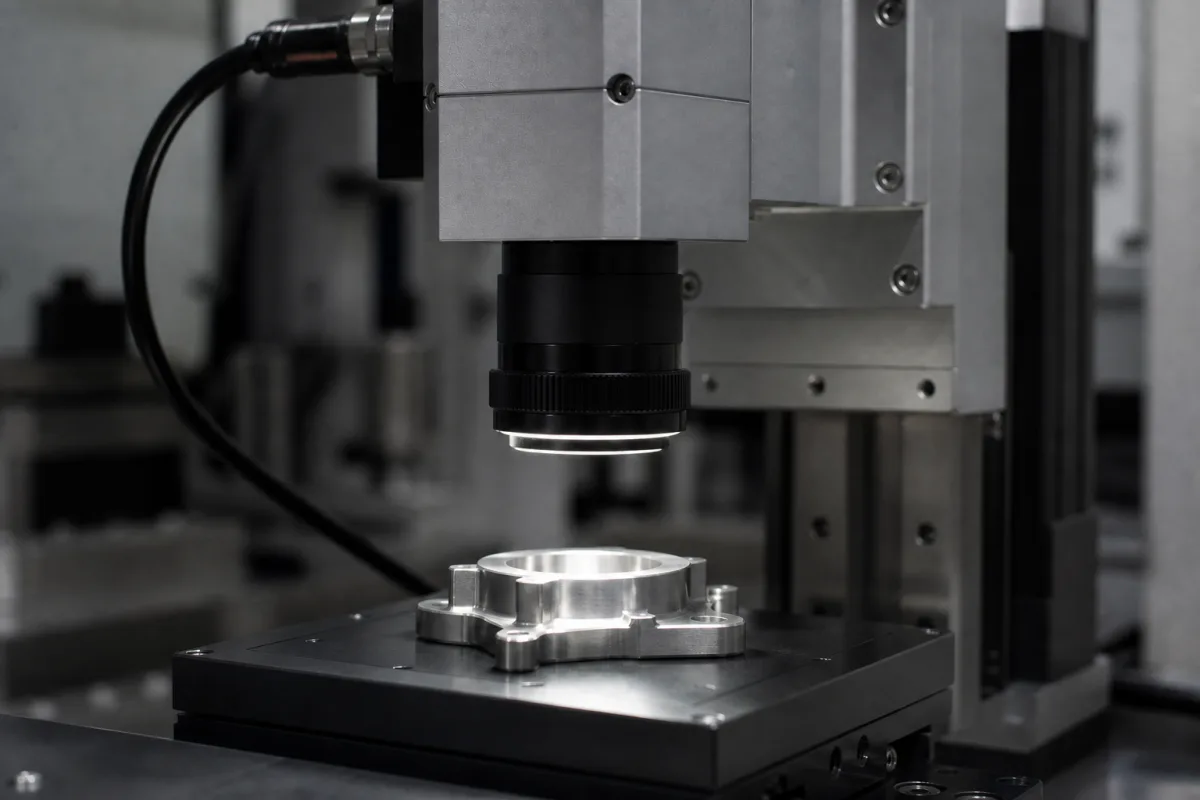
The optical sensing component of an Automated Metrology Module that captures dimensional or surface data through light-based detection.
Product Specifications

Technical details and manufacturing context for Optical Sensor Head

Definition
An optical sensor head is a critical component within an Automated Metrology Module, responsible for non-contact measurement and inspection. It houses the optical elements (e.g., lenses, light sources, detectors) that project light onto a target and capture the reflected or transmitted signal. Its primary role is to convert physical properties like dimensions, contours, surface defects, or presence/absence into quantifiable electronic data for the module's processing system.
Working Principle
The sensor head typically operates by emitting a controlled light beam (e.g., laser, LED) towards the target. It then detects the interaction of this light—through reflection, transmission, diffraction, or triangulation—using photodetectors. Variations in the detected light pattern, intensity, or position are analyzed to determine the target's physical characteristics, such as distance, height, profile, or surface quality.
Common Materials
Optical-grade glass (lenses), Aluminum alloy (housing), Stainless steel (mounting fixtures)
Technical Parameters
  • Measurement range (e.g., stand-off distance, field of view) (mm) Customizable
Components / BOM
  • Lens Assembly
    Focuses the emitted light beam onto the target and collects the reflected light.
    Material: Optical glass
  • Light Source (e.g., Laser Diode)
    Generates the coherent or structured light beam used for illumination and measurement.
    Material: Semiconductor materials
  • Photodetector Array (e.g., CMOS/CCD)
    Converts the incoming light signal into an electrical signal for processing.
    Material: Silicon
  • Protective Housing
    Provides mechanical protection, alignment, and environmental sealing for internal optical components.
    Material: Anodized aluminum alloy
Engineering Reasoning
400-700 nm wavelength, 0.1-1000 lux illumination, -10°C to 60°C ambient temperature
Lens surface contamination exceeding 0.5 μm particulate density, CCD sensor temperature exceeding 85°C, optical path misalignment >0.01° angular deviation
Design Rationale: Photodiode quantum efficiency degradation due to thermal-induced dark current increase (Arrhenius equation: failure rate doubles per 10°C rise above 60°C), Fresnel reflection losses exceeding 4% per optical interface at non-normal incidence
Risk Mitigation (FMEA)
Trigger Condensation formation on optical window due to dew point crossing (relative humidity >80% at operating temperature)
Mode: Beam scattering causing signal-to-noise ratio degradation below 20 dB
Strategy: Hermetic sealing with desiccant cartridge and active thermoelectric cooling maintaining 5°C above ambient dew point
Trigger LED emitter intensity decay following L70@50k hours lifetime curve (luminous flux <70% initial)
Mode: Insufficient photon count for triangulation algorithms requiring >1000 photons/pixel
Strategy: Closed-loop feedback control with reference photodiode and automatic current adjustment maintaining 650 nm ±2 nm wavelength stability

Industry Taxonomies & Aliases

Commonly used trade names and technical identifiers for Optical Sensor Head.

Applied To / Applications

This component is essential for the following industrial systems and equipment:

Industrial Ecosystem & Supply Chain DNA

Complementary Systems
Downstream Applications
Specialized Tooling

Application Fit & Sizing Matrix

Operational Limits
pressure: 0 to 1 bar (non-pressurized)
other spec: Ambient light interference < 100 lux, Vibration tolerance < 0.5g RMS
temperature: -10°C to 50°C
Media Compatibility
✓ Clear optical windows (glass, quartz) ✓ Non-reflective metal surfaces ✓ Plastic components with matte finish
Unsuitable: High particulate environments (dust, smoke > 10mg/m³)
Sizing Data Required
  • Target measurement resolution (microns)
  • Required field of view (mm)
  • Working distance from target surface (mm)

Reliability & Engineering Risk Analysis

Failure Mode & Root Cause
Lens Contamination
Cause: Accumulation of dust, oil mist, or process residues on optical surfaces, degrading signal transmission due to environmental exposure or inadequate sealing.
LED/Laser Degradation
Cause: Gradual output power reduction from thermal stress, aging, or electrical overstress, leading to signal drift or complete failure.
Maintenance Indicators
  • Intermittent or unstable readings despite stable process conditions
  • Visible condensation, cracks, or deposits on the sensor lens or housing
Engineering Tips
  • Implement regular lens cleaning with approved solvents and lint-free wipes, and ensure proper IP-rated sealing for the operating environment.
  • Maintain stable power supply within specifications and avoid thermal cycling by controlling ambient temperature and duty cycles.

Compliance & Manufacturing Standards

Reference Standards
ISO 10110-7:2017 (Optics and photonics - Preparation of drawings for optical elements and systems - Surface imperfection tolerances) IEC 60825-1:2014 (Safety of laser products - Part 1: Equipment classification and requirements) EN 61326-1:2013 (Electrical equipment for measurement, control and laboratory use - EMC requirements)
Manufacturing Precision
  • Lens Centering: +/-0.01mm
  • Surface Roughness: Ra 0.02μm
Quality Inspection
  • Laser Power Output Verification
  • Environmental Sealing Test (IP Rating)

Factories Producing Optical Sensor Head

Verified manufacturers with capability to produce this product in China

✓ 92% Supplier Capability Match Found

S Sourcing Manager from United States Feb 05, 2026
★★★★★
"As a professional in the Computer, Electronic and Optical Product Manufacturing sector, I confirm this Optical Sensor Head meets all ISO standards."
Technical Specifications Verified
P Procurement Specialist from United Arab Emirates Feb 02, 2026
★★★★☆
"Standard OEM quality for Computer, Electronic and Optical Product Manufacturing applications. The Optical Sensor Head arrived with full certification. (Delivery took slightly longer than expected, but technical support was excellent.)"
Technical Specifications Verified
T Technical Director from Australia Jan 30, 2026
★★★★★
"Great transparency on the Optical Sensor Head components. Essential for our Computer, Electronic and Optical Product Manufacturing supply chain."
Technical Specifications Verified
Verification Protocol

“Feedback is collected from verified sourcing managers during RFQ (Request for Quote) and factory evaluation processes on CNFX. These reports represent historical performance data and technical audit summaries from our B2B manufacturing network.”

17 sourcing managers are analyzing this specification now. Last inquiry for Optical Sensor Head from India (1h ago).

Supply Chain Compatible Machinery & Devices

Industrial IoT Gateway

Edge computing device connecting industrial equipment to cloud platforms.

Explore Specs →
Modular Industrial Edge Computing Device

Rugged computing platform for industrial data processing at the network edge

Explore Specs →
Industrial Smart Camera Module

Embedded vision system for industrial automation and quality inspection.

Explore Specs →
Industrial Wireless Power Transfer Module

Wireless power transfer module for industrial equipment applications

Explore Specs →

Frequently Asked Questions

What applications is this optical sensor head designed for?

This optical sensor head is specifically designed for automated metrology modules in manufacturing environments, used for precision dimensional measurement, surface inspection, and quality control applications in computer, electronic, and optical product manufacturing.

What materials are used in the construction of the sensor head?

The sensor head features optical-grade glass for high-precision lenses, aluminum alloy for durable and lightweight housing, and stainless steel for robust mounting fixtures that ensure stability in industrial environments.

What components are included in the optical sensor head assembly?

The complete assembly includes a lens assembly for light focusing, a light source (typically laser diode), a photodetector array (CMOS or CCD), and a protective housing that shields sensitive components from industrial contaminants.

Can I contact factories directly on CNFX?

CNFX is an open directory, not a transaction platform. Each factory profile provides direct contact information and production details to help you initiate direct inquiries with Chinese suppliers.

Get Quote for Optical Sensor Head

Request technical pricing, lead times, or customized specifications for Optical Sensor Head directly from verified manufacturing units.

Your business information is encrypted and only shared with verified Optical Sensor Head suppliers.

Thank you! Your message has been sent. We'll respond within 1–3 business days.

Need to Manufacture Optical Sensor Head?

Connect with verified factories specializing in this product category

Add Your Factory Contact Us
Previous Product
Optical Sensor Array / Electronic Distance Measurement (EDM) Unit
Next Product
Optical Source/IR Emitter