Industry-Verified Manufacturing Data (2026)

Output Driver Stage

Based on aggregated insights from multiple verified factory profiles within the CNFX directory, the standard Output Driver Stage used in the Computer, Electronic and Optical Product Manufacturing sector typically supports operational capacities ranging from standard industrial configurations to heavy-duty production requirements.

Technical Definition & Core Assembly

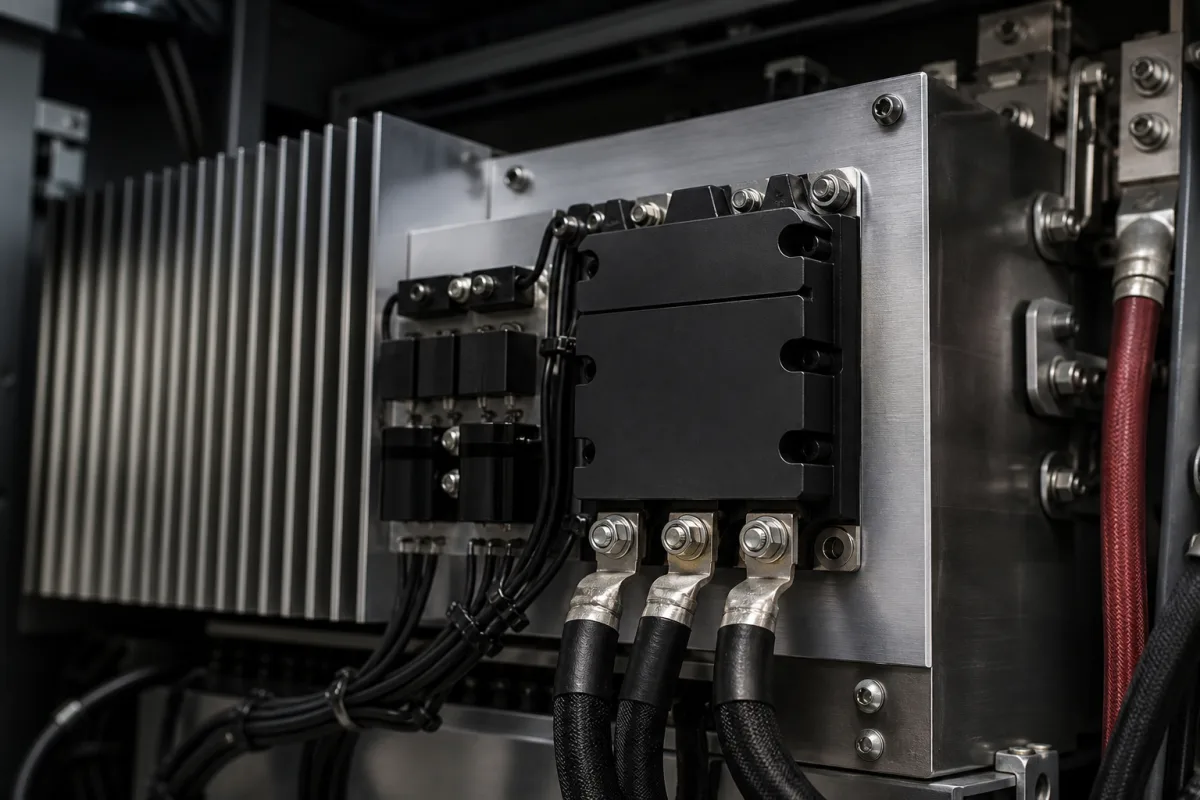
A canonical Output Driver Stage is characterized by the integration of Power Transistor and Gate Driver IC. In industrial production environments, manufacturers listed on CNFX commonly emphasize Semiconductor silicon construction to support stable, high-cycle operation across diverse manufacturing scenarios.

An electronic circuit stage within I/O interface circuitry that amplifies and conditions control signals to drive external loads or devices.
Product Specifications

Technical details and manufacturing context for Output Driver Stage

Definition
The Output Driver Stage is a critical component within Input/Output (I/O) Interface Circuitry responsible for receiving low-power control signals from preceding logic or processing stages and amplifying them to appropriate voltage/current levels required to reliably operate external devices such as motors, actuators, relays, displays, or communication lines. It ensures signal integrity, provides electrical isolation when needed, and protects sensitive internal circuitry from external electrical disturbances.
Working Principle
The stage typically receives a digital or analog input signal, processes it through amplification circuits (which may include transistors, operational amplifiers, or dedicated driver ICs), and delivers an output with sufficient power to drive the target load. It may incorporate features like level shifting, current boosting, short-circuit protection, and thermal management to ensure reliable operation under various conditions.
Common Materials
Semiconductor silicon, Copper, Epoxy resin, Ceramic substrate
Technical Parameters
  • Maximum output current capacity (A) Customizable
Components / BOM
  • Power Transistor
    Amplifies current/voltage to drive external loads
    Material: Semiconductor silicon
  • Gate Driver IC
    Provides precise control signals to power switching elements
    Material: Semiconductor silicon
  • Current Sense Resistor
    Monitors output current for protection and feedback
    Material: Metal alloy
  • Heat Sink
    Dissipates thermal energy generated during operation
    Material: Aluminum alloy
  • Protection Diode
    Prevents voltage spikes from damaging the circuit
    Material: Semiconductor silicon
Engineering Reasoning
0-24 VDC, 0-20 mA, -40°C to 85°C ambient temperature
Semiconductor junction temperature exceeding 150°C, output current exceeding 125% of rated capacity for >10 ms, voltage transients exceeding ±40V from nominal
Design Rationale: Thermal runaway due to excessive power dissipation (P=I²R) in output transistors, electromigration in aluminum interconnects at sustained high current densities (>10⁶ A/cm²), dielectric breakdown in gate oxide layers at electric field strengths >10 MV/cm
Risk Mitigation (FMEA)
Trigger Inductive load switching causing back-EMF voltage spikes of 50-100V
Mode: Output MOSFET gate oxide puncture leading to permanent short-circuit failure
Strategy: Integrated flyback diode with reverse recovery time <50 ns and clamping voltage <30V, RC snubber network with 100Ω resistor and 10nF capacitor
Trigger Continuous operation at 95% of maximum rated current causing junction temperature rise to 145°C
Mode: Thermal stress-induced bond wire lift-off and aluminum electromigration in output stage
Strategy: Thermal shutdown circuit with hysteresis, activating at 140°C and resetting at 120°C, copper interconnects with current density limit of 5×10⁵ A/cm²

Industry Taxonomies & Aliases

Commonly used trade names and technical identifiers for Output Driver Stage.

Applied To / Applications

This component is essential for the following industrial systems and equipment:

Industrial Ecosystem & Supply Chain DNA

Complementary Systems
Downstream Applications
Specialized Tooling

Application Fit & Sizing Matrix

Operational Limits
temperature: -40°C to +85°C (operational), -55°C to +125°C (storage)
voltage range: 3V to 36V DC (supply), ±15V (signal)
current capacity: Up to 2A continuous, 5A peak (depending on model)
isolation voltage: Up to 2500Vrms (optional)
frequency response: DC to 100kHz (typical)
Media Compatibility
✓ Industrial PLC/DCS systems ✓ Motor control circuits ✓ Solenoid/relay driving applications
Unsuitable: High-voltage RF transmission environments (due to EMI susceptibility)
Sizing Data Required
  • Load current requirement (continuous/peak)
  • Supply voltage range and stability
  • Required switching frequency/speed

Reliability & Engineering Risk Analysis

Failure Mode & Root Cause
Bearing fatigue failure
Cause: Cyclic loading beyond design limits due to misalignment, imbalance, or improper lubrication leading to subsurface cracking and spalling
Shaft coupling wear
Cause: Misalignment-induced fretting and fretting corrosion at coupling interfaces, exacerbated by inadequate torque or improper installation
Maintenance Indicators
  • High-frequency vibration spikes (>4x baseline) in axial or radial directions indicating imminent bearing failure
  • Abnormal audible knocking or grinding noises during operation suggesting mechanical interference or severe wear
Engineering Tips
  • Implement laser alignment during installation and quarterly checks to maintain shaft alignment within 0.05mm tolerance
  • Establish condition-based lubrication using ultrasound-guided greasing to prevent overlubrication and monitor bearing health

Compliance & Manufacturing Standards

Reference Standards
ISO 9001:2015 Quality Management Systems ANSI B11.0 Safety of Machinery CE Marking (Machinery Directive 2006/42/EC)
Manufacturing Precision
  • Bore Diameter: +/-0.01mm
  • Surface Flatness: 0.05mm per 100mm
Quality Inspection
  • Dimensional Verification with CMM
  • Hardness Testing (Rockwell C Scale)

Factories Producing Output Driver Stage

Verified manufacturers with capability to produce this product in China

✓ 98% Supplier Capability Match Found

T Technical Director from Singapore Jan 18, 2026
★★★★★
"The Output Driver Stage we sourced perfectly fits our Computer, Electronic and Optical Product Manufacturing production line requirements."
Technical Specifications Verified
P Project Engineer from Germany Jan 15, 2026
★★★★☆
"Found 42+ suppliers for Output Driver Stage on CNFX, but this spec remains the most cost-effective. (Delivery took slightly longer than expected, but technical support was excellent.)"
Technical Specifications Verified
S Sourcing Manager from Brazil Jan 12, 2026
★★★★★
"The technical documentation for this Output Driver Stage is very thorough, especially regarding technical reliability."
Technical Specifications Verified
Verification Protocol

“Feedback is collected from verified sourcing managers during RFQ (Request for Quote) and factory evaluation processes on CNFX. These reports represent historical performance data and technical audit summaries from our B2B manufacturing network.”

5 sourcing managers are analyzing this specification now. Last inquiry for Output Driver Stage from Germany (11m ago).

Supply Chain Compatible Machinery & Devices

Industrial IoT Gateway

Edge computing device connecting industrial equipment to cloud platforms.

Explore Specs →
Modular Industrial Edge Computing Device

Rugged computing platform for industrial data processing at the network edge

Explore Specs →
Industrial Smart Camera Module

Embedded vision system for industrial automation and quality inspection.

Explore Specs →
Industrial Wireless Power Transfer Module

Wireless power transfer module for industrial equipment applications

Explore Specs →

Frequently Asked Questions

What is the primary function of an output driver stage in electronic circuits?

The output driver stage amplifies and conditions control signals from preceding circuitry to provide sufficient power and signal integrity for driving external loads or devices such as motors, displays, or other peripherals.

Why are heat sinks important in output driver stage design?

Heat sinks are critical because power transistors and other components in output driver stages generate significant heat during operation; proper thermal management prevents overheating, ensures reliability, and maintains performance specifications.

How does a protection diode enhance output driver stage reliability?

Protection diodes (such as flyback or clamping diodes) safeguard the circuit from voltage spikes, back-EMF, and reverse current conditions that can occur when driving inductive loads, preventing damage to sensitive semiconductor components.

Can I contact factories directly on CNFX?

CNFX is an open directory, not a transaction platform. Each factory profile provides direct contact information and production details to help you initiate direct inquiries with Chinese suppliers.

Get Quote for Output Driver Stage

Request technical pricing, lead times, or customized specifications for Output Driver Stage directly from verified manufacturing units.

Your business information is encrypted and only shared with verified Output Driver Stage suppliers.

Thank you! Your message has been sent. We'll respond within 1–3 business days.

Need to Manufacture Output Driver Stage?

Connect with verified factories specializing in this product category

Add Your Factory Contact Us
Previous Product
Output Driver Circuits
Next Product
Output Driver/Buffer