Industry-Verified Manufacturing Data (2026)

Input/Output (I/O) Interface Circuitry

Based on aggregated insights from multiple verified factory profiles within the CNFX directory, the standard Input/Output (I/O) Interface Circuitry used in the Computer, Electronic and Optical Product Manufacturing sector typically supports operational capacities ranging from standard industrial configurations to heavy-duty production requirements.

Technical Definition & Core Assembly

A canonical Input/Output (I/O) Interface Circuitry is characterized by the integration of Input Buffer/Protection Network and Analog-to-Digital Converter (ADC). In industrial production environments, manufacturers listed on CNFX commonly emphasize Printed Circuit Board (PCB) construction to support stable, high-cycle operation across diverse manufacturing scenarios.

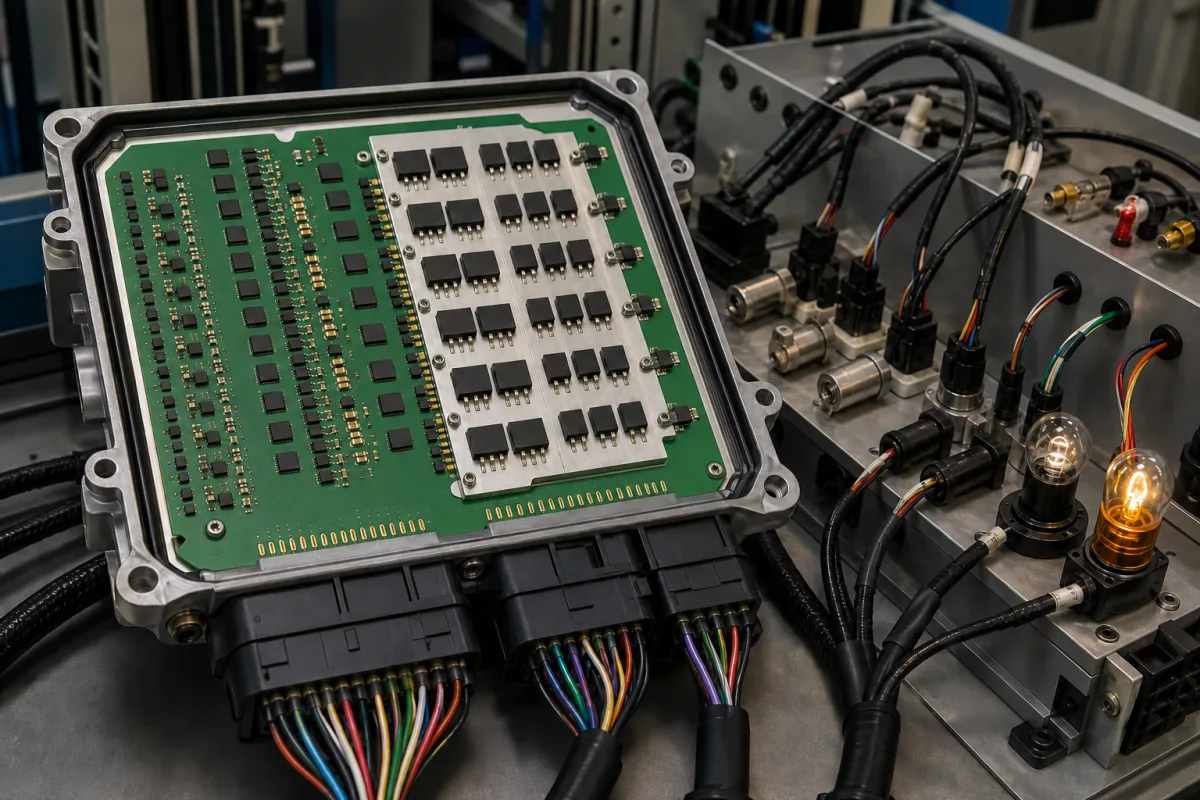
Electronic circuitry within an Electronic Control Unit (ECU) that manages the bidirectional flow of signals between the ECU's microprocessor and external sensors, actuators, and other devices.
Product Specifications

Technical details and manufacturing context for Input/Output (I/O) Interface Circuitry

Definition
The Input/Output (I/O) Interface Circuitry is a critical sub-system of an Electronic Control Unit (ECU). Its primary role is to act as a signal conditioning and translation layer. It receives low-level analog or digital signals from various sensors (e.g., temperature, pressure, position), converts them into clean digital signals the ECU's central processor can interpret, and conversely, translates the processor's digital commands into the appropriate power levels and signal types required to drive actuators (e.g., solenoids, motors, relays) and communicate with other control modules.
Working Principle
The circuitry typically consists of input buffers, analog-to-digital converters (ADCs) for sensor signals, digital-to-analog converters (DACs) or power drivers for actuator outputs, opto-isolators or galvanic isolation for noise protection and safety, and communication transceivers (e.g., for CAN, LIN buses). It conditions signals by filtering noise, providing voltage level shifting, and offering protection against electrical transients (ESD, surges).
Common Materials
Printed Circuit Board (PCB), Semiconductors (ICs, transistors), Passive components (resistors, capacitors), Connectors
Technical Parameters
  • Input voltage range and output drive voltage/current specifications. (V) Per Request
Components / BOM
  • Input Buffer/Protection Network
    Conditions incoming signals, provides electrostatic discharge (ESD) and over-voltage protection, and may perform level shifting.
    Material: Semiconductors, resistors, transient voltage suppression diodes
  • Analog-to-Digital Converter (ADC)
    Converts continuous analog sensor signals (e.g., voltage from a temperature sensor) into discrete digital values for the microprocessor.
    Material: Integrated Circuit (IC)
  • Output Driver Stage
    Amplifies the low-power digital signals from the microprocessor to the higher current/voltage levels needed to drive actuators like solenoids, motors, or indicator lamps.
    Material: Power transistors, MOSFETs, or driver ICs
  • Communication Transceiver
    Manages serial data communication protocols (e.g., Controller Area Network - CAN, Local Interconnect Network - LIN) for networking with other ECUs.
    Material: Integrated Circuit (IC)
  • Isolation Barrier
    Provides galvanic isolation between the ECU's logic side and noisy/high-voltage external circuits to prevent ground loops and protect the microprocessor.
    Material: Optocouplers, isolation transformers, or capacitive isolators
Engineering Reasoning
0-5 VDC for analog inputs, 0-24 VDC for digital I/O, -40°C to +125°C ambient temperature
Input voltage exceeding 30 VDC causes dielectric breakdown in protection diodes, output current exceeding 100 mA per channel saturates driver transistors
Design Rationale: Electromigration in aluminum interconnects at current densities above 1×10⁶ A/cm², latch-up in CMOS structures when substrate current exceeds 100 μA
Risk Mitigation (FMEA)
Trigger Electrostatic discharge (ESD) event exceeding 8 kV human body model
Mode: Gate oxide rupture in input protection MOSFETs
Strategy: Integrated silicon-controlled rectifier (SCR) clamps with 5 ns response time
Trigger Inductive load back-EMF generating voltage spikes to 60 V
Mode: Avalanche breakdown in output driver BJT collector-base junction
Strategy: Schottky diode clamping circuits with 1.5 ns reverse recovery time

Industry Taxonomies & Aliases

Commonly used trade names and technical identifiers for Input/Output (I/O) Interface Circuitry.

Applied To / Applications

This component is essential for the following industrial systems and equipment:

Industrial Ecosystem & Supply Chain DNA

Complementary Systems
Downstream Applications
Specialized Tooling

Application Fit & Sizing Matrix

Operational Limits
current: Up to 100mA per channel (typical), configurable for higher loads
voltage: 3.3V to 5V logic levels, with 12V/24V tolerant inputs where specified
frequency: DC to 1MHz signal bandwidth (typical for digital/analog I/O)
isolation: Up to 2500Vrms (if isolated channels are specified)
temperature: -40°C to +125°C (typical automotive/industrial range)
Media Compatibility
✓ Automotive sensor networks (e.g., CAN, LIN interfaces) ✓ Industrial PLC digital/analog signal conditioning ✓ Low-voltage actuator control (solenoids, relays, motors)
Unsuitable: High-voltage power switching (>60V) or RF signal environments without additional protection
Sizing Data Required
  • Number and type of I/O channels required (digital input/output, analog input/output, PWM)
  • Signal voltage/current levels and required isolation/protection
  • Communication protocol compatibility (e.g., SPI, I2C, CAN) and data rate

Reliability & Engineering Risk Analysis

Failure Mode & Root Cause
Signal Degradation
Cause: Electromagnetic interference (EMI) from nearby equipment or poor grounding, leading to corrupted data transmission and intermittent faults.
Component Overheating
Cause: Excessive current draw, poor ventilation, or aging capacitors/resistors causing thermal stress and eventual circuit failure.
Maintenance Indicators
  • Intermittent or erratic system behavior (e.g., random shutdowns, data errors) indicating signal integrity issues
  • Burning smell or visible discoloration/melting on circuitry components signaling overheating
Engineering Tips
  • Implement proper EMI shielding and grounding protocols, including separation from high-power equipment and use of shielded cables
  • Install thermal monitoring (e.g., infrared sensors) and ensure adequate ventilation/cooling to maintain operating temperatures within specifications

Compliance & Manufacturing Standards

Reference Standards
ISO 9001:2015 - Quality management systems IEC 61000-6-2:2019 - Electromagnetic compatibility (EMC) UL 60950-1 - Safety of information technology equipment
Manufacturing Precision
  • Connector pin alignment: +/-0.1mm
  • Signal rise/fall time: +/-10% of nominal
Quality Inspection
  • Continuity and isolation testing
  • Signal integrity analysis (eye diagram test)

Factories Producing Input/Output (I/O) Interface Circuitry

Verified manufacturers with capability to produce this product in China

✓ 94% Supplier Capability Match Found

T Technical Director from United Arab Emirates Feb 27, 2026
★★★★★
"Found 42+ suppliers for Input/Output (I/O) Interface Circuitry on CNFX, but this spec remains the most cost-effective."
Technical Specifications Verified
P Project Engineer from Australia Feb 24, 2026
★★★★☆
"The technical documentation for this Input/Output (I/O) Interface Circuitry is very thorough, especially regarding technical reliability. (Delivery took slightly longer than expected, but technical support was excellent.)"
Technical Specifications Verified
S Sourcing Manager from Singapore Feb 21, 2026
★★★★★
"Reliable performance in harsh Computer, Electronic and Optical Product Manufacturing environments. No issues with the Input/Output (I/O) Interface Circuitry so far."
Technical Specifications Verified
Verification Protocol

“Feedback is collected from verified sourcing managers during RFQ (Request for Quote) and factory evaluation processes on CNFX. These reports represent historical performance data and technical audit summaries from our B2B manufacturing network.”

10 sourcing managers are analyzing this specification now. Last inquiry for Input/Output (I/O) Interface Circuitry from Germany (59m ago).

Supply Chain Compatible Machinery & Devices

Industrial Smart Camera Module

Embedded vision system for industrial automation and quality inspection.

Explore Specs →
Industrial Wireless Power Transfer Module

Wireless power transfer module for industrial equipment applications

Explore Specs →
Industrial Smart Sensor Module

Modular industrial sensor with embedded processing and wireless connectivity

Explore Specs →
Surface Mount Resistor

Passive electronic component for current limiting and voltage division in circuits

Explore Specs →

Frequently Asked Questions

What is the primary function of I/O interface circuitry in an ECU?

The primary function is to manage bidirectional signal flow between the ECU's microprocessor and external devices like sensors and actuators, ensuring proper communication while providing protection and signal conditioning.

What components are typically included in the BOM for I/O interface circuitry?

Typical BOM includes Analog-to-Digital Converters (ADCs) for signal conversion, communication transceivers for data transmission, input buffer/protection networks for safeguarding, isolation barriers for electrical separation, and output driver stages for power delivery.

Why is isolation important in industrial I/O interface circuitry?

Isolation prevents electrical interference, protects sensitive microprocessor components from voltage spikes, ensures safety in high-voltage environments, and maintains signal integrity in noisy industrial settings.

Can I contact factories directly on CNFX?

CNFX is an open directory, not a transaction platform. Each factory profile provides direct contact information and production details to help you initiate direct inquiries with Chinese suppliers.

Get Quote for Input/Output (I/O) Interface Circuitry

Request technical pricing, lead times, or customized specifications for Input/Output (I/O) Interface Circuitry directly from verified manufacturing units.

Your business information is encrypted and only shared with verified Input/Output (I/O) Interface Circuitry suppliers.

Thank you! Your message has been sent. We'll respond within 1–3 business days.

Need to Manufacture Input/Output (I/O) Interface Circuitry?

Connect with verified factories specializing in this product category

Add Your Factory Contact Us
Previous Product
Input/Output (I/O) Interface
Next Product
Input/Output (I/O) Module