Industry-Verified Manufacturing Data (2026)

Power Semiconductor Devices

Based on aggregated insights from multiple verified factory profiles within the CNFX directory, the standard Power Semiconductor Devices used in the Computer, Electronic and Optical Product Manufacturing sector typically supports operational capacities ranging from standard industrial configurations to heavy-duty production requirements.

Technical Definition & Core Assembly

A canonical Power Semiconductor Devices is characterized by the integration of Semiconductor Die and Terminals. In industrial production environments, manufacturers listed on CNFX commonly emphasize Silicon (Si) construction to support stable, high-cycle operation across diverse manufacturing scenarios.

Electronic components designed to control and convert electrical power in high-power applications.
Product Specifications

Technical details and manufacturing context for Power Semiconductor Devices

Definition
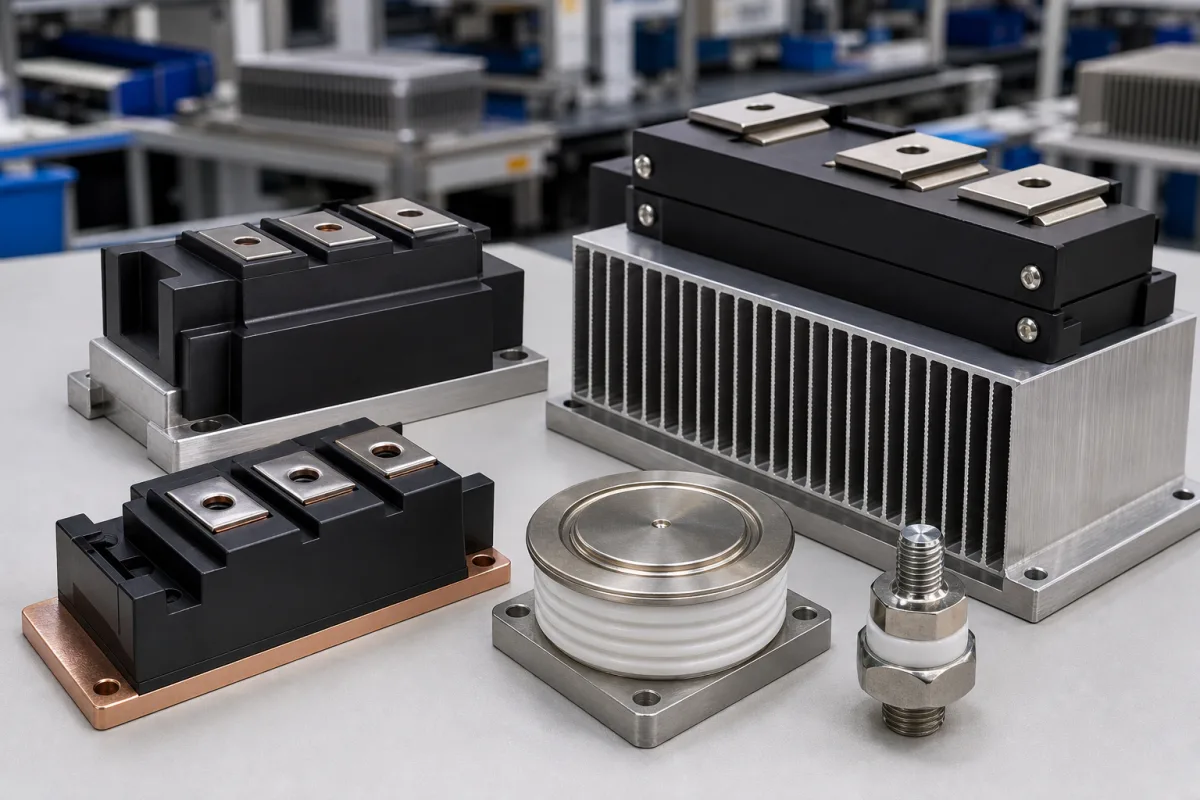
Power semiconductor devices are specialized electronic components that form the core switching elements within power electronics modules. They handle high voltages and currents to efficiently convert, control, and regulate electrical power in systems such as motor drives, power supplies, inverters, and converters. These devices enable precise management of electrical energy flow through switching operations.
Working Principle
Power semiconductor devices operate by controlling the flow of electrical current through semiconductor materials (typically silicon, silicon carbide, or gallium nitride). They function as electronic switches or amplifiers, turning on/off rapidly to modulate power flow. Common operating principles include field-effect control (MOSFETs, IGBTs), bipolar junction control (BJTs), and thyristor-based latching mechanisms (SCRs, TRIACs).
Common Materials
Silicon (Si), Silicon Carbide (SiC), Gallium Nitride (GaN)
Technical Parameters
  • Voltage rating indicating maximum operating voltage (V) Standard Spec
Components / BOM
  • Semiconductor Die
    Core semiconductor material where electron flow is controlled
    Material: Silicon/SiC/GaN
  • Terminals
    Electrical connection points (gate, source, drain for MOSFETs; gate, anode, cathode for thyristors)
    Material: Copper alloy
  • Package
    Protective housing providing thermal management and electrical isolation
    Material: Plastic/ceramic with metal heat spreader
Engineering Reasoning
600-6500 V, 1-3600 A
Junction temperature exceeding 175°C for silicon, 200°C for silicon carbide
Design Rationale: Thermal runaway due to avalanche breakdown at critical electric field strength of 2.5×10^5 V/cm for silicon, 3.0×10^6 V/cm for silicon carbide
Risk Mitigation (FMEA)
Trigger Gate oxide breakdown at electric field > 10 MV/cm
Mode: Short-circuit failure with collector-emitter voltage drop to 0.7 V
Strategy: Gate-source voltage clamping at ±20 V with Zener diode protection
Trigger Thermal cycling exceeding 50,000 cycles between -40°C and 150°C
Mode: Wire bond lift-off causing open-circuit failure
Strategy: Copper clip bonding with thermal expansion coefficient matching to 17 ppm/K

Industry Taxonomies & Aliases

Commonly used trade names and technical identifiers for Power Semiconductor Devices.

Applied To / Applications

This component is essential for the following industrial systems and equipment:

Industrial Ecosystem & Supply Chain DNA

Complementary Systems
Downstream Applications
Specialized Tooling

Application Fit & Sizing Matrix

Operational Limits
current: Up to 3600A (continuous current)
voltage: Up to 6500V (blocking voltage)
frequency: Up to 100kHz (switching frequency)
temperature: -40°C to +175°C (junction temperature)
Media Compatibility
✓ Industrial motor drives ✓ Power supplies and UPS systems ✓ Renewable energy inverters
Unsuitable: High-radiation environments (nuclear facilities, space applications)
Sizing Data Required
  • Maximum operating voltage (V)
  • Continuous current requirement (A)
  • Switching frequency (Hz)

Reliability & Engineering Risk Analysis

Failure Mode & Root Cause
Thermal runaway
Cause: Excessive junction temperature due to inadequate cooling, overcurrent, or poor thermal interface management leading to catastrophic failure.
Gate oxide breakdown
Cause: Voltage spikes exceeding rated gate-source voltage, electrostatic discharge (ESD), or prolonged exposure to high electric fields degrading insulation.
Maintenance Indicators
  • Audible arcing or popping sounds from the device enclosure
  • Visible discoloration, bulging, or charring on the device casing or adjacent components
Engineering Tips
  • Implement active thermal management with derating curves, ensuring heatsink contact integrity and monitoring junction temperature via thermal sensors.
  • Use snubber circuits and transient voltage suppressors to clamp voltage spikes, and enforce ESD protocols during handling and installation.

Compliance & Manufacturing Standards

Reference Standards
IEC 60747-9: Semiconductor devices - Discrete devices - Part 9: Insulated-gate bipolar transistors (IGBTs) JEDEC JESD22-A101: Steady-State Temperature Humidity Bias Life Test AEC-Q101: Failure Mechanism Based Stress Test Qualification for Discrete Semiconductors in Automotive Applications
Manufacturing Precision
  • Gate threshold voltage (Vth): +/-0.5V
  • Collector-emitter saturation voltage (Vce(sat)): +/-5% of rated value
Quality Inspection
  • Thermal cycling test (-55°C to +150°C, 1000 cycles)
  • High-temperature reverse bias (HTRB) test at maximum rated voltage and 150°C for 1000 hours

Factories Producing Power Semiconductor Devices

Verified manufacturers with capability to produce this product in China

✓ 95% Supplier Capability Match Found

P Procurement Specialist from Brazil Jan 11, 2026
★★★★★
"Great transparency on the Power Semiconductor Devices components. Essential for our Computer, Electronic and Optical Product Manufacturing supply chain."
Technical Specifications Verified
T Technical Director from Canada Jan 08, 2026
★★★★★
"The Power Semiconductor Devices we sourced perfectly fits our Computer, Electronic and Optical Product Manufacturing production line requirements."
Technical Specifications Verified
P Project Engineer from United States Jan 05, 2026
★★★★★
"Found 29+ suppliers for Power Semiconductor Devices on CNFX, but this spec remains the most cost-effective."
Technical Specifications Verified
Verification Protocol

“Feedback is collected from verified sourcing managers during RFQ (Request for Quote) and factory evaluation processes on CNFX. These reports represent historical performance data and technical audit summaries from our B2B manufacturing network.”

13 sourcing managers are analyzing this specification now. Last inquiry for Power Semiconductor Devices from Thailand (1h ago).

Supply Chain Compatible Machinery & Devices

Modular Industrial Edge Computing Device

Rugged computing platform for industrial data processing at the network edge

Explore Specs →
Industrial Smart Camera Module

Embedded vision system for industrial automation and quality inspection.

Explore Specs →
Industrial Wireless Power Transfer Module

Wireless power transfer module for industrial equipment applications

Explore Specs →
Industrial Smart Sensor Module

Modular industrial sensor with embedded processing and wireless connectivity

Explore Specs →

Frequently Asked Questions

What are the main advantages of Silicon Carbide (SiC) in power semiconductor devices?

SiC offers higher thermal conductivity, faster switching speeds, and better high-temperature performance compared to traditional silicon, making it ideal for high-power applications in computer and electronic manufacturing.

How do power semiconductor devices differ in computer versus optical product manufacturing?

In computer manufacturing, they often focus on efficient power conversion for processors and components, while in optical manufacturing, they may prioritize precise power control for lasers and imaging systems, though both use similar Si, SiC, and GaN materials.

What should I consider when selecting power semiconductor devices for high-power applications?

Key factors include material (Si, SiC, or GaN) for efficiency and temperature tolerance, package design for heat dissipation, semiconductor die specifications for current handling, and terminal compatibility with your system's power requirements.

Can I contact factories directly on CNFX?

CNFX is an open directory, not a transaction platform. Each factory profile provides direct contact information and production details to help you initiate direct inquiries with Chinese suppliers.

Get Quote for Power Semiconductor Devices

Request technical pricing, lead times, or customized specifications for Power Semiconductor Devices directly from verified manufacturing units.

Your business information is encrypted and only shared with verified Power Semiconductor Devices suppliers.

Thank you! Your message has been sent. We'll respond within 1–3 business days.

Need to Manufacture Power Semiconductor Devices?

Connect with verified factories specializing in this product category

Add Your Factory Contact Us
Previous Product
Power Semiconductor (e.g., MOSFET/IGBT Module)
Next Product
Power Semiconductor Module