Industry-Verified Manufacturing Data (2026)

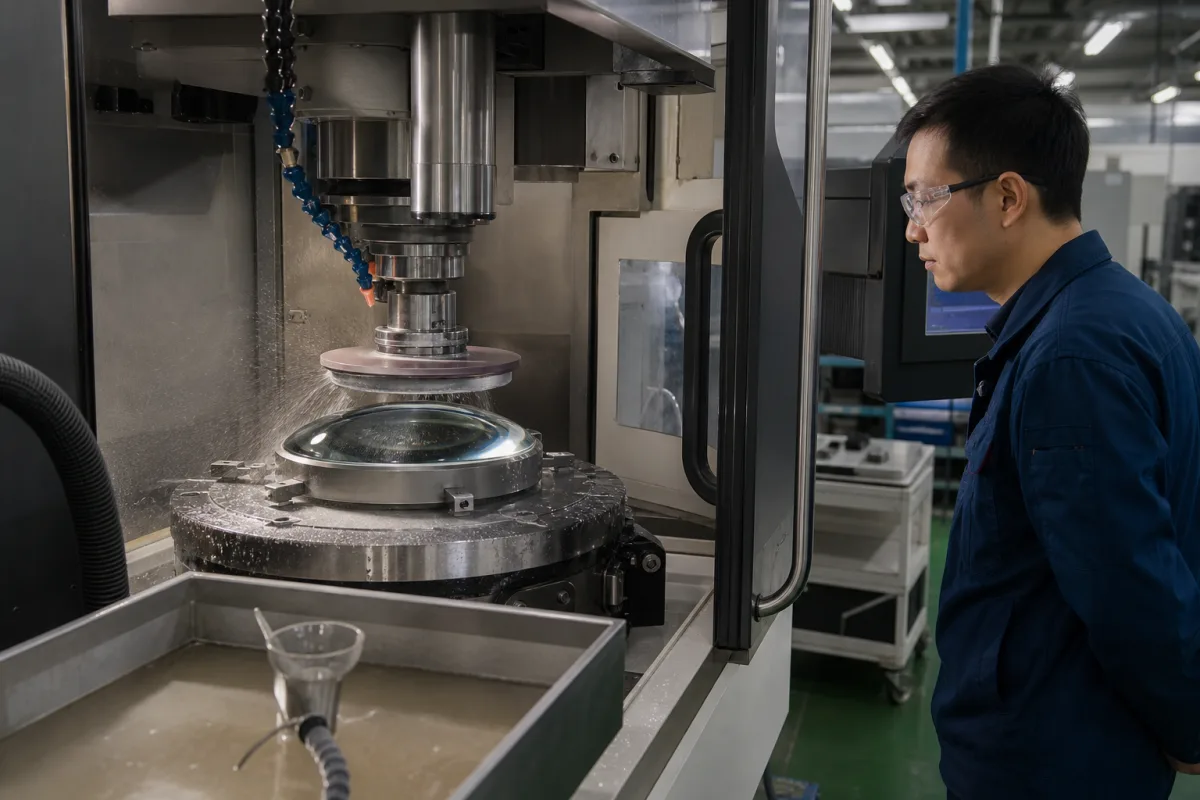
Precision Optical Lens Grinding Machine

Based on aggregated insights from multiple verified factory profiles within the CNFX directory, the standard Precision Optical Lens Grinding Machine used in the Computer, Electronic and Optical Product Manufacturing sector typically supports operational capacities ranging from standard industrial configurations to heavy-duty production requirements.

Technical Definition & Core Assembly

A canonical Precision Optical Lens Grinding Machine is characterized by the integration of Main Grinding Spindle and Lens Chuck Assembly. In industrial production environments, manufacturers listed on CNFX commonly emphasize Stainless Steel construction to support stable, high-cycle operation across diverse manufacturing scenarios.

Industrial machine for shaping optical lens blanks to precise curvature specifications
Product Specifications

Technical details and manufacturing context for Precision Optical Lens Grinding Machine

Definition
A standalone industrial machine used in optical manufacturing facilities to grind lens blanks to specific spherical or aspherical curvatures. It employs diamond-impregnated grinding wheels to remove material from glass or crystal substrates with micron-level accuracy. The machine is essential for creating the base optical form before polishing and coating processes. It features automated control systems for maintaining consistent surface profiles across production batches.
Working Principle
Utilizes rotating diamond grinding wheels that contact the lens blank at controlled angles and pressures, removing material through abrasive action while maintaining precise curvature through computer-controlled positioning systems.
Common Materials
Stainless Steel, Cast Iron, Aluminum Alloy
Technical Parameters
  • Allowed deviation from target curvature radius (mm) Customizable
  • Peak-to-valley surface form error (μm PV) Customizable
Components / BOM
  • Main Grinding Spindle
    Rotates diamond grinding wheel for material removal
    Material: Precision steel bearing assembly
  • Lens Chuck Assembly
    Holds and positions lens blank during grinding
    Material: Stainless steel with vacuum or mechanical clamping
  • Coolant System
    Circulates coolant to control temperature and remove debris
    Material: Polymer tubing with stainless steel pump
  • CNC Control Unit
    Controls machine movements and grinding parameters
    Material: Electronic components in industrial enclosure
Engineering Reasoning
0.1-5.0 μm surface roughness (Ra), 0.001-0.1 mm/min feed rate, 1000-5000 rpm spindle speed
Spindle vibration exceeding 0.5 μm displacement amplitude at 1000-5000 rpm, grinding wheel wear exceeding 0.2 mm radial loss, coolant temperature exceeding 40°C
Design Rationale: Thermal expansion mismatch between ceramic spindle bearings and steel housing (Δα=8×10⁻⁶ K⁻¹), abrasive particle embedment causing Hertzian contact stress exceeding 2 GPa, phase transformation of grinding wheel binder at 250°C
Risk Mitigation (FMEA)
Trigger Coolant contamination with 0.5% v/v mineral oil causing 60% reduction in heat transfer coefficient
Mode: Lens surface thermal cracking due to localized temperature gradient exceeding 200°C/mm
Strategy: Install capacitive oil detection sensor with 0.1% v/v sensitivity and automatic coolant bypass system
Trigger Grinding wheel imbalance exceeding ISO 1940 G2.5 grade at 4000 rpm
Mode: Spindle bearing Brinell damage from impact loads exceeding 3 kN at 100 Hz frequency
Strategy: Implement active magnetic bearing system with 0.1 μm displacement control and real-time dynamic balancing

Industry Taxonomies & Aliases

Commonly used trade names and technical identifiers for Precision Optical Lens Grinding Machine.

Industrial Ecosystem & Supply Chain DNA

Complementary Systems
Downstream Applications
Specialized Tooling

Application Fit & Sizing Matrix

Operational Limits
pressure: 0.5-2.0 bar (coolant system)
flow rate: 10-30 L/min (coolant circulation)
temperature: 15-25°C (controlled environment)
slurry concentration: 5-20% diamond/CBN abrasive by weight
Media Compatibility
✓ BK7 optical glass ✓ Fused silica ✓ Zerodur ceramic glass
Unsuitable: High-vibration environments without isolation
Sizing Data Required
  • Lens blank diameter range (mm)
  • Required surface accuracy (PV/RMS in nm)
  • Production throughput (lens/hour)

Reliability & Engineering Risk Analysis

Failure Mode & Root Cause
Spindle bearing degradation
Cause: Contaminant ingress from grinding slurry or coolant, leading to abrasive wear and loss of precision due to thermal expansion and vibration
Optical surface contamination and scratching
Cause: Inadequate filtration of coolant/lubricant, accumulation of abrasive particles, or improper handling causing micro-scratches that degrade optical quality
Maintenance Indicators
  • Audible high-frequency vibration or irregular grinding noise from spindle assembly
  • Visible increase in surface haze, streaks, or inconsistent finish on ground lenses
Engineering Tips
  • Implement multi-stage filtration (down to 1 micron) for coolant/lubricant systems with regular particle count monitoring to prevent abrasive contamination
  • Establish predictive maintenance using vibration analysis and thermal imaging on spindle bearings, coupled with strict environmental controls for temperature and humidity

Compliance & Manufacturing Standards

Reference Standards
ISO 10110-5:2015 (Optics and photonics - Preparation of drawings for optical elements and systems - Part 5: Surface form tolerances) ANSI/ASME B46.1-2019 (Surface Texture, Surface Roughness, Waviness, and Lay) DIN 3140-7:2018 (Optics and optical instruments - Preparation of drawings for optical elements and systems - Part 7: Surface imperfection tolerances)
Manufacturing Precision
  • Surface Roughness: Ra ≤ 0.01 μm
  • Centering Error: ≤ 0.002 mm
Quality Inspection
  • Interferometric Surface Form Test
  • Coordinate Measuring Machine (CMM) Dimensional Verification

Factories Producing Precision Optical Lens Grinding Machine

Verified manufacturers with capability to produce this product in China

✓ 97% Supplier Capability Match Found

P Procurement Specialist from Canada Jan 16, 2026
★★★★★
"As a professional in the Computer, Electronic and Optical Product Manufacturing sector, I confirm this Precision Optical Lens Grinding Machine meets all ISO standards."
Technical Specifications Verified
T Technical Director from United States Jan 13, 2026
★★★★★
"Standard OEM quality for Computer, Electronic and Optical Product Manufacturing applications. The Precision Optical Lens Grinding Machine arrived with full certification."
Technical Specifications Verified
P Project Engineer from United Arab Emirates Jan 10, 2026
★★★★★
"Great transparency on the Precision Optical Lens Grinding Machine components. Essential for our Computer, Electronic and Optical Product Manufacturing supply chain."
Technical Specifications Verified
Verification Protocol

“Feedback is collected from verified sourcing managers during RFQ (Request for Quote) and factory evaluation processes on CNFX. These reports represent historical performance data and technical audit summaries from our B2B manufacturing network.”

10 sourcing managers are analyzing this specification now. Last inquiry for Precision Optical Lens Grinding Machine from Vietnam (1h ago).

Supply Chain Commonly Integrated Components

Signal Processor

Electronic device that conditions, amplifies, filters, and converts raw sensor signals into standardized outputs for temperature measurement systems

Explore Specs →
Optical Spectrometer

An analytical instrument that measures the intensity of light as a function of wavelength to determine the elemental composition of materials.

Explore Specs →
Stereo Camera Array

A multi-camera system that captures synchronized images from multiple perspectives to enable 3D depth perception and pattern recognition.

Explore Specs →
Structured Light Projector

Optical device that projects precisely controlled light patterns onto surfaces for 3D scanning applications

Explore Specs →

Frequently Asked Questions

What materials is this optical lens grinding machine constructed from?

The machine is built from durable materials including Stainless Steel, Cast Iron, and Aluminum Alloy for stability, corrosion resistance, and longevity in industrial environments.

What is the positioning accuracy of this lens grinding machine?

This precision grinding machine offers micron-level positioning accuracy (measured in μm), ensuring exact curvature specifications for optical lenses in manufacturing applications.

What key components are included in the Bill of Materials (BOM)?

The BOM includes essential components: CNC Control Unit for precision operation, Coolant System for temperature management, Lens Chuck Assembly for secure holding, and Main Grinding Spindle for shaping.

Can I contact factories directly on CNFX?

CNFX is an open directory, not a transaction platform. Each factory profile provides direct contact information and production details to help you initiate direct inquiries with Chinese suppliers.

Get Quote for Precision Optical Lens Grinding Machine

Request technical pricing, lead times, or customized specifications for Precision Optical Lens Grinding Machine directly from verified manufacturing units.

Your business information is encrypted and only shared with verified Precision Optical Lens Grinding Machine suppliers.

Thank you! Your message has been sent. We'll respond within 1–3 business days.

Need to Manufacture Precision Optical Lens Grinding Machine?

Connect with verified factories specializing in this product category

Add Your Factory Contact Us
Previous Product
Precision Optical Lens Coating Chamber
Next Product
Precision Optical Lens Inspection and Measurement System