Editorial Technical Reference

CNC Control Unit

This page explains how CNC Control Unit is classified within Machinery and Equipment Manufacturing. Technical values and manufacturer relationships are research references; confirm the current specification and supplier evidence for each order.

Technical Definition & Core Assembly

The electronic control system that interprets G-code instructions and coordinates the precise movements of a CNC machine's axes and spindle.
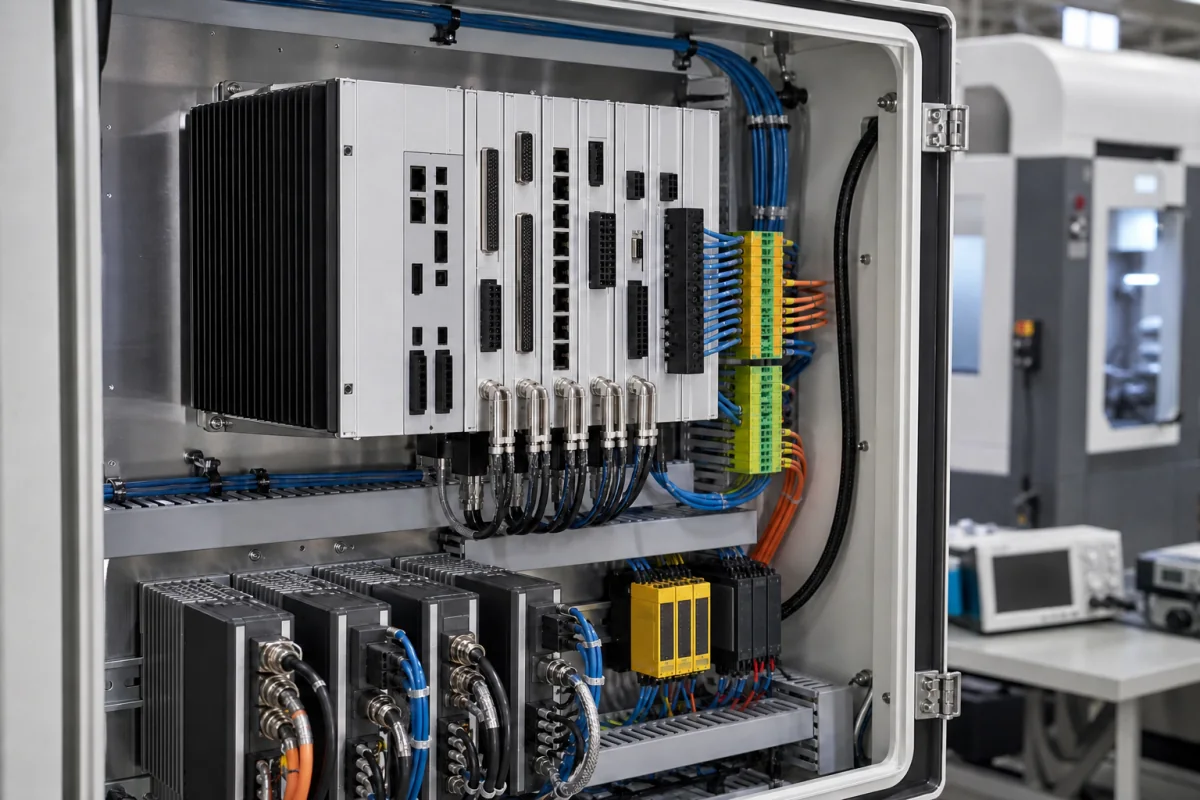
Representative product image. Confirm appearance and specifications with the manufacturer.

Product Specifications

Technical details and manufacturing context for CNC Control Unit

Definition
In a Precision Optical Lens Grinding Machine, the CNC Control Unit is the central processing component responsible for executing complex grinding programs. It translates digital design data (CAD/CAM) into precise, high-frequency motion commands for the grinding wheel, workpiece positioning stages, and coolant systems to achieve sub-micron surface accuracy and complex aspheric lens geometries. The unit receives a pre-programmed sequence of machine control instructions (G-code/M-code). Its processor interprets these commands, calculates precise trajectories, and sends synchronized electrical signals (via servo drives or stepper drivers) to the machine's motors. It continuously monitors feedback from position encoders and sensors to maintain accuracy through closed-loop control, adjusting for any deviations in real-time during the grinding process. The control unit typically supports 3 to 5 controlled axes, with a spindle speed range of 0 to 10,000 rpm and rapid traverse rates of 10 to 30 m/min. Positioning accuracy is ±0.005 to ±0.02 mm, and repeatability is ±0.003 to ±0.01 mm, both per ISO 230-2. It operates on 220/380 V AC ±10% (IEC 60038) with power consumption of 0.5 to 2.0 kW. The unit is designed for operating temperatures of 0 to 45 °C and humidity of 10 to 90% RH (non-condensing), per IEC 60721-3-3. Its ingress protection rating is IP54 to IP65 (IEC 60529), and it weighs 5 to 15 kg. Memory capacity ranges from 1 to 4 GB for part programs and tool data. Communication interfaces include Ethernet, USB, and RS-232 (IEEE 802.3). The housing is typically aluminum alloy, with internal printed circuit boards and semiconductor chips. These values are directory reference ranges; verify model-specific specifications with the legal manufacturer or supplier.
Working Principle
The unit receives a pre-programmed sequence of machine control instructions (G-code/M-code). Its processor interprets these commands, calculates precise trajectories, and sends synchronized electrical signals (via servo drives or stepper drivers) to the machine's motors. It continuously monitors feedback from position encoders and sensors to maintain accuracy through closed-loop control, adjusting for any deviations in real-time during the grinding process.
Common Materials
Printed Circuit Board (PCB), Semiconductor Chips (Microprocessor, Memory), Aluminum Alloy (Housing)
Technical Parameters
ParameterTypical rangeNotes & selection driver
Number of Controlled Axes3–5 axesDetermines complexity of machining operations
Spindle Speed Range0–10000 rpmHigher speeds for non-ferrous materials
Rapid Traverse Rate10–30 m/minAffects cycle time
Positioning Accuracy±0.005–±0.02 mmCritical for precision machiningISO 230-2
Repeatability±0.003–±0.01 mmConsistency of positioningISO 230-2
Input Voltage220/380 V AC ±10% VThree-phase for industrial useIEC 60038
Power Consumption0.5–2.0 kWDepends on number of axes and spindle
Operating Temperature0–45 °COutside range may cause thermal driftIEC 60721-3-3
Humidity Range10–90 % RHNon-condensingIEC 60721-3-3
Ingress Protection RatingIP54–IP65Higher rating for harsh environmentsIEC 60529
Control Unit Weight5–15 kgAffects mounting requirements
Memory Capacity1–4 GBFor part programs and tool data
Communication InterfaceEthernet, USB, RS-232For networking and data transferIEEE 802.3

Ranges are indicative industry figures for RFQ preparation, not a supplier commitment. Confirm every value and standard with the legal manufacturer before ordering.

Components / BOM
  • Central Processing Unit (CPU)
    Executes the control program, performs trajectory calculations, and manages data flow between memory, I/O, and drives.
    Material: Semiconductor (Silicon)
  • Servo Drive Interface
    Converts low-power control signals from the CPU into high-power electrical currents required to drive the servo or stepper motors that move the machine axes.
    Material: PCB, Electronic Components
  • Feedback Interface (Encoder Input)
    Receives and processes real-time position data from rotary or linear encoders on each axis, enabling closed-loop precision control.
    Material: PCB, Electronic Components
  • Operator Panel Interface
    Provides the physical and logical connection for the Human-Machine Interface (HMI), allowing program input, manual control (jogging), and process monitoring.
    Material: PCB, Connectors

Industrial Ecosystem & Supply Chain Structure

Complementary Systems
Downstream Applications
Specialized Tooling

Application Fit & Sizing Matrix

Operational Limits
pressure: Atmospheric (sealed unit, not pressure-rated)
other spec: Humidity: 10-90% non-condensing, Vibration: ≤5G, IP Rating: IP54 (dust/water splash resistant)
temperature: 0°C to +45°C
Media Compatibility
✓ Machine tool cutting fluids (coolants) ✓ Industrial lubricants (for machine maintenance) ✓ Clean compressed air (for cooling/purge)
Unsuitable: Corrosive chemical atmospheres (e.g., acid mists, chlorine gas)
Sizing Data Required
  • Number of controlled axes (e.g., 3-axis, 5-axis)
  • Maximum spindle speed (RPM) and power (kW)
  • Required I/O count (digital/analog inputs & outputs)

Reliability & Engineering Risk Analysis

Failure Mode & Root Cause
Overheating of electronic components
Cause: Inadequate cooling due to dust accumulation on heat sinks, poor ventilation, or failing cooling fans leading to thermal stress and component degradation.
Power supply instability
Cause: Voltage spikes, brownouts, or aging capacitors causing erratic behavior, data corruption, or complete shutdown of the control unit.
Maintenance Indicators
  • Intermittent or unresponsive axis movements accompanied by audible clicking or grinding from servo drives
  • Flickering or distorted display on the operator interface, often with error codes or system alarms
Engineering Tips
  • Implement regular preventive maintenance: Clean air filters and heat sinks monthly, verify cooling fan operation, and monitor internal temperatures with thermal imaging during operation.
  • Install an uninterruptible power supply (UPS) with voltage regulation and surge protection to shield the control unit from electrical disturbances and ensure clean, stable power.

Indicative industry ranges for design and RFQ preparation. Confirm the exact figures and applicable standard with the manufacturer before specifying.

Compliance & Manufacturing Standards

Applicable Standards
ISO 230-1:2012 (Test code for machine tools - Part 1: Geometric accuracy of machines operating under no-load or quasi-static conditions) IEC 61131-2:2017 (Programmable controllers - Part 2: Equipment requirements and tests) EN 60204-1:2018 (Safety of machinery - Electrical equipment of machines - Part 1: General requirements)

Quoted from the published standard.

Manufacturing Precision
  • Positional Accuracy: +/-0.005 mm
  • Repeatability: +/-0.002 mm
Quality Inspection
  • Vibration Analysis Test
  • Environmental Testing (Temperature, Humidity, EMC)

Manufacturers of CNC Control Unit

Manufacturer profiles associated with CNC Control Unit.

Sourcing CNC Control Unit from China?
Tell us your specification and target quantity — we will match it against manufacturer records and come back with the factories that fit.
Request manufacturers We manufacture this

Manufacturer listings support early research and capability understanding. They are not certification, ranking, or transaction guarantees.

Technical documentation
Request current drawings, revision history, and a signed specification sheet.
Manufacturing capability
Verify equipment lists, process limits, capacity, and representative production evidence.
Inspection readiness
Confirm test methods, calibrated equipment, sampling plans, and traceable reports.
Supplier transparency
Check the legal entity, factory address, ownership, certifications, and direct contacts.

CNFX does not score or rank suppliers. Buyers must verify all claims and documents with the legal manufacturer before ordering.

Supply Chain Compatible Machinery & Devices

Automated Powder Coating System

Integrated industrial system for applying dry powder coatings to metal substrates.

Explore Specs →
Centrifugal Pump Impeller

The centrifugal pump impeller is a critical rotating component that converts mechanical energy from the motor into kinetic energy in fluid systems.

Explore Specs →
High-Precision CNC Laser Cutting Machine

Computer-controlled industrial machine using focused laser beams to cut sheet metal with micron-level accuracy.

Explore Specs →
Industrial-Grade Hydraulic Cylinder Piston Rod

This industrial-grade piston rod is a precision-ground cylindrical component designed for use in hydraulic cylinders.

Explore Specs →

Frequently Asked Questions

What is the role of the CNC Control Unit in a precision optical lens grinding machine?

The CNC Control Unit is the central processing component that executes grinding programs. It translates CAD/CAM data into precise motion commands for the grinding wheel, workpiece stages, and coolant systems, enabling sub-micron accuracy and complex lens geometries.

How does the CNC Control Unit maintain accuracy during grinding?

It uses closed-loop control: it continuously monitors feedback from position encoders and sensors, compares actual positions to commanded positions, and adjusts motor signals in real-time to correct any deviations.

What are typical specifications for a CNC Control Unit in this application?

Typical ranges include 3-5 controlled axes, spindle speed 0-10,000 rpm, rapid traverse 10-30 m/min, positioning accuracy ±0.005-±0.02 mm, repeatability ±0.003-±0.01 mm, input voltage 220/380 V AC ±10%, power 0.5-2.0 kW, operating temperature 0-45 °C, humidity 10-90% RH, IP54-IP65, weight 5-15 kg, memory 1-4 GB, and interfaces Ethernet, USB, RS-232. Verify with the manufacturer.

What standards are referenced for the CNC Control Unit?

Standards referenced include ISO 230-2 for positioning accuracy and repeatability, IEC 60038 for voltage, IEC 60721-3-3 for environmental conditions, IEC 60529 for ingress protection, and IEEE 802.3 for Ethernet. These are verification references, not certifications.

Data Basis

Editorial classification, named public sources where available, and source-reviewed manufacturer records.

Preliminary Technical Classification
This page supports structured research, RFQ preparation, and supplier evaluation. It does not replace buyer-led supplier qualification, standards review, or technical approval.
Buyer enquiry

Request manufacturing insight for CNC Control Unit

Ask for use case, specification boundaries, supplier type, and RFQ preparation information for this product.

Where it goes
Straight to the CNFX editorial desk, and to the manufacturer if this product is linked to a claimed profile. Nothing is broadcast to a supplier list.
Your details stay here
We do not sell or rent enquiry data, and we do not add you to a mailing list. Used only to answer this request.
No commission, no middleman
CNFX is a directory. We take no cut of any order and never negotiate on a supplier's behalf.
What we don't claim
A listing is not an endorsement. Qualify every supplier and verify every figure yourself before ordering.

Your business information is used only to process this request.

Thank you! Your message has been sent. We'll respond within 1–3 business days.
Sorry, we couldn't send your message. Please try again, or email us at contact@cnfx.com.

Need to Manufacture CNC Control Unit?

Compare manufacturer profiles with relevant product and process capability.

Previous Product
Clutch or Coupling
Next Product
CNC Controller
Get QuotesChat