Industry-Verified Manufacturing Data (2026)

Protocol Engine

Based on aggregated insights from multiple verified factory profiles within the CNFX directory, the standard Protocol Engine used in the Computer, Electronic and Optical Product Manufacturing sector typically supports operational capacities ranging from standard industrial configurations to heavy-duty production requirements.

Technical Definition & Core Assembly

A canonical Protocol Engine is characterized by the integration of Protocol State Machine and Shift Register. In industrial production environments, manufacturers listed on CNFX commonly emphasize Silicon (Semiconductor Substrate) construction to support stable, high-cycle operation across diverse manufacturing scenarios.

A specialized hardware or firmware module within Communication Interface ICs that implements and manages communication protocols.
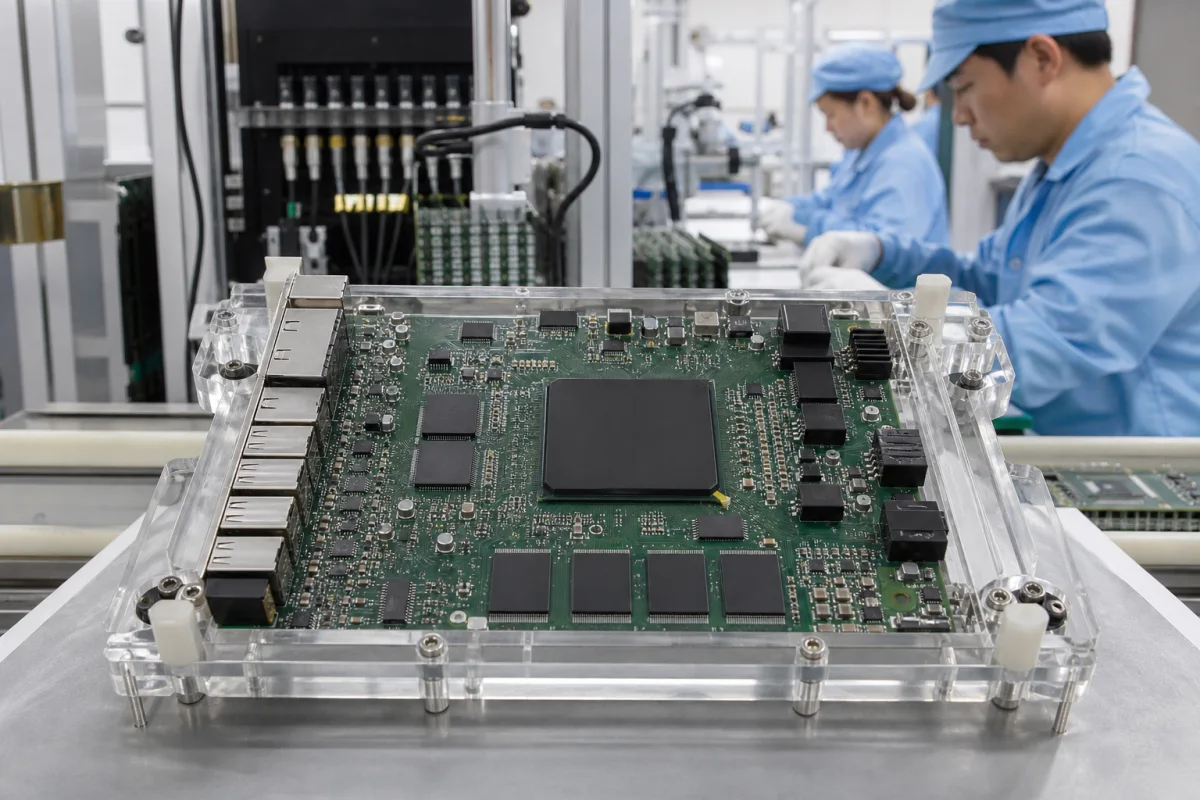
Product Specifications

Technical details and manufacturing context for Protocol Engine

Definition
The Protocol Engine is a core functional block within Communication Interface Integrated Circuits (ICs) responsible for the real-time encoding, decoding, sequencing, error checking, and state management required by specific data communication protocols (e.g., SPI, I2C, UART, CAN, USB, Ethernet MAC). It handles the low-level timing, framing, and handshaking procedures, offloading these tasks from the main system processor to ensure reliable and efficient data transmission and reception.
Working Principle
The engine operates by following a defined protocol state machine. It typically consists of dedicated logic (hardwired or programmable) that: 1) Receives raw data/instructions from a system interface or buffer. 2) Encapsulates the data according to the protocol's frame structure (adding headers, footers, checksums). 3) Manages physical layer signaling (e.g., clock generation, bit banging) for serial transmission. 4) On reception, it synchronizes to the incoming signal, strips protocol framing, performs error detection (e.g., CRC check), and extracts the payload data for the host system. Its operation is often controlled via configuration registers and triggered by interrupts or DMA requests.
Common Materials
Silicon (Semiconductor Substrate)
Technical Parameters
  • Maximum supported data transfer rate (bandwidth) of the protocol. (Mbps) Per Request
Components / BOM
  • Protocol State Machine
    Controls the sequence of operations (idle, start, data transfer, stop/ack) as defined by the protocol.
    Material: Silicon (Logic Gates)
  • Shift Register
    Converts parallel data from the system bus to serial data for transmission, and vice-versa on reception.
    Material: Silicon (Flip-Flops)
  • Baud Rate Generator / Clock Controller
    Generates the precise internal clock signals required for bit timing and synchronization.
    Material: Silicon (Counters/PLI Logic)
  • Error Detection Unit
    Calculates and verifies checksums (e.g., CRC, parity) for data integrity.
    Material: Silicon (Combinational Logic)
  • Control & Status Registers
    Memory-mapped registers for configuring the engine (mode, speed) and reading its status (busy, error flags).
    Material: Silicon (Flip-Flops)
Engineering Reasoning
0-125°C ambient temperature, 1.8-3.3V supply voltage, 0-100MHz clock frequency
Junction temperature exceeding 150°C, supply voltage below 1.62V or above 3.63V, clock frequency exceeding 110MHz
Design Rationale: Thermal runaway due to semiconductor junction temperature exceeding silicon's maximum operating limit (150°C), electromigration at high frequencies causing interconnect degradation, latch-up from voltage transients exceeding safe operating area
Risk Mitigation (FMEA)
Trigger Electrostatic discharge (ESD) event exceeding 2kV HBM
Mode: Gate oxide breakdown in CMOS transistors
Strategy: Integrated ESD protection diodes with 8kV HBM rating and 500V CDM rating
Trigger Clock jitter exceeding 200ps peak-to-peak
Mode: Protocol synchronization loss and bit error rate exceeding 10^-3
Strategy: Phase-locked loop (PLL) with 50ps jitter tolerance and 0.1% frequency stability

Industry Taxonomies & Aliases

Commonly used trade names and technical identifiers for Protocol Engine.

Applied To / Applications

This component is essential for the following industrial systems and equipment:

Industrial Ecosystem & Supply Chain DNA

Complementary Systems
Downstream Applications
Specialized Tooling

Application Fit & Sizing Matrix

Operational Limits
pressure: Not applicable (electronic component)
other spec: Operating voltage: 1.8V to 3.3V, Clock frequency: up to 200 MHz, Protocol throughput: up to 1 Gbps
temperature: -40°C to +85°C (industrial grade), -40°C to +125°C (extended automotive/industrial)
Media Compatibility
✓ Ethernet/IP industrial networks ✓ CAN bus automotive systems ✓ Modbus RTU/ASCII serial communications
Unsuitable: High-voltage electrical environments without proper isolation (risk of electrical noise and signal corruption)
Sizing Data Required
  • Required protocol standards (e.g., Ethernet, CAN, Modbus)
  • Data throughput requirements (bps)
  • Number of simultaneous communication channels needed

Reliability & Engineering Risk Analysis

Failure Mode & Root Cause
Overheating and thermal degradation
Cause: Inadequate cooling system performance, excessive ambient temperatures, or prolonged operation beyond design thermal limits leading to material fatigue and electronic component failure.
Corrosion and chemical attack
Cause: Exposure to aggressive process fluids, moisture ingress, or incompatible chemical environments causing material deterioration and functional impairment.
Maintenance Indicators
  • Unusual high-frequency vibrations or audible knocking sounds during operation
  • Visible fluid leaks, discoloration, or abnormal smoke/steam emission from the unit
Engineering Tips
  • Implement predictive maintenance using vibration analysis and thermal imaging to detect early-stage abnormalities before catastrophic failure
  • Establish strict fluid compatibility protocols and install proper filtration systems to prevent contamination-induced degradation

Compliance & Manufacturing Standards

Reference Standards
ISO 9001:2015 Quality Management Systems ISO/IEC 17025:2017 Testing and Calibration Laboratories CE Marking (EU Machinery Directive 2006/42/EC)
Manufacturing Precision
  • Dimensional Accuracy: +/-0.05mm for critical interfaces
  • Surface Finish: Ra 0.8μm maximum for sealing surfaces
Quality Inspection
  • Functional Performance Testing under simulated operating conditions
  • Material Verification via X-ray Fluorescence (XRF) Analysis

Factories Producing Protocol Engine

Verified manufacturers with capability to produce this product in China

✓ 95% Supplier Capability Match Found

P Procurement Specialist from Brazil Jan 07, 2026
★★★★★
"Found 53+ suppliers for Protocol Engine on CNFX, but this spec remains the most cost-effective."
Technical Specifications Verified
T Technical Director from Canada Jan 04, 2026
★★★★★
"The technical documentation for this Protocol Engine is very thorough, especially regarding technical reliability."
Technical Specifications Verified
P Project Engineer from United States Jan 01, 2026
★★★★★
"Reliable performance in harsh Computer, Electronic and Optical Product Manufacturing environments. No issues with the Protocol Engine so far."
Technical Specifications Verified
Verification Protocol

“Feedback is collected from verified sourcing managers during RFQ (Request for Quote) and factory evaluation processes on CNFX. These reports represent historical performance data and technical audit summaries from our B2B manufacturing network.”

16 sourcing managers are analyzing this specification now. Last inquiry for Protocol Engine from UAE (17m ago).

Supply Chain Compatible Machinery & Devices

Industrial Smart Camera Module

Embedded vision system for industrial automation and quality inspection.

Explore Specs →
Industrial Wireless Power Transfer Module

Wireless power transfer module for industrial equipment applications

Explore Specs →
Industrial Smart Sensor Module

Modular industrial sensor with embedded processing and wireless connectivity

Explore Specs →
Surface Mount Resistor

Passive electronic component for current limiting and voltage division in circuits

Explore Specs →

Frequently Asked Questions

What is a Protocol Engine in Communication Interface ICs?

A Protocol Engine is a specialized hardware or firmware module embedded within Communication Interface Integrated Circuits (ICs) that implements, manages, and executes specific communication protocols, handling tasks like data framing, error detection, and timing control.

What are the key components of a Protocol Engine?

Key components include a Protocol State Machine for managing protocol states, a Shift Register for data serialization/deserialization, a Baud Rate Generator/Clock Controller for timing, an Error Detection Unit for data integrity, and Control & Status Registers for configuration and monitoring.

Why is silicon used as the material for Protocol Engines?

Silicon is used as the semiconductor substrate because it enables high-speed, reliable, and energy-efficient integration of complex digital logic, making it ideal for implementing protocol engines in compact, cost-effective ICs for electronic and optical products.

Can I contact factories directly on CNFX?

CNFX is an open directory, not a transaction platform. Each factory profile provides direct contact information and production details to help you initiate direct inquiries with Chinese suppliers.

Get Quote for Protocol Engine

Request technical pricing, lead times, or customized specifications for Protocol Engine directly from verified manufacturing units.

Your business information is encrypted and only shared with verified Protocol Engine suppliers.

Thank you! Your message has been sent. We'll respond within 1–3 business days.

Need to Manufacture Protocol Engine?

Connect with verified factories specializing in this product category

Add Your Factory Contact Us
Previous Product
Protocol Decoder
Next Product
Protocol Engine Core