Editorial Technical Reference

Communication Interface ICs

This page explains how Communication Interface ICs is classified within Computer, Electronic and Optical Product Manufacturing. Technical values and manufacturer relationships are research references; confirm the current specification and supplier evidence for each order.

Technical Definition & Core Assembly

Integrated circuits designed to manage and facilitate data exchange between the main processing board and external devices or networks.
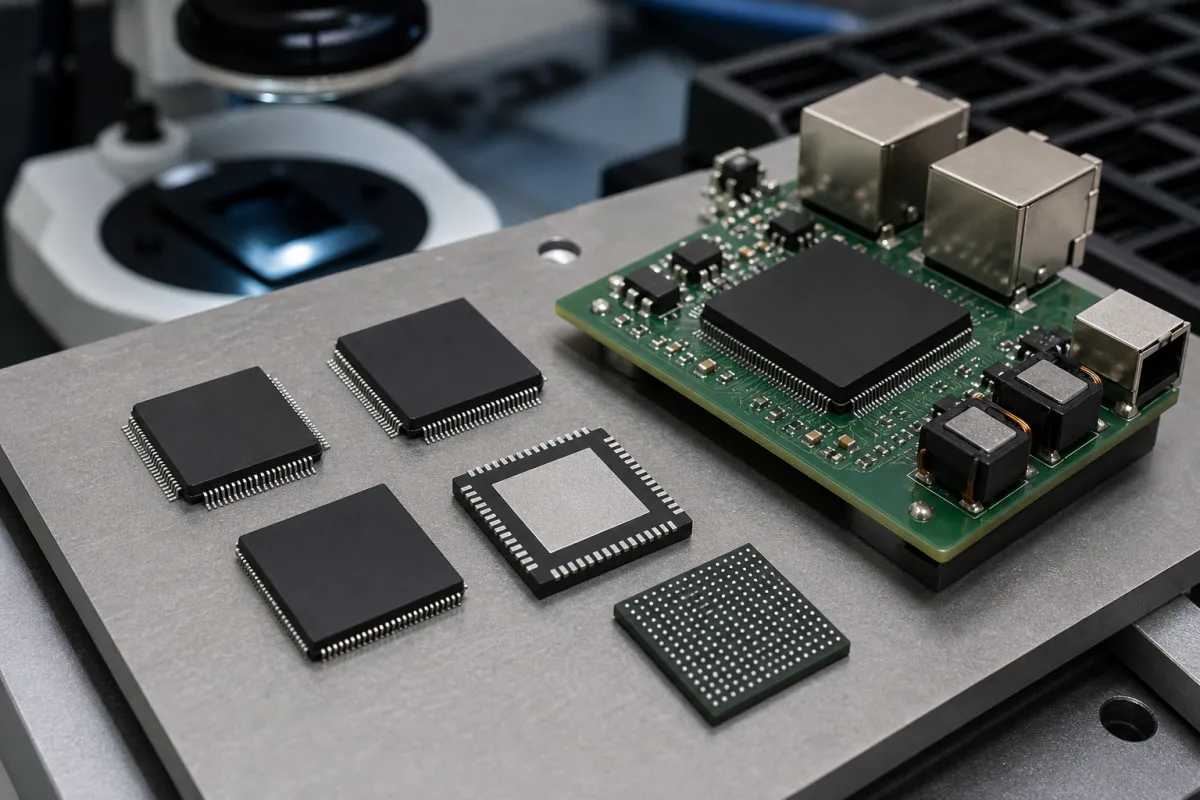
Representative product image. Confirm appearance and specifications with the manufacturer.

Product Specifications

Technical details and manufacturing context for Communication Interface ICs

Definition
Communication Interface ICs are specialized integrated circuits that serve as the intermediary for data transmission between the main processing board and various external communication channels. They implement specific communication protocols (such as UART, SPI, I2C, Ethernet, USB, CAN, etc.), handling signal conversion, timing, error checking, and data buffering to ensure reliable and efficient data transfer within industrial control systems, embedded devices, and computing platforms. These components are essential in computer, electronic, and optical product manufacturing, where they enable interoperability between different subsystems. The ICs are typically packaged in plastic or epoxy with copper interconnects on a silicon wafer, and they operate at data rates specified by the protocol, for example, up to 10 Mbps for Ethernet or 12 Mbps for USB Full Speed. When selecting a communication interface IC, engineers must verify the required protocol, data rate, voltage levels, and physical interface compatibility with the target application. It is crucial to confirm model-specific parameters and compliance with relevant standards with the legal manufacturer or supplier, as the directory provides general reference ranges only. Maintenance signals include intermittent communication failures, increased error rates, or overheating, which may indicate issues with the IC or its surrounding circuitry. Failure boundaries are defined by the IC's absolute maximum ratings and operating conditions; exceeding these can lead to permanent damage. For verification, consult the datasheet and application notes from the manufacturer to ensure proper integration and reliability.
Working Principle
These ICs operate by receiving digital or analog signals from the main processor, converting them into the appropriate format for the target communication protocol (e.g., serializing data, adding packet headers, modulating signals), and transmitting them via physical interfaces (pins, connectors). Conversely, they receive incoming signals, demodulate/decode them according to the protocol, perform error detection/correction, and present clean digital data to the processor. They often include built-in buffers, clock generators, and voltage level translators to manage timing and electrical compatibility.
Common Materials
Silicon wafer, Copper interconnects, Plastic/epoxy packaging
Technical Parameters

What to specify in your RFQ

  • Maximum data transfer rate supported by the communication protocol (e.g., 10 Mbps for Ethernet, 12 Mbps for USB Full Speed). in Mbps

These are the quantities to specify to the manufacturer when sizing or requesting a quote. The manufacturer's own documentation governs the exact figures and applicable standard.

Components / BOM
  • Transceiver
    Converts internal logic-level signals to/from the voltage levels required for the physical communication medium (e.g., RS-232, RS-485, CAN bus).
    Material: Silicon with integrated drivers/receivers
  • Protocol Engine
    Hardware logic that implements the specific communication protocol, handling framing, addressing, error checking, and flow control.
    Material: Silicon logic gates
  • FIFO Buffer Part
    Temporary memory storage (First-In-First-Out) to hold data during transmission or reception, smoothing out rate differences between the processor and the communication line.
    Material: SRAM cells on silicon
  • Clock Generator / PLL
    Generates precise clock signals required for data sampling, bit timing, and synchronization in synchronous protocols.
    Material: Silicon with oscillator circuits
  • I/O Pads & ESD Protection Part
    Physical connection points (bond pads) to the IC package pins, with built-in electrostatic discharge (ESD) protection circuits to prevent damage.
    Material: Aluminum/copper pads with silicon diodes/transistors
  • Voltage Level Translator
    Shifts logic levels so the IC can talk to devices running at different voltages.

Applied To / Applications

This component is essential for the following industrial systems and equipment:

Industrial Ecosystem & Supply Chain Structure

Complementary Systems
Downstream Applications
Specialized Tooling

Application Fit & Sizing Matrix

Operational Limits
voltage: 1.8V to 5.5V typical operating range
data rate: Up to 10 Gbps for high-speed interfaces, 100 Mbps to 1 Gbps for standard interfaces
temperature: -40°C to +125°C (industrial grade), -40°C to +85°C (commercial grade)
power consumption: 10 mW to 500 mW depending on protocol and speed
Media Compatibility
✓ Ethernet networks (IEEE 802.3) ✓ CAN bus automotive systems ✓ RS-485 industrial automation networks
Unsuitable: High-voltage power transmission environments (>1000V) due to EMI susceptibility and isolation requirements
Sizing Data Required
  • Required communication protocol (e.g., UART, SPI, I2C, Ethernet, CAN)
  • Maximum data transfer rate (bps)
  • Power supply voltage and power budget constraints

Reliability & Engineering Risk Analysis

Failure Mode & Root Cause
Thermal Overstress
Cause: Excessive heat generation due to poor thermal management, high ambient temperatures, or overcurrent conditions, leading to material degradation and eventual failure.
Electrostatic Discharge (ESD) Damage
Cause: Accumulation and sudden discharge of static electricity during handling, installation, or operation, causing immediate or latent damage to sensitive semiconductor structures.
Maintenance Indicators
  • Intermittent or complete loss of data transmission, often accompanied by error messages or communication timeouts in the connected system.
  • Abnormal heating of the IC package detected via thermal imaging or touch, indicating potential overcurrent or internal short circuits.
Engineering Tips
  • Implement robust thermal management: Use appropriate heat sinks, ensure adequate airflow, and avoid placing ICs near high-temperature components to maintain optimal operating temperatures.
  • Enforce strict ESD protection protocols: Use grounded workstations, anti-static packaging, and proper handling procedures during all maintenance and installation activities.

Indicative industry ranges for design and RFQ preparation. Confirm the exact figures and applicable standard with the manufacturer before specifying.

Compliance & Manufacturing Standards

Applicable Standards
IEC 60747-14-1:2020 - Semiconductor devices - Part 14-1: Semiconductor sensors - Generic specification for sensors CE Marking - Directive 2014/35/EU (Low Voltage Directive) and 2014/30/EU (EMC Directive)

Quoted from the published standard.

Manufacturing Precision
  • Package dimensions: +/- 0.1mm
  • Lead coplanarity: 0.1mm maximum
Quality Inspection
  • Automated Optical Inspection (AOI) for solder joints and component placement
  • Electrical testing for signal integrity and protocol compliance

Manufacturers of Communication Interface ICs

Manufacturer profiles associated with Communication Interface ICs.

Sourcing Communication Interface ICs from China?
Tell us your specification and target quantity — we will match it against manufacturer records and come back with the factories that fit.
Request manufacturers We manufacture this

Manufacturer listings support early research and capability understanding. They are not certification, ranking, or transaction guarantees.

Technical documentation
Request current drawings, revision history, and a signed specification sheet.
Manufacturing capability
Verify equipment lists, process limits, capacity, and representative production evidence.
Inspection readiness
Confirm test methods, calibrated equipment, sampling plans, and traceable reports.
Supplier transparency
Check the legal entity, factory address, ownership, certifications, and direct contacts.

CNFX does not score or rank suppliers. Buyers must verify all claims and documents with the legal manufacturer before ordering.

Supply Chain Compatible Machinery & Devices

Modular Industrial Edge Computing Device

This modular industrial edge computing device is a ruggedized system designed for deployment in harsh industrial environments to perform real-time data processing, analytics, and control functions at the network edge.

Explore Specs →
Industrial Smart Camera Module

The Industrial Smart Camera Module is a compact, self-contained vision processing unit designed for integration into industrial machinery and production lines.

Explore Specs →
Surface Mount Resistor

Passive electronic component for current limiting and voltage division in circuits

Explore Specs →
Surface Mount Capacitor

A surface mount capacitor is a fundamental electronic component used for energy storage, filtering, coupling, and decoupling in electronic circuits.

Explore Specs →

Frequently Asked Questions

What communication protocols do these ICs support?

They support protocols such as UART, SPI, I2C, Ethernet, USB, and CAN, among others. The specific protocols implemented depend on the IC model and its intended application.

How do I select the right communication interface IC for my design?

Consider the required communication protocol, data rate, voltage levels, and physical interface compatibility. Always verify model-specific parameters and standards with the manufacturer or supplier.

What are common signs of failure in these ICs?

Intermittent communication failures, increased error rates, or overheating can indicate issues. Check the IC's operating conditions and surrounding circuitry.

Are these ICs compliant with industry standards?

Compliance depends on the specific model and manufacturer. Always verify standards and certifications with the legal manufacturer or supplier before procurement.

Data Basis

Editorial classification, named public sources where available, and source-reviewed manufacturer records.

Preliminary Technical Classification
This page supports structured research, RFQ preparation, and supplier evaluation. It does not replace buyer-led supplier qualification, standards review, or technical approval.
Buyer enquiry

Request manufacturing insight for Communication Interface ICs

Ask for use case, specification boundaries, supplier type, and RFQ preparation information for this product.

Where it goes
Straight to the CNFX editorial desk, and to the manufacturer if this product is linked to a claimed profile. Nothing is broadcast to a supplier list.
Your details stay here
We do not sell or rent enquiry data, and we do not add you to a mailing list. Used only to answer this request.
No commission, no middleman
CNFX is a directory. We take no cut of any order and never negotiate on a supplier's behalf.
What we don't claim
A listing is not an endorsement. Qualify every supplier and verify every figure yourself before ordering.

Your business information is used only to process this request.

Thank you! Your message has been sent. We'll respond within 1–3 business days.
Sorry, we couldn't send your message. Please try again, or email us at contact@cnfx.com.

Need to Manufacture Communication Interface ICs?

Compare manufacturer profiles with relevant product and process capability.

Previous Product
XY Positioning Stage
Last Product
Get QuotesChat