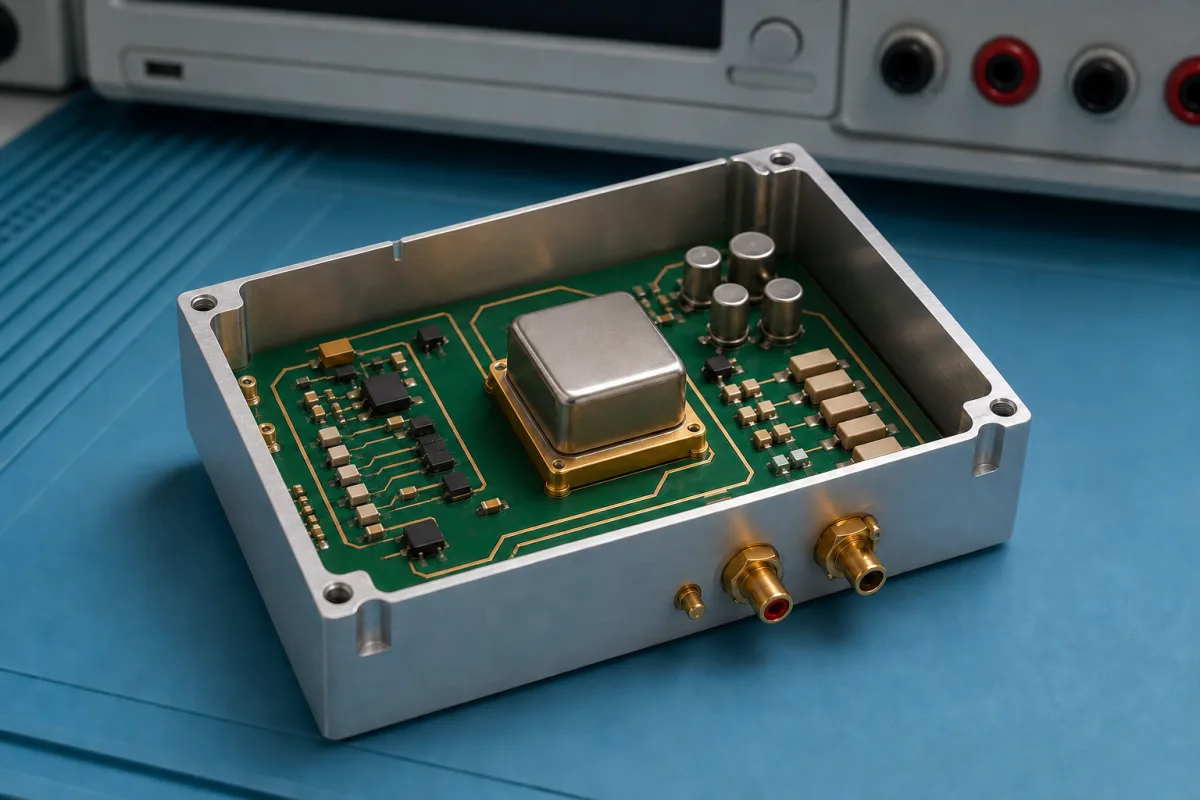
Voltage reference ICs · Series or shunt topology, output voltage, initial accuracy and temperature coefficient, noise, long-term stability and hysteresis, operating and quiescent current, temperature range and package
A voltage reference IC produces a precise, stable voltage that ADCs, DACs, sensors and power supplies measure against, so its accuracy and drift set the accuracy of the whole measurement. Settle three things before choosing one: series or shunt topology and the output voltage, the accuracy, drift, noise and stability your error budget allows, and the supply and load current, temperature range and package.
Series and shunt voltage reference ICs for data converters, sensors, instrumentation and power-supply control. Current references, voltage regulators (LDOs and switching regulators), reference standards and calibrators as instruments are outside this page; low-dropout regulators have their own page.
CNFX editorial research · Sources checked October 12, 2026 · 4 sources
TI's REF35 datasheet describes a family of nanopower, low-drift series references with output options of 1.024, 1.2, 1.25, 1.6, 1.8, 2.048, 2.5, 3.0, 3.3, 4.096 and 5.0 V, initial accuracy of ±0.05% maximum, temperature coefficient of 12 ppm/°C maximum (−40 to 105 °C, SOT-23) or 10 ppm/°C (−40 to 85 °C, WCSP), 1/f output noise of 3.3 ppm p-p (0.1–10 Hz), long-term stability of 40 ppm at 1,000 hours and thermal hysteresis of 70 ppm. [1]
TI's LM4040 datasheet describes a precision micropower shunt reference with fixed reverse-breakdown voltages of 2.048, 2.5, 3, 4.096, 5, 8.192 and 10 V; for the 2.5 V A grade it lists ±0.1% output tolerance at 25 °C, 35 µV rms noise (10 Hz–10 kHz), an operating current range of 60 µA to 15 mA and 100 ppm/°C maximum temperature coefficient, needing no output capacitor and tolerating capacitive loads. [2]
Editorial calculation: for a 2.5 V REF35, ±0.05% is ±1.25 mV and 12 ppm/°C over a 60 °C swing adds up to 2.5 × 12 × 60 × 10⁻⁶ ≈ 1.8 mV; a 16-bit ADC on a 2.5 V reference has an LSB of about 38 µV, so reference error, not ADC resolution, sets absolute accuracy unless the system is calibrated. [1]
Give the supplier the output voltage, series or shunt topology, initial accuracy, temperature coefficient over your range, noise band, long-term stability and hysteresis, supply voltage and load current (or shunt current range), quiescent current budget, enable or noise-reduction pins, temperature range, qualification grade, package and quantity.
02
Check current, stability, temperature and package
The REF35 lists 650 nA (typ.) quiescent current, output current of +10 mA source and −5 mA sink, input voltage from VREF plus dropout up to 6 V, an NR pin to reduce noise and an EN pin to cut shutdown current, operation from −55 to 125 °C, and 6-pin SOT-23 or 4-pin WCSP packages, for flow transmitters, glucose monitors, servo drives, power-quality analysers and oscilloscopes. [1]
The LM4040 comes in SOT-23, TO-92 and SC70 packages, in industrial (−40 to 85 °C) and extended (−40 to 125 °C) grades, with an AEC-Q100 automotive version. [2]
Editorial note: a shunt reference draws its current through a series resistor whether or not the load needs it, so compare the total supply current of a shunt design against a series reference's quiescent current for battery products. [2][1]
03
Add up drift, accuracy and noise into an error budget
SGMICRO's product page for its SGM4029 low-noise, low-drift precision series reference lists temperature drift of 5 ppm/°C (typ.) and 10 ppm/°C maximum over −40 to +125 °C, and 3 ppm/°C (typ.) over 0 to 85 °C; initial accuracy of ±0.05% (typ.) and ±0.1% maximum; noise of 4.5 µVp-p per volt of output; ±10 mA output current (source or sink); and a green SOIC-8 package. [3] It lists data acquisition, test and lab instruments, industrial process control, medical equipment and temperature and pressure transmitters as applications. [3]
Comparing two makers' parts on the same lines shows the trade-off between initial accuracy, drift, current and power: the REF35 is specified for 650 nA quiescent current, while the SGM4029 is positioned for low noise and ±10 mA drive. [3][1]
Editorial calculation: for an example 2.5 V output, ±0.1% initial error is ±2.5 mV; a 10 ppm/°C maximum drift over the 165 °C span from −40 to +125 °C adds up to 1,650 ppm (about 4.1 mV); noise of 4.5 µVp-p/V is about 11 µVp-p. For a 16-bit converter with a 2.5 V range, one LSB is about 38 µV, so drift and initial error dominate unless calibrated out.
Figure
SGM4029 (SGMICRO)
REF35 (TI, above)
Initial accuracy, max
±0.1%
±0.05%
Temperature coefficient, max
10 ppm/°C (−40 to 125 °C)
12 ppm/°C
Output current
±10 mA
+10 mA / −5 mA
Noise
4.5 µVp-p per V
See datasheet
Package
SOIC-8
See datasheet
State the output voltage, the temperature range the system sees, whether one-point calibration is possible, and the converter resolution, and ask for initial accuracy, drift (with method), noise, long-term stability and current figures for the exact grade.
04
When the budget is tighter: a laser-compensated zener reference for 16- to 18-bit converters
Apex Microtechnology's VRE302 page describes a zener-based +2.5 V reference whose accuracy comes from a proprietary multipoint laser compensation technique. The headline lists ±0.40 mV (0.016%) output accuracy, drift as low as 1.0 ppm/°C, 1.5 µVp-p noise from 0.1 to 10 Hz, 6 ppm/V (typ.) line regulation and output trim capability; the description gives ±0.6 mV (0.024%) initial accuracy for the series. [4] Apex recommends the series as a reference for 14-, 16- or 18-bit D/A converters that need an external precision reference, and for calibrating the scale factor of high-resolution A/D converters. The two listed variants, VRE302JD (8-pin DIP) and VRE302JS (8-pin SMT), are each ±0.6 mV initial error and 2.2 ppm/°C over −40 to 85 °C. [4]
Editorial calculation: for a VRE302JD, 2.2 ppm/°C over the 125 °C span from −40 to 85 °C allows up to 2.5 V × 2.2 × 125 × 10⁻⁶ ≈ 0.69 mV, and with ±0.6 mV initial error the worst case is about 1.3 mV. On the same 2.5 V output the SGM4029 example above reached about 2.5 mV initial plus 4.1 mV drift over a wider span. Against a 16-bit, 2.5 V converter's 38 µV LSB, even the zener part's 0.69 mV drift is about 18 LSB, so specify whether the system calibrates at one temperature or must hold accuracy uncalibrated. [4][3]
Read the page's own figures carefully: its headline and its variant table give different initial accuracy (±0.40 mV against ±0.6 mV) and drift (1.0 against 2.2 ppm/°C), because the best figures apply to particular models and grades. Order by full part number and ask the supplier for the guaranteed values of that grade, not the series headline. [4]
SGMICRO and 3PEAK reference families, and the grade data to ask any maker for
SGMICRO lists the SGM4020, SGM4027, SGM4029, SGM4030 and SGM4040 references; 3PEAK lists shunt references including the TPR433-S and TPR6040.
Ask each supplier for the datasheet with initial accuracy, temperature coefficient and its test method (box or slope), noise, long-term stability, hysteresis and current figures for the grade you order. [1][2]
06
Reference core, series output stage, shunt element, NR and EN pins, package
The package row reaches into the drift figure: TI quotes the REF35 at 12 ppm/°C maximum in SOT-23 over −40 to 105 °C and 10 ppm/°C in WCSP over −40 to 85 °C. [1]
5 companies list this product among what they make. Company figures are quoted from each
company's own website; every card states where the relationship came from.
SG Micro (Beijing) Co., Ltd.
Manufacturing site to be confirmed for the order
Lists voltage references including SGM4020, SGM4027, SGM4029, SGM4030 and SGM4040.
Explore company information and manufacturing capabilities, then discuss the scope of your project with a relevant supplier.
Share this page
Compiled and source-reviewed by the CNFX editorial team.
Each manufacturer above links to the page on that company's own website where the product is listed, with the date we checked it. How we source and review
· Page last updated 13 October 2026
Buyer questions
What is the difference between series and shunt voltage references?
A series reference such as TI's REF35 supplies the load from its output; a shunt reference such as the LM4040 regulates across a resistor over a current range (60 µA–15 mA). [1][2]
How accurate are voltage references?
The REF35 lists ±0.05% initial accuracy and 12 ppm/°C maximum drift. [1]
How little current can a voltage reference use?
The REF35 lists 650 nA (typ.) quiescent current. [1]
Which voltages are available?
The REF35 offers 1.024 to 5.0 V options and the LM4040 2.048 to 10 V. [1][2]
How much error does a 10 ppm/°C reference add over temperature?
Over −40 to +125 °C, 10 ppm/°C allows up to 1,650 ppm, about 4.1 mV on a 2.5 V reference (editorial calculation from SGMICRO's SGM4029 figures). [3]
Which voltage references suit 16- to 18-bit converters?
Apex Microtechnology recommends its zener-based VRE302 (+2.5 V, ±0.6 mV, 2.2 ppm/°C over −40 to 85 °C for the listed variants, 1.5 µVp-p noise) for 14-, 16- or 18-bit D/A converters. [4]
Sources and what still needs a direct check
Sources checked 2026-10-12. Texas Instruments' REF35 series reference and LM4040 shunt reference datasheets, SGMICRO's SGM4029 page and Apex Microtechnology's VRE302 page are used to show what a voltage reference specification covers; values for your order must come from the supplier's datasheet.