Editorial Technical Reference

ADC Converter

This page explains how ADC Converter is classified within Computer, Electronic and Optical Product Manufacturing. Technical values and manufacturer relationships are research references; confirm the current specification and supplier evidence for each order.

Technical Definition & Core Assembly

Electronic device that converts continuous analog signals into discrete digital values for processing by digital systems.
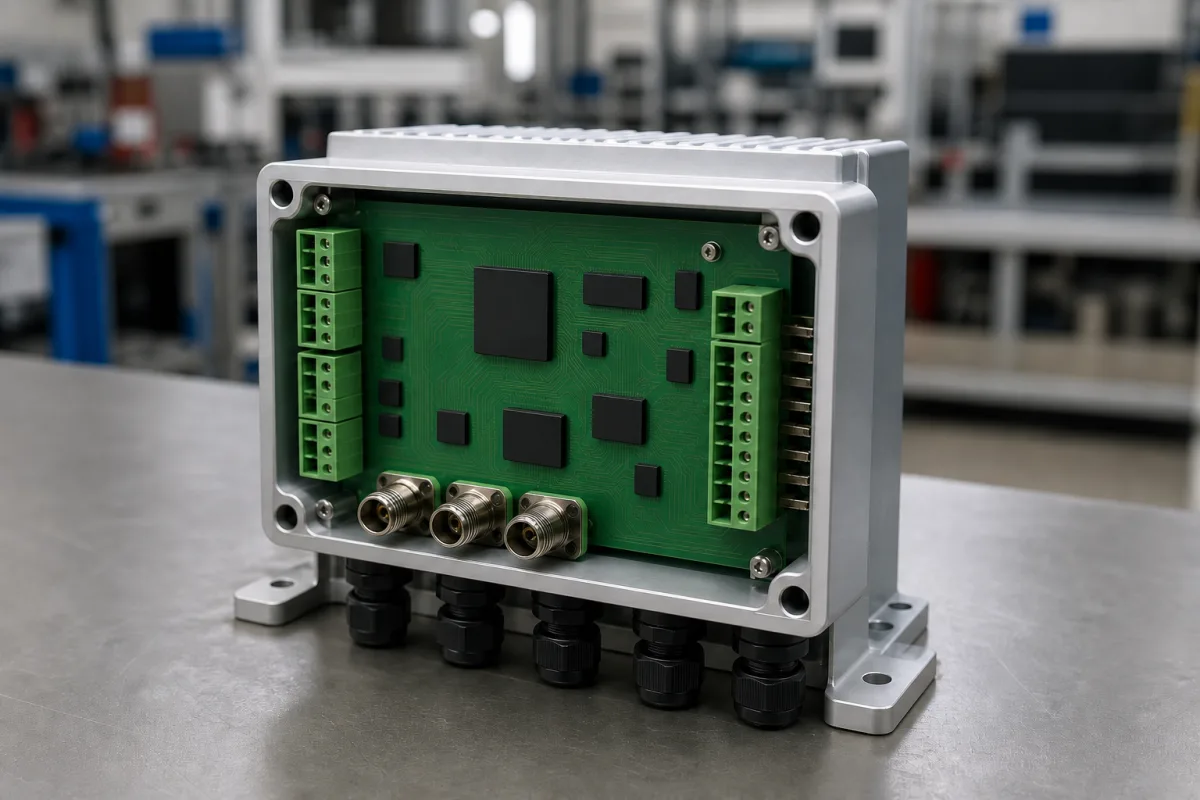
ADC Converter in a manufacturing environment
Representative product image. Confirm appearance and specifications with the manufacturer.

Product Specifications

Technical details and manufacturing context for ADC Converter

Definition
An ADC (Analog-to-Digital Converter) is a critical component within Data Acquisition Systems (DAS) that transforms real-world analog signals—such as voltage, current, temperature, or pressure—into digital data that can be processed, stored, and analyzed by computers, microcontrollers, or digital signal processors. It serves as the bridge between the physical analog world and digital computing systems. This directory entry covers general-purpose ADC converters used in industrial, commercial, and research applications. The device is typically manufactured as an integrated circuit (IC) using semiconductor silicon, with copper leads and plastic encapsulation. Key parameters to consider when selecting an ADC include resolution (8–24 bits), sampling rate (10–1000 kSPS), input voltage range (0–5 V, unipolar or bipolar), supply voltage (2.7–5.5 V DC), power consumption (0.5–100 mW at max sampling rate), integral nonlinearity (±0.5 to ±4 LSB), signal-to-noise ratio (50–100 dB), operating temperature range (-40 to 85 °C), input impedance (10–100 MΩ), package type (SOIC-8 to QFN-48), and weight (0.1–2.0 g). These values are typical ranges; actual specifications vary by model and must be verified with the manufacturer or supplier. The ADC operates by sampling the analog input at regular intervals, quantizing each sample to the nearest discrete level based on its resolution, and encoding these levels into binary digital output. Common conversion methods include successive approximation, delta-sigma modulation, and flash conversion, each offering different trade-offs between speed, accuracy, and cost. When integrating an ADC, consider the interface (parallel, serial SPI, I2C, etc.), reference voltage, and anti-aliasing filtering. Verification questions include: What is the required resolution and sampling rate? What is the input signal range and impedance? What are the power supply and temperature constraints? Maintenance signals include drift in output codes, increased noise, or failure to meet specified INL/SNR. Failure boundaries include exceeding absolute maximum ratings, such as supply voltage or input voltage beyond specified limits, which can cause permanent damage. Always consult the datasheet and confirm model-specific values with the legal manufacturer or supplier.
Working Principle
The ADC Converter samples the continuous analog input signal at regular intervals, quantizes each sample to the nearest discrete level based on its resolution, and encodes these levels into binary digital output values. Common conversion methods include successive approximation, delta-sigma modulation, and flash conversion, each with different trade-offs between speed, accuracy, and cost. The sampling rate determines how many samples per second are taken, while resolution defines the number of discrete levels. The input voltage range must match the signal amplitude, and the supply voltage powers the internal circuitry. The output is a digital code that represents the analog input at each sampling instant.
Common Materials
Semiconductor silicon, Copper, Plastic encapsulation
Technical Parameters
ParameterTypical rangeNotes & selection driver
Resolution8–24 bitHigher resolution for finer quantization
Sampling Rate10–1000 kSPSMaximum samples per second
Input Voltage Range0–5 VUnipolar or bipolar options
Supply Voltage2.7–5.5 V DCSingle supply operation
Power Consumption0.5–100 mWAt max sampling rate
Integral Nonlinearity (INL)±0.5–±4 LSBDeviation from ideal transfer function
Signal-to-Noise Ratio (SNR)50–100 dBHigher is better for dynamic range
Operating Temperature Range-40–85 °CIndustrial grade
Input Impedance10–100 High impedance for minimal loading
Package TypeSOIC-8–QFN-48Surface mount options
Weight0.1–2.0 gDepends on package

Ranges are indicative industry figures for RFQ preparation, not a supplier commitment. Confirm every value and standard with the legal manufacturer before ordering.

Components / BOM
  • Sample and Hold Circuit
    Captures and maintains a stable analog input voltage during the conversion process to prevent errors from signal fluctuations.
    Material: Semiconductor components
  • Quantizer
    Compares the sampled analog value to reference levels and determines the closest discrete digital value based on the converter's resolution.
    Material: Comparator circuits, reference voltage sources
  • Encoder
    Converts the quantized level into a binary digital output code that represents the analog input value.
    Material: Digital logic circuits
  • Reference Voltage Source
    Provides stable voltage references against which the analog input is compared during the quantization process.
    Material: Precision voltage regulators, bandgap references

Applied To / Applications

This component is essential for the following industrial systems and equipment:

Industrial Ecosystem & Supply Chain Structure

Complementary Systems
Downstream Applications
Specialized Tooling

Application Fit & Sizing Matrix

Operational Limits
pressure: Not applicable (electronic device)
other spec: Sampling rate: 1 kSPS to 10 GSPS, Resolution: 8-bit to 24-bit, Power supply: 1.8V to 5V
temperature: -40°C to +85°C (industrial grade), -55°C to +125°C (military grade)
Media Compatibility
✓ Clean electrical signals (e.g., sensor outputs) ✓ Low-voltage analog circuits ✓ Laboratory measurement systems
Unsuitable: High-voltage industrial environments without proper isolation/protection
Sizing Data Required
  • Required sampling rate (Hz)
  • Required resolution (bits)
  • Input voltage range (V)

Reliability & Engineering Risk Analysis

Failure Mode & Root Cause
Signal distortion or loss
Cause: Degradation of analog input components (e.g., op-amps, filters) due to thermal stress, aging, or contamination, leading to inaccurate digital output.
Complete conversion failure
Cause: Power supply instability or voltage spikes damaging internal circuitry, or clock signal degradation causing timing errors in the conversion process.
Maintenance Indicators
  • Inconsistent or erratic digital output readings under stable analog input conditions
  • Audible high-frequency noise or visible overheating in the converter module
Engineering Tips
  • Implement regular calibration and signal integrity checks using precision reference sources to detect early performance drift.
  • Ensure robust power conditioning (e.g., filtering, regulation) and thermal management (e.g., heatsinks, airflow) to protect sensitive electronic components.

Indicative industry ranges for design and RFQ preparation. Confirm the exact figures and applicable standard with the manufacturer before specifying.

Compliance & Manufacturing Standards

Applicable Standards
IEC 60747-8: Integrated circuits - Interface circuits - Part 8: Analog-to-digital converters CE marking per EU EMC Directive 2014/30/EU for electromagnetic compatibility

Quoted from the published standard.

Manufacturing Precision
  • Linearity error: +/-0.5 LSB (Least Significant Bit)
  • Full-scale error: +/-0.1% of full-scale range
Quality Inspection
  • Dynamic performance test (SINAD, THD, ENOB measurement)
  • Environmental stress screening (temperature cycling, vibration testing)

Manufacturers of ADC Converter

Manufacturer profiles associated with ADC Converter.

Sourcing ADC Converter from China?
Tell us your specification and target quantity — we will match it against manufacturer records and come back with the factories that fit.
Request manufacturers We manufacture this

Manufacturer listings support early research and capability understanding. They are not certification, ranking, or transaction guarantees.

Share this page
Technical documentation
Request current drawings, revision history, and a signed specification sheet.
Manufacturing capability
Verify equipment lists, process limits, capacity, and representative production evidence.
Inspection readiness
Confirm test methods, calibrated equipment, sampling plans, and traceable reports.
Supplier transparency
Check the legal entity, factory address, ownership, certifications, and direct contacts.

CNFX does not score or rank suppliers. Buyers must verify all claims and documents with the legal manufacturer before ordering.

Supply Chain Compatible Machinery & Devices

Industrial Smart Camera Module

The Industrial Smart Camera Module is a compact, self-contained vision processing unit designed for integration into industrial machinery and production lines.

Explore Specs →
Surface Mount Resistor

Passive electronic component for current limiting and voltage division in circuits

Explore Specs →
Surface Mount Capacitor

A surface mount capacitor is a fundamental electronic component used for energy storage, filtering, coupling, and decoupling in electronic circuits.

Explore Specs →
Surface Mount Technology (SMT) Pick-and-Place Machine

Automated machine that precisely places electronic components onto printed circuit boards.

Explore Specs →

Frequently Asked Questions

What is the difference between resolution and sampling rate?

Resolution (in bits) determines how finely the analog signal is quantized; higher resolution means more discrete levels. Sampling rate (in kSPS) indicates how many samples are taken per second. Both affect the accuracy and fidelity of the digital representation, but they are independent parameters.

How do I choose the right input voltage range?

The input voltage range should match the amplitude of your analog signal. If the signal exceeds the range, it may be clipped or damage the ADC. If it is too small, you may not use the full resolution. Check the datasheet for unipolar or bipolar options and ensure the signal is within the specified range.

What is integral nonlinearity (INL) and why does it matter?

INL is the deviation of the actual transfer function from an ideal straight line, expressed in LSB. It indicates how accurately the ADC converts analog levels to digital codes. Lower INL values mean better linearity, which is important for precision measurements.

Can I use an ADC converter in high-temperature environments?

The operating temperature range for industrial-grade ADCs is typically -40 to 85 °C. If your application requires higher temperatures, you must select a device rated for that range. Always verify the temperature specifications with the manufacturer.

Data Basis

Editorial classification, named public sources where available, and source-reviewed manufacturer records.

Preliminary Technical Classification
This page supports structured research, RFQ preparation, and supplier evaluation. It does not replace buyer-led supplier qualification, standards review, or technical approval.
Buyer enquiry

Request manufacturing insight for ADC Converter

Ask for use case, specification boundaries, supplier type, and RFQ preparation information for this product.

Where it goes
Straight to the CNFX editorial desk, and to the manufacturer if this product is linked to a claimed profile. Nothing is broadcast to a supplier list.
Your details stay here
We do not sell or rent enquiry data, and we do not add you to a mailing list. Used only to answer this request.
No commission, no middleman
CNFX is a directory. We take no cut of any order and never negotiate on a supplier's behalf.
What we don't claim
A listing is not an endorsement. Qualify every supplier and verify every figure yourself before ordering.

Your business information is used only to process this request.

Thank you! Your message has been sent. We'll respond within 1–3 business days.
Sorry, we couldn't send your message. Please try again, or email us at [email protected].

Need to Manufacture ADC Converter?

Compare manufacturer profiles with relevant product and process capability.

Previous Product
XY Positioning Stage
Last Product
Get QuotesChat