Editorial Technical Reference

Reflow Oven Module

This page explains how Reflow Oven Module is classified within Computer, Electronic and Optical Product Manufacturing. Technical values and manufacturer relationships are research references; confirm the current specification and supplier evidence for each order.

Technical Definition & Core Assembly

A specialized heating module for soldering electronic components onto printed circuit boards (PCBs) in 5G base station manufacturing.

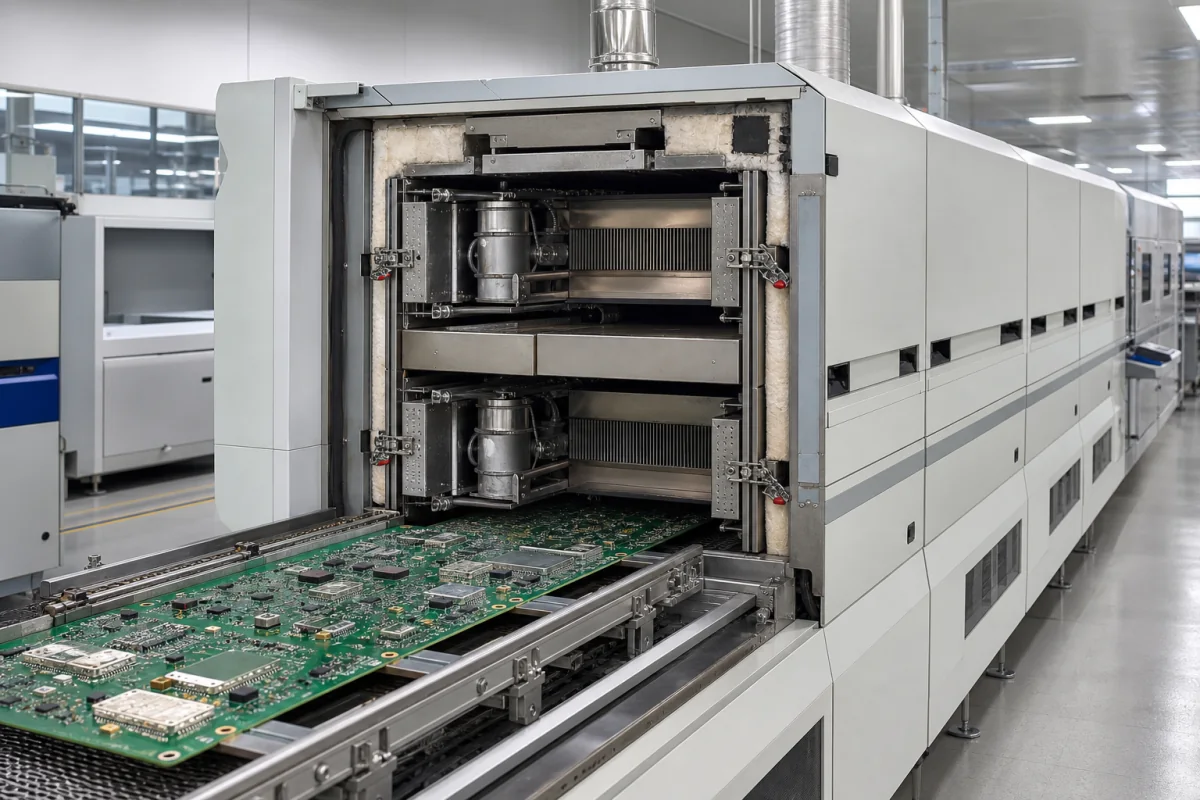
Representative product image. Confirm appearance and specifications with the manufacturer.

Product Specifications

Technical details and manufacturing context for Reflow Oven Module

Definition
The Reflow Oven Module is a critical component within the Modular 5G Base Station Production System, responsible for the precise thermal processing of assembled PCBs. It melts solder paste to form permanent electrical and mechanical connections between surface-mount devices (SMDs) and the PCB substrate, ensuring the reliability and performance of 5G radio units and control boards. The module transports PCBs on a conveyor through multiple controlled heating zones (preheat, soak, reflow, cooling). It uses heaters (infrared, convection, or vapor phase) to raise the board temperature according to a specific thermal profile, melting the solder paste without damaging sensitive components, then cools the assembly to solidify the joints. Key parameters include 8–12 heating zones, 2–4 cooling zones, a maximum conveyor speed of 1500–2500 mm/min, a conveyor width of 300–500 mm, a temperature range of 25–350°C, temperature uniformity of ±2°C, heating power of 30–60 kW, supply voltage of 380 V AC ±10% (three-phase, 50/60 Hz), nitrogen consumption of 15–30 m³/h (when using N2 for inert atmosphere), exhaust flow rate of 500–1000 m³/h, machine dimensions of 6000–10000 × 1200–1500 × 1500–1800 mm (L×W×H), and weight of 2000–4000 kg. Materials on file include stainless steel (housing/conveyor), ceramic insulators, quartz heating elements, and high-temperature silicone seals. These values are directory reference ranges and must be confirmed for the actual model and application with the legal manufacturer or supplier. The module is designed for integration into the production line, with interfaces for conveyor control, power supply, exhaust, and optional nitrogen. Verification questions should address thermal profile accuracy, uniformity, and compliance with applicable standards. Maintenance signals include temperature drift, uneven heating, or excessive exhaust flow. Failure boundaries include loss of temperature control, conveyor jams, or seal degradation.
Working Principle
The module transports PCBs on a conveyor through multiple controlled heating zones (preheat, soak, reflow, cooling). It uses heaters (infrared, convection, or vapor phase) to raise the board temperature according to a specific thermal profile, melting the solder paste without damaging sensitive components, then cools the assembly to solidify the joints. The conveyor speed and zone temperatures are set to achieve the required thermal profile, with temperature uniformity maintained across the PCB surface. The module may use nitrogen to create an inert atmosphere, reducing oxidation. Exhaust systems remove fumes generated during soldering.
Common Materials
Stainless Steel (housing/conveyor), Ceramic Insulators, Quartz Heating Elements, High-Temperature Silicone Seals
Technical Parameters
ParameterTypical rangeNotes & selection driver
Heating Zone Count8–12 zonesMore zones allow finer thermal profile control
Cooling Zone Count2–4 zonesCritical for solder joint solidification
Max Conveyor Speed1500–2500 mm/minDetermines throughput
Conveyor Width300–500 mmMust accommodate PCB size
Temperature Range25–350 °CPeak reflow temperature typically 245–260°C
Temperature Uniformity±2 °CAcross PCB surface for consistent soldering
Heating Power30–60 kWTotal installed heating capacity
Supply Voltage380 ±10% V ACThree-phase, 50/60 Hz
Nitrogen Consumption15–30 m³/hWhen using N2 for inert atmosphere
Exhaust Flow Rate500–1000 m³/hFor fume extraction
Machine Dimensions (L×W×H)6000–10000 × 1200–1500 × 1500–1800 mmFootprint for floor planning
Weight2000–4000 kgAffects installation and floor loading

Ranges are indicative industry figures for RFQ preparation, not a supplier commitment. Confirm every value and standard with the legal manufacturer before ordering.

Components / BOM
  • Heating Zone
    Provides controlled radiant or convective heat to raise PCB temperature according to the thermal profile.
    Material: Stainless Steel housing with ceramic-insulated heating elements
  • Conveyor System
    Transports PCBs smoothly and consistently through all zones of the oven module.
    Material: Stainless Steel mesh or rail
  • Cooling Zone
    Rapidly cools the PCB after reflow to solidify solder joints and minimize thermal stress on components.
    Material: Aluminum heat sinks with forced air fans
  • Control Panel
    Interface for setting and monitoring temperature profiles, conveyor speed, and system status.
    Material: Stainless Steel enclosure with touchscreen
  • Exhaust System
    Draws off the flux fumes given off during reflow.
  • Nitrogen Inerting System Optional
    Fills the tunnel with nitrogen to hold oxidation down, on the versions that use it.

Industrial Ecosystem & Supply Chain Structure

Complementary Systems
Downstream Applications
Specialized Tooling

Application Fit & Sizing Matrix

Operational Limits
pressure: Atmospheric to 5 kPa (vacuum-capable for void reduction)
other spec: Heating rate: 1-4°C/sec, Cooling rate: 1-6°C/sec, Belt width: 300-500 mm, Nitrogen atmosphere: O2 < 1000 ppm
temperature: Ambient to 300°C (typical reflow profile: 150-250°C)
Media Compatibility
✓ Lead-free solder paste (SAC305) ✓ No-clean flux formulations ✓ FR-4 and high-Tg PCB substrates
Unsuitable: Corrosive or halogenated cleaning solvents (e.g., trichloroethylene)
Sizing Data Required
  • Maximum PCB dimensions (L x W x thickness)
  • Required throughput (boards/hour) and thermal profile
  • Power supply availability (voltage, phase, amperage)

Reliability & Engineering Risk Analysis

Failure Mode & Root Cause
Heater Element Degradation
Cause: Thermal cycling and oxidation leading to reduced heating efficiency or complete failure, often due to prolonged high-temperature operation or inadequate cooling cycles.
Conveyor Belt Wear or Misalignment
Cause: Friction, thermal expansion, and mechanical stress causing belt stretching, tracking issues, or component failure, typically from improper tensioning, debris accumulation, or worn drive mechanisms.
Maintenance Indicators
  • Inconsistent temperature profiles across heating zones, indicated by thermal mapping deviations or product quality issues like uneven soldering.
  • Unusual noises (e.g., grinding, squealing) from conveyor motors or bearings, or visible belt slippage/misalignment during operation.
Engineering Tips
  • Implement regular thermal profiling and calibration of heating zones to ensure uniform temperature distribution and prevent localized overheating or underheating.
  • Establish a preventive maintenance schedule for conveyor system components, including belt tension checks, lubrication of bearings and drives, and inspection for debris or wear.

Indicative industry ranges for design and RFQ preparation. Confirm the exact figures and applicable standard with the manufacturer before specifying.

Compliance & Manufacturing Standards

Applicable Standards
IPC-A-610 - Acceptability of Electronic Assemblies CE Marking - EU Directive 2014/35/EU (Low Voltage Directive)

Quoted from the published standard.

Manufacturing Precision
  • Temperature Uniformity: +/- 2°C across heating zones
  • Conveyor Speed Accuracy: +/- 1% of setpoint
Quality Inspection
  • Thermal Profiling Verification
  • Electrical Safety Testing (Insulation Resistance, Ground Continuity)

Manufacturers of Reflow Oven Module

Manufacturer profiles associated with Reflow Oven Module.

Sourcing Reflow Oven Module from China?
Tell us your specification and target quantity — we will match it against manufacturer records and come back with the factories that fit.
Request manufacturers We manufacture this

Manufacturer listings support early research and capability understanding. They are not certification, ranking, or transaction guarantees.

Technical documentation
Request current drawings, revision history, and a signed specification sheet.
Manufacturing capability
Verify equipment lists, process limits, capacity, and representative production evidence.
Inspection readiness
Confirm test methods, calibrated equipment, sampling plans, and traceable reports.
Supplier transparency
Check the legal entity, factory address, ownership, certifications, and direct contacts.

CNFX does not score or rank suppliers. Buyers must verify all claims and documents with the legal manufacturer before ordering.

Supply Chain Compatible Machinery & Devices

Industrial Smart Camera Module

The Industrial Smart Camera Module is a compact, self-contained vision processing unit designed for integration into industrial machinery and production lines.

Explore Specs →
Surface Mount Resistor

Passive electronic component for current limiting and voltage division in circuits

Explore Specs →
Surface Mount Capacitor

A surface mount capacitor is a fundamental electronic component used for energy storage, filtering, coupling, and decoupling in electronic circuits.

Explore Specs →
Surface Mount Technology (SMT) Pick-and-Place Machine

Automated machine that precisely places electronic components onto printed circuit boards.

Explore Specs →

Frequently Asked Questions

What is the typical temperature range for the reflow process?

The directory lists a temperature range of 25–350°C, with peak reflow temperature typically 245–260°C. However, the exact profile depends on the solder paste and components; verify with the manufacturer.

How many heating zones does the module have?

The module typically has 8–12 heating zones, allowing finer control of the thermal profile. Confirm the exact count for the specific model.

What is the maximum conveyor speed?

The maximum conveyor speed is listed as 1500–2500 mm/min, which determines throughput. Actual speed settings depend on the PCB design and thermal requirements.

Does the module support nitrogen atmosphere?

Yes, it can use nitrogen for an inert atmosphere, with consumption of 15–30 m³/h. This reduces oxidation during soldering. Verify nitrogen capability with the supplier.

Data Basis

Editorial classification, named public sources where available, and source-reviewed manufacturer records.

Preliminary Technical Classification
This page supports structured research, RFQ preparation, and supplier evaluation. It does not replace buyer-led supplier qualification, standards review, or technical approval.
Buyer enquiry

Request manufacturing insight for Reflow Oven Module

Ask for use case, specification boundaries, supplier type, and RFQ preparation information for this product.

Where it goes
Straight to the CNFX editorial desk, and to the manufacturer if this product is linked to a claimed profile. Nothing is broadcast to a supplier list.
Your details stay here
We do not sell or rent enquiry data, and we do not add you to a mailing list. Used only to answer this request.
No commission, no middleman
CNFX is a directory. We take no cut of any order and never negotiate on a supplier's behalf.
What we don't claim
A listing is not an endorsement. Qualify every supplier and verify every figure yourself before ordering.

Your business information is used only to process this request.

Thank you! Your message has been sent. We'll respond within 1–3 business days.
Sorry, we couldn't send your message. Please try again, or email us at contact@cnfx.com.

Need to Manufacture Reflow Oven Module?

Compare manufacturer profiles with relevant product and process capability.

Previous Product
XY Positioning Stage
Last Product
Get QuotesChat