Industry-Verified Manufacturing Data (2026)

RF Interface

Based on aggregated insights from multiple verified factory profiles within the CNFX directory, the standard RF Interface used in the Computer, Electronic and Optical Product Manufacturing sector typically supports operational capacities ranging from standard industrial configurations to heavy-duty production requirements.

Technical Definition & Core Assembly

A canonical RF Interface is characterized by the integration of Mixer and Filter. In industrial production environments, manufacturers listed on CNFX commonly emphasize Silicon construction to support stable, high-cycle operation across diverse manufacturing scenarios.

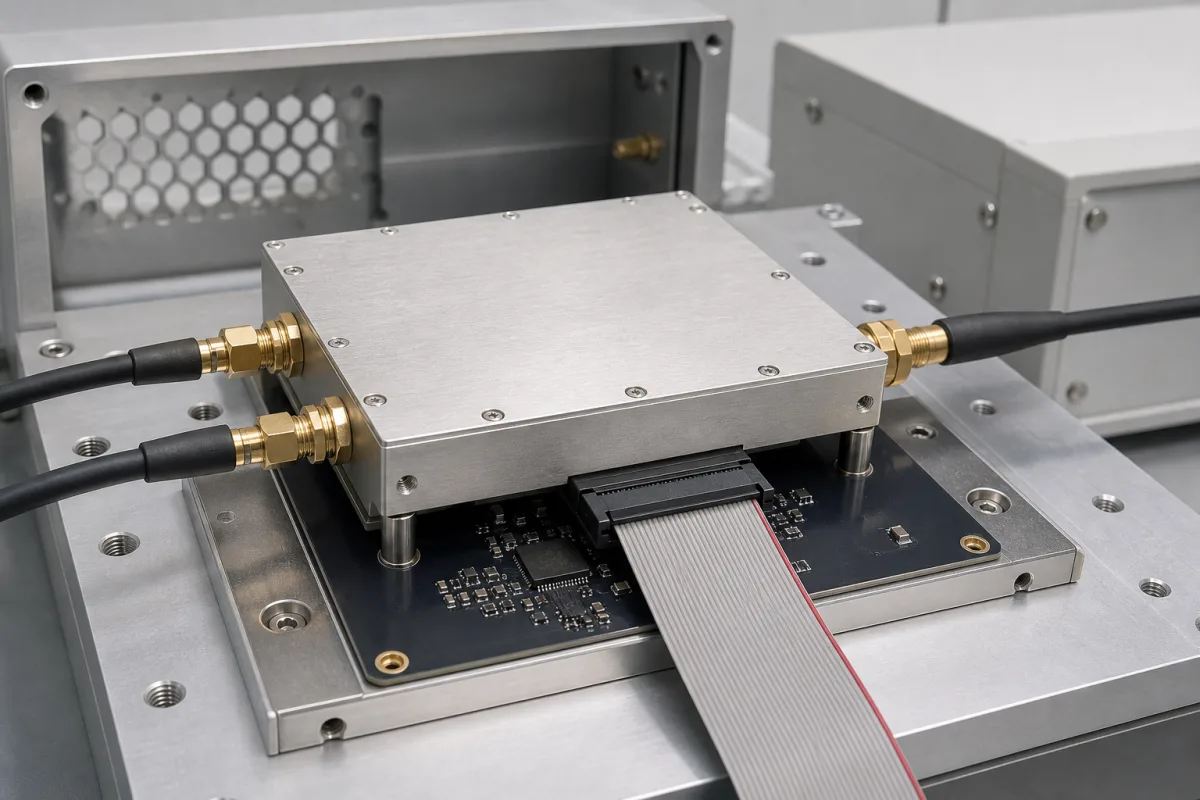
Interface circuit that connects the baseband processor to the radio frequency front-end for signal conversion and transmission.
Product Specifications

Technical details and manufacturing context for RF Interface

Definition
The RF Interface is a critical component within the baseband processor that serves as the bridge between digital baseband processing and analog RF transmission/reception. It handles the conversion of digital baseband signals to analog RF signals for transmission, and vice versa for reception, ensuring proper modulation, filtering, and impedance matching for wireless communication systems.
Working Principle
The RF Interface operates by converting digital signals from the baseband processor into analog signals at radio frequencies through digital-to-analog conversion (DAC) and modulation. For reception, it performs analog-to-digital conversion (ADC) and demodulation of incoming RF signals. It includes frequency synthesizers, mixers, amplifiers, and filters to maintain signal integrity and comply with wireless communication standards.
Common Materials
Silicon, Gallium Arsenide (GaAs), Copper, FR-4 substrate
Technical Parameters
  • Operating frequency range of the RF interface (MHz) Standard Spec
Components / BOM
  • Mixer
    Frequency conversion between baseband and RF signals
    Material: Silicon/GaAs semiconductor
  • Filter
    Signal filtering to remove unwanted frequencies and noise
    Material: Ceramic/SAW materials
  • Amplifier
    Signal amplification for transmission and reception
    Material: Silicon/GaAs semiconductor
  • Oscillator
    Generates stable reference frequencies for signal processing
    Material: Quartz crystal/Silicon
Engineering Reasoning
1.8-3.6 V DC, -40 to +85 °C, 50 Ω impedance
Voltage > 3.8 V causes dielectric breakdown in CMOS transistors; temperature > 125 °C induces thermal runaway in power amplifiers; VSWR > 2:1 creates destructive standing waves
Design Rationale: Electromigration at current densities > 1×10⁶ A/cm²; hot carrier injection at electric fields > 5×10⁵ V/cm; phase noise degradation from oscillator Q-factor < 50
Risk Mitigation (FMEA)
Trigger Local oscillator pulling from adjacent transmitter at -20 dBc coupling
Mode: Frequency synthesizer lock loss with > 100 kHz phase error
Strategy: Triple-shielded VCO cavity with -40 dB isolation and 100 MHz guard band
Trigger Electrostatic discharge (ESD) event at 8 kV HBM model
Mode: Gate oxide rupture in CMOS switches with > 10 mA leakage current
Strategy: Cascaded TVS diodes with 5 pF capacitance and 1 ns response time

Industry Taxonomies & Aliases

Commonly used trade names and technical identifiers for RF Interface.

Applied To / Applications

This component is essential for the following industrial systems and equipment:

Industrial Ecosystem & Supply Chain DNA

Complementary Systems
Downstream Applications
Specialized Tooling

Application Fit & Sizing Matrix

Operational Limits
pressure: Not applicable (electronic component)
other spec: Frequency range: 400 MHz to 6 GHz, Supply voltage: 1.8V to 3.3V
temperature: -40°C to +85°C
Media Compatibility
✓ Wireless communication systems ✓ IoT devices ✓ Automotive telematics
Unsuitable: High-power RF transmitters (>10W output)
Sizing Data Required
  • Operating frequency band
  • Required data rate/bandwidth
  • Power supply constraints

Reliability & Engineering Risk Analysis

Failure Mode & Root Cause
Signal Attenuation
Cause: Corrosion or contamination at the RF interface connector contacts, leading to increased electrical resistance and signal loss.
Intermittent Connection
Cause: Mechanical fatigue or loosening of the RF connector due to vibration, thermal cycling, or improper installation torque.
Maintenance Indicators
  • Fluctuating or degraded signal strength readings on connected monitoring equipment
  • Audible arcing or popping noises from the RF interface during operation
Engineering Tips
  • Implement regular torque verification and re-torquing schedules for RF connectors using calibrated torque wrenches to manufacturer specifications
  • Apply appropriate dielectric grease or corrosion inhibitors to connector interfaces and establish routine cleaning protocols with approved solvents

Compliance & Manufacturing Standards

Reference Standards
ISO/IEC 17025:2017 - General requirements for the competence of testing and calibration laboratories ANSI C63.4 - Methods of measurement of radio-noise emissions from low-voltage electrical and electronic equipment in the range of 9 kHz to 40 GHz DIN EN 55032 - Electromagnetic compatibility of multimedia equipment - Emission requirements
Manufacturing Precision
  • Impedance: 50Ω +/- 1Ω
  • VSWR: < 1.5:1 across operating frequency range
Quality Inspection
  • Vector Network Analyzer (VNA) Test for S-parameters
  • Radiated Spurious Emission (RSE) Test

Factories Producing RF Interface

Verified manufacturers with capability to produce this product in China

✓ 98% Supplier Capability Match Found

P Procurement Specialist from Singapore Jan 11, 2026
★★★★★
"Great transparency on the RF Interface components. Essential for our Computer, Electronic and Optical Product Manufacturing supply chain."
Technical Specifications Verified
T Technical Director from Germany Jan 08, 2026
★★★★★
"The RF Interface we sourced perfectly fits our Computer, Electronic and Optical Product Manufacturing production line requirements."
Technical Specifications Verified
P Project Engineer from Brazil Jan 05, 2026
★★★★★
"Found 49+ suppliers for RF Interface on CNFX, but this spec remains the most cost-effective."
Technical Specifications Verified
Verification Protocol

“Feedback is collected from verified sourcing managers during RFQ (Request for Quote) and factory evaluation processes on CNFX. These reports represent historical performance data and technical audit summaries from our B2B manufacturing network.”

17 sourcing managers are analyzing this specification now. Last inquiry for RF Interface from Thailand (29m ago).

Supply Chain Compatible Machinery & Devices

Modular Industrial Edge Computing Device

Rugged computing platform for industrial data processing at the network edge

Explore Specs →
Industrial Smart Camera Module

Embedded vision system for industrial automation and quality inspection.

Explore Specs →
Industrial Wireless Power Transfer Module

Wireless power transfer module for industrial equipment applications

Explore Specs →
Industrial Smart Sensor Module

Modular industrial sensor with embedded processing and wireless connectivity

Explore Specs →

Frequently Asked Questions

What is the primary function of this RF interface circuit?

This RF interface circuit connects the baseband processor to the radio frequency front-end, handling signal conversion and transmission for wireless communication systems in electronic devices.

Why are Gallium Arsenide (GaAs) and silicon used in this RF interface?

GaAs provides high-frequency performance and low noise for RF applications, while silicon offers cost-effective integration for baseband processing, creating an optimal balance of performance and efficiency.

What key components are included in the BOM for this RF interface?

The bill of materials includes a mixer for frequency conversion, filter for signal conditioning, amplifier for gain control, and oscillator for stable frequency generation, ensuring reliable RF signal processing.

Can I contact factories directly on CNFX?

CNFX is an open directory, not a transaction platform. Each factory profile provides direct contact information and production details to help you initiate direct inquiries with Chinese suppliers.

Get Quote for RF Interface

Request technical pricing, lead times, or customized specifications for RF Interface directly from verified manufacturing units.

Your business information is encrypted and only shared with verified RF Interface suppliers.

Thank you! Your message has been sent. We'll respond within 1–3 business days.

Need to Manufacture RF Interface?

Connect with verified factories specializing in this product category

Add Your Factory Contact Us
Previous Product
RF Integrated Circuit (RFIC)
Next Product
RF Oscillator