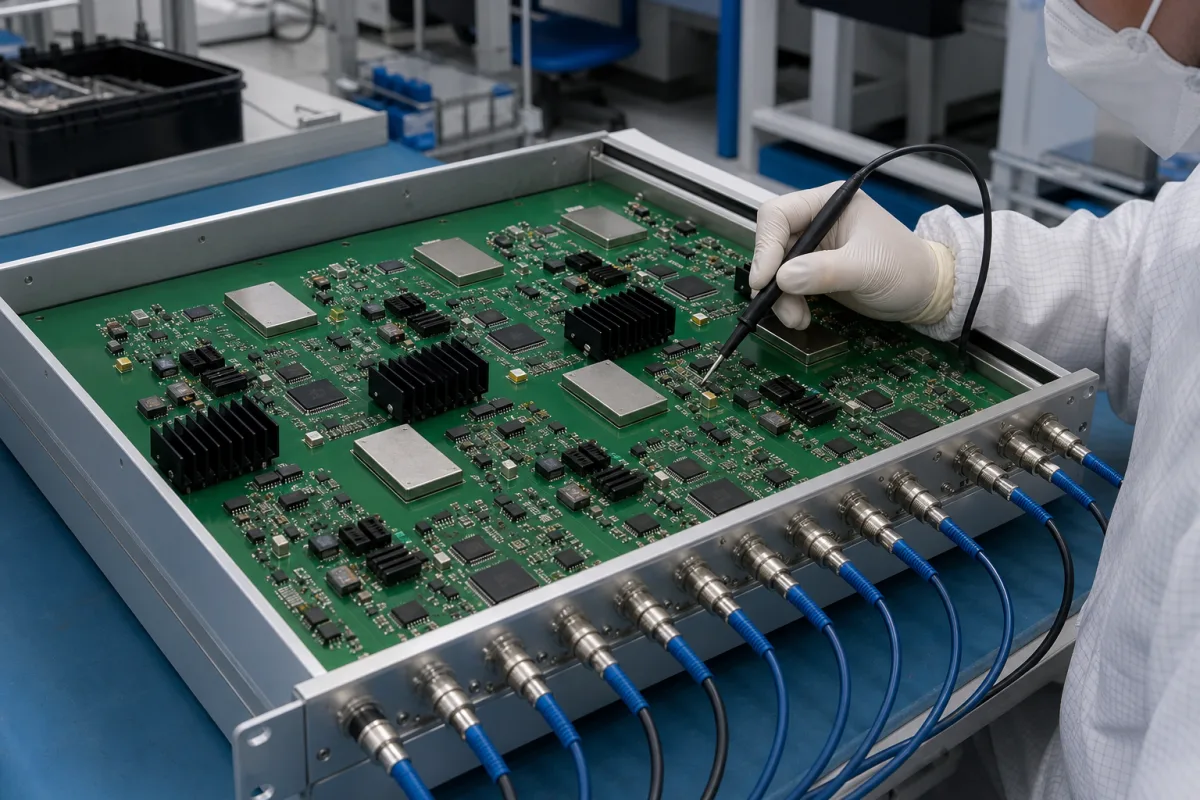
Signal processing board for X-ray fish bone detection: turning dual-energy detector readings into a bone image and a reject decision
Signal processing boards in X-ray fish bone detectors · High- and low-energy readings per pixel turned into a bone image, thresholds on fragment count, area, mass and shape, 0.1 mm pixels for Ø0.35 mm pin bones, and the pixel rate that follows from belt speed
This page covers the signal processing board inside an X-ray bone detection unit for fish fillets: the electronics that receive the line-scan detector's readings, combine the two energy channels, build a bone image and decide which pieces to reject. Ask three things first: whether the detector delivers single- or dual-energy data and how the board combines it, which bone sizes and false-reject rate the processing is set for, and how many pixels per second it must handle at your belt speed and inspection width.
Signal processing boards and processing electronics for X-ray bone detection in fish and meat fillets, as part of the detector module. Signal processors for pyrometers are covered on the Signal processor for mill pyrometers page, strain-gauge and pulse signal conditioners on their own pages, and radiography detectors on the Flat panel X-ray detectors page. Complete X-ray inspection machines, general-purpose DSP or FPGA boards sold on their own and optical (UV or camera) bone detection are outside this page.
CNFX editorial research · Sources checked October 12, 2026 · 4 sources
From two energy readings per pixel to a bone image and a reject decision
A GE-Lunar patent on inspecting meat for bone with dual-energy X-ray describes a detector that supplies high- and low-energy measurements at multiple pixel locations; from these and an index of photoelectric absorption and Compton scattering for meat and bone, the processing deduces the ratio of bone to non-bone at each point and builds a bone image, cancelling effects of varying thickness, density and inhomogeneity. The bone image is then judged against thresholds on the number of bone fragments, fragment area, area times mass, fragment shape or total bone mass, and the same data give the total mass traversed, which a conveyor path sensor turns into a total for the batch. [1]
Ishida explains the reason for dual energy in bone detection: its dual energy technology distinguishes contaminants from product where their densities are close, as with chicken bone and meat, which have almost the same density; its IX-G2 sets itself up automatically and uses image data across inspections, with data logging used to refine calibration as recurring defects appear. [2] Anritsu describes its XR75 DualX+ for fish fillets as built around an ultra-high-resolution dual-energy sensor, in an IP69K washdown machine. [3]
Give the supplier the species and fillet types (fresh or frozen, fillets or portions), the smallest bone to find, the false-reject rate you can accept, the belt speed and inspection width, the detector type and its data interface, the reject device, and the data you need logged.
02
0.1 mm pixels for Ø0.35 mm pin bones, and the pixel rate that follows from belt speed
JBT's fish bone X-ray brochure, for systems built by Innospexion, gives an image resolution of 0.1 × 0.1 mm, up to 99% detection with under 5% false rejects for bones down to Ø0.35 mm and 10 mm long, software tailored to very thin pin bones, and placement immediately after bone removal so that only products still holding bones are rejected, through flap-down or retractable-gate rejects. [4]
Editorial calculation, with assumed figures: at a belt speed of 0.5 m/s and 0.1 mm pixels, the detector produces 5,000 lines per second; over a 400 mm inspection width each line has 4,000 pixels, so the board must take about 20 million pixels per second per energy channel, about 40 million for dual energy, and decide within the travel time to the reject. [4]
Editorial note: ask the supplier for its detection and false-reject figures on your own species and bone sizes, since the brochure's figures are stated for its system and bone dimensions.
03
Send the product, the bone target and the line data together
Paste it into your enquiry below or into an email to a maker, then replace every bracket.
Explore company information and manufacturing capabilities, then discuss the scope of your project with a relevant supplier.
Share this page
Compiled and source-reviewed by the CNFX editorial team.
Each manufacturer above links to the page on that company's own website where the product is listed, with the date we checked it. How we source and review
· Page last updated 13 October 2026
Buyer questions
Why use dual energy for bone detection?
Ishida explains that bone and meat can have almost the same density, and its dual energy technology is used to distinguish such contaminants from the product. [2]
What does the processing judge a bone image on?
The GE-Lunar patent lists thresholds on number of fragments, fragment area, area times mass, shape and total bone mass. [1]
What resolution finds fish pin bones?
JBT's system gives 0.1 × 0.1 mm resolution and up to 99% detection with under 5% false rejects for bones down to Ø0.35 mm and 10 mm long. [4]
Sources and what still needs a direct check
Sources checked 2026-10-12. A GE-Lunar patent explains dual-energy bone processing; FoodNavigator, Automate UK and a JBT brochure report Ishida, Anritsu and Innospexion systems.