Industry-Verified Manufacturing Data (2026)

Solid Electrolyte Separator

Based on aggregated insights from multiple verified factory profiles within the CNFX directory, the standard Solid Electrolyte Separator used in the Computer, Electronic and Optical Product Manufacturing sector typically supports operational capacities ranging from standard industrial configurations to heavy-duty production requirements.

Technical Definition & Core Assembly

A canonical Solid Electrolyte Separator is characterized by the integration of Electrolyte matrix and Interface layer. In industrial production environments, manufacturers listed on CNFX commonly emphasize Ceramic electrolytes (e.g., LLZO, LATP) construction to support stable, high-cycle operation across diverse manufacturing scenarios.

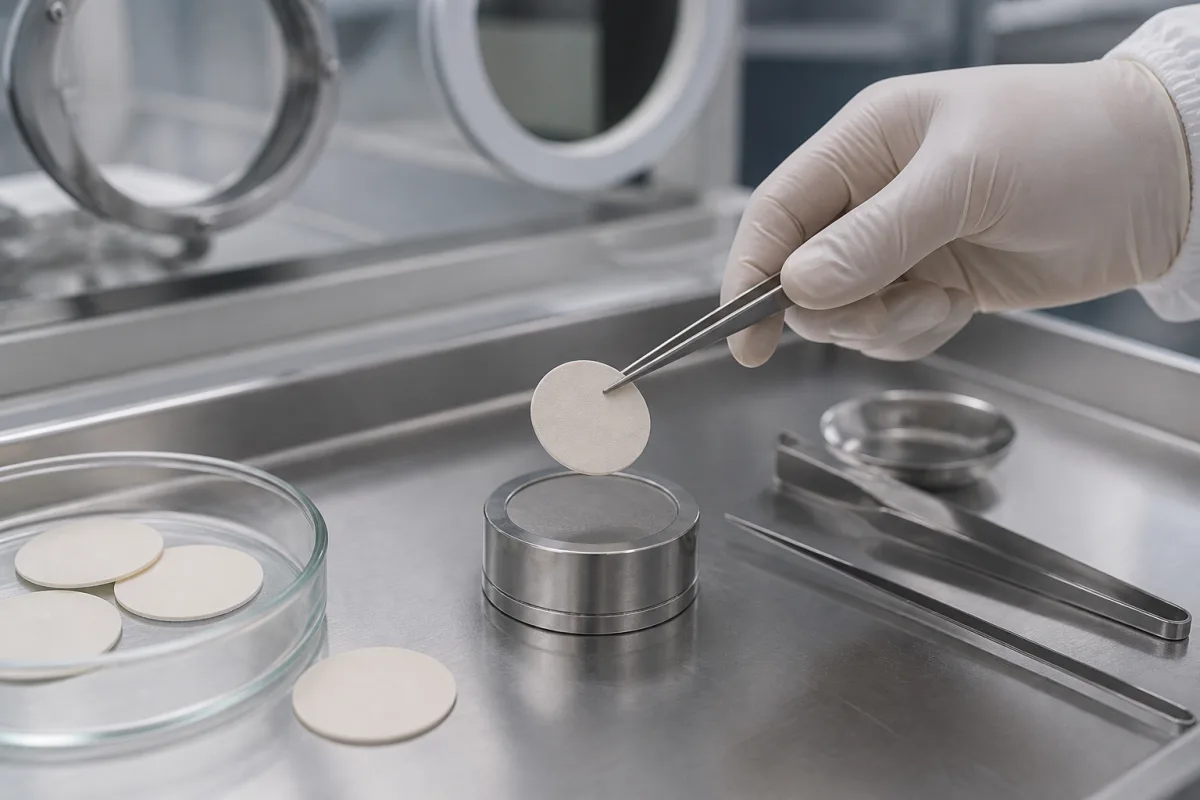
A solid-state ionic conductor that physically separates electrodes while allowing ion transport in battery cells
Product Specifications

Technical details and manufacturing context for Solid Electrolyte Separator

Definition
A critical component within the electrode assembly that serves as both a physical barrier between anode and cathode and an ion-conducting medium, preventing electrical short circuits while enabling lithium-ion or other ion migration during charge/discharge cycles in solid-state batteries
Working Principle
Functions as an ion-conductive solid membrane that allows selective passage of lithium ions (or other charge carriers) while blocking electron flow, maintaining electrode separation to prevent internal short circuits and thermal runaway
Common Materials
Ceramic electrolytes (e.g., LLZO, LATP), Polymer-ceramic composites, Sulfide-based solid electrolytes
Technical Parameters
  • Thickness range typically 10-100μm, with thinner separators enabling higher energy density but requiring enhanced mechanical properties (μm) Per Request
Components / BOM
  • Electrolyte matrix
    Primary ion-conducting medium with crystalline or amorphous structure
    Material: Ceramic/polymer composite
  • Interface layer
    Enhances contact with electrode surfaces to reduce interfacial resistance
    Material: Functional coating materials
  • Support structure
    Provides mechanical integrity and dimensional stability
    Material: Polymer scaffold or reinforced matrix
Engineering Reasoning
0.1-100 MPa compressive stress, -40 to 200°C temperature, 1-1000 μm thickness
Fracture at 120 MPa compressive stress, ionic conductivity drops below 1×10⁻⁴ S/cm at 250°C, delamination at 50 MPa interfacial shear stress
Design Rationale: Brittle fracture exceeding fracture toughness (K_IC = 1.5 MPa·m¹/²), thermal decomposition of polymer-ceramic composite above glass transition temperature (T_g = 180°C), interfacial debonding due to coefficient of thermal expansion mismatch (ΔCTE = 8×10⁻⁶ K⁻¹)
Risk Mitigation (FMEA)
Trigger Lithium dendrite penetration exceeding separator mechanical strength (σ_yield = 80 MPa)
Mode: Internal short circuit with current surge > 10 C-rate
Strategy: Multilayer composite design with ceramic coating (Al₂O₃ layer, 5 μm) and polymer matrix (PVDF-HFP) for dendrite blocking
Trigger Cyclic volumetric expansion/contraction (ΔV = 12%) during charge-discharge causing fatigue
Mode: Crack propagation leading to ionic conductivity loss > 50% after 500 cycles
Strategy: Elastic polymer network (polyethylene oxide with 30% crosslinking) and compressive pre-stress (5 MPa) during cell assembly

Industry Taxonomies & Aliases

Commonly used trade names and technical identifiers for Solid Electrolyte Separator.

Applied To / Applications

This component is essential for the following industrial systems and equipment:

Industrial Ecosystem & Supply Chain DNA

Complementary Systems
Downstream Applications
Specialized Tooling

Application Fit & Sizing Matrix

Operational Limits
pressure: 0.1 to 5 MPa (mechanical compression range), withstands up to 10 MPa burst pressure
other spec: Ionic conductivity: 10^-4 to 10^-2 S/cm, thickness range: 10-100 μm, porosity: <5%
temperature: -40°C to 150°C (operational), up to 200°C (short-term thermal stability)
Media Compatibility
✓ Lithium metal anodes ✓ High-voltage cathodes (NMC, LCO) ✓ Solid-state battery assemblies
Unsuitable: Aqueous electrolyte systems (moisture-sensitive degradation)
Sizing Data Required
  • Cell voltage and chemistry (anode/cathode materials)
  • Required ionic conductivity and thickness
  • Mechanical compression force and stack pressure

Reliability & Engineering Risk Analysis

Failure Mode & Root Cause
Electrolyte decomposition
Cause: Exposure to moisture or contaminants leading to chemical breakdown of the solid electrolyte material, often due to improper sealing or manufacturing defects.
Mechanical fracture
Cause: Thermal cycling or physical stress causing cracks or delamination in the separator, typically from rapid temperature changes, mechanical pressure, or poor material bonding.
Maintenance Indicators
  • Visible discoloration or swelling of the separator material indicating chemical degradation or gas generation
  • Audible cracking or popping sounds during operation, suggesting mechanical failure or internal short circuits
Engineering Tips
  • Implement strict environmental controls to maintain low humidity and prevent contamination during handling and operation
  • Use thermal management systems to minimize temperature fluctuations and apply uniform pressure to avoid stress concentrations

Compliance & Manufacturing Standards

Reference Standards
ISO 9001:2015 - Quality Management Systems ASTM D882 - Standard Test Method for Tensile Properties of Thin Plastic Sheeting IEC 62660-1 - Secondary lithium-ion cells for the propulsion of electric road vehicles
Manufacturing Precision
  • Thickness uniformity: +/- 0.5 μm
  • Pore size distribution: +/- 0.05 μm
Quality Inspection
  • Ionic Conductivity Test (AC impedance spectroscopy)
  • Thermal Stability Test (Thermogravimetric analysis)

Factories Producing Solid Electrolyte Separator

Verified manufacturers with capability to produce this product in China

✓ 95% Supplier Capability Match Found

S Sourcing Manager from Brazil Jan 28, 2026
★★★★★
"Testing the Solid Electrolyte Separator now; the technical reliability results are within 1% of the laboratory datasheet."
Technical Specifications Verified
P Procurement Specialist from Canada Jan 25, 2026
★★★★☆
"Impressive build quality. Especially the technical reliability is very stable during long-term operation. (Delivery took slightly longer than expected, but technical support was excellent.)"
Technical Specifications Verified
T Technical Director from United States Jan 22, 2026
★★★★★
"As a professional in the Computer, Electronic and Optical Product Manufacturing sector, I confirm this Solid Electrolyte Separator meets all ISO standards."
Technical Specifications Verified
Verification Protocol

“Feedback is collected from verified sourcing managers during RFQ (Request for Quote) and factory evaluation processes on CNFX. These reports represent historical performance data and technical audit summaries from our B2B manufacturing network.”

10 sourcing managers are analyzing this specification now. Last inquiry for Solid Electrolyte Separator from Germany (1h ago).

Supply Chain Compatible Machinery & Devices

Industrial Smart Camera Module

Embedded vision system for industrial automation and quality inspection.

Explore Specs →
Industrial Wireless Power Transfer Module

Wireless power transfer module for industrial equipment applications

Explore Specs →
Industrial Smart Sensor Module

Modular industrial sensor with embedded processing and wireless connectivity

Explore Specs →
Surface Mount Resistor

Passive electronic component for current limiting and voltage division in circuits

Explore Specs →

Frequently Asked Questions

What are the key advantages of solid electrolyte separators over traditional polymer separators?

Solid electrolyte separators offer superior thermal stability, eliminate leakage risks, enable higher energy density, and prevent dendrite formation, making them ideal for advanced electronic devices requiring enhanced safety and performance.

How do ceramic solid electrolytes like LLZO improve battery performance in optical products?

LLZO ceramic electrolytes provide high ionic conductivity (10^-3 S/cm), wide electrochemical window, and excellent mechanical strength, enabling thinner separators, faster charging, and extended cycle life for precision optical and electronic applications.

What manufacturing considerations exist for integrating solid electrolyte separators in computer hardware?

Key considerations include precise thickness control (20-100 μm), interface engineering with electrodes, thermal expansion matching, and scalable deposition techniques like tape casting or screen printing for consistent performance in computer battery packs.

Can I contact factories directly on CNFX?

CNFX is an open directory, not a transaction platform. Each factory profile provides direct contact information and production details to help you initiate direct inquiries with Chinese suppliers.

Get Quote for Solid Electrolyte Separator

Request technical pricing, lead times, or customized specifications for Solid Electrolyte Separator directly from verified manufacturing units.

Your business information is encrypted and only shared with verified Solid Electrolyte Separator suppliers.

Thank you! Your message has been sent. We'll respond within 1–3 business days.

Need to Manufacture Solid Electrolyte Separator?

Connect with verified factories specializing in this product category

Add Your Factory Contact Us
Previous Product
Solder Paste Printer
Next Product
Solid-State Cell Module