Editorial Technical Reference

Solder Paste Printer

This page explains how Solder Paste Printer is classified within Computer, Electronic and Optical Product Manufacturing. Technical values and manufacturer relationships are research references; confirm the current specification and supplier evidence for each order.

Technical Definition & Core Assembly

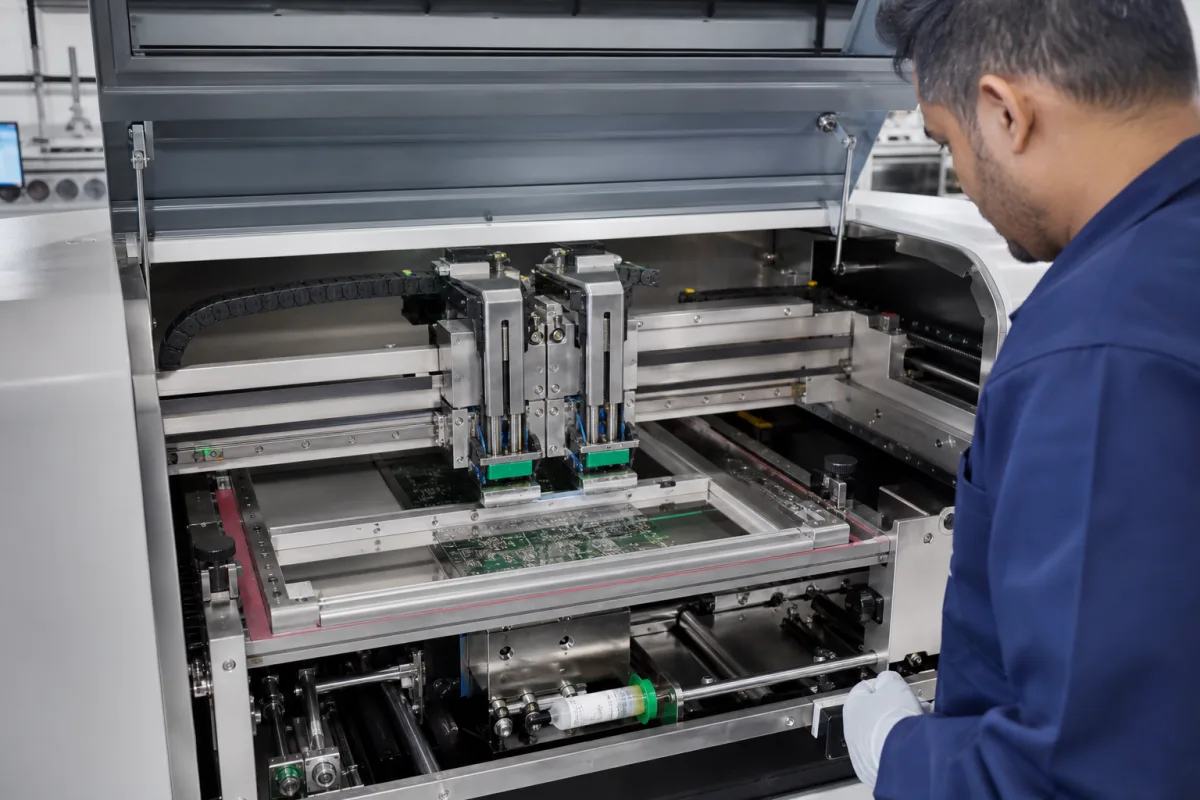
A solder paste printer is a precision machine used in the assembly of printed circuit boards (PCBs).

Representative product image. Confirm appearance and specifications with the manufacturer.

Product Specifications

Technical details and manufacturing context for Solder Paste Printer

Definition
A solder paste printer is a precision machine used in the assembly of printed circuit boards (PCBs). It is a critical component within an automated PCB assembly line, responsible for accurately applying solder paste to designated pads on the PCB. The process uses a stencil, which is a thin metal sheet with apertures that correspond to the pad locations. The PCB is loaded and aligned under the stencil, and solder paste is applied to the stencil's surface. A squeegee blade then moves across the stencil, forcing the paste through the apertures and onto the PCB pads below. This step is essential for subsequent component placement and reflow soldering, as it ensures that the correct amount of solder is deposited at each pad. The machine's performance is characterized by parameters such as maximum printing area (e.g., 400×300 mm), printing speed (10–50 mm/s), positioning accuracy (±0.02 mm), repeatability (±0.01 mm), squeegee pressure (0–10 kgf), squeegee speed (10–100 mm/s), stencil thickness (0.1–0.3 mm), board thickness (0.5–5 mm), power supply (220 V AC ±10%, single phase, 50/60 Hz), air supply pressure (0.5–0.7 MPa), operating temperature (15–35 °C), humidity range (30–60 %RH), and machine weight (800–1500 kg). These values are typical reference ranges and must be verified for the specific model and application. The machine is constructed with materials such as stainless steel, aluminum alloy, and polymer blades. It is important to note that the listed parameters are not guarantees of performance; they are provided as directory references for procurement and verification. Always confirm model-specific specifications with the legal manufacturer or supplier.
Working Principle
The solder paste printer operates by loading a PCB and aligning it under a stencil. Solder paste is applied to the stencil's surface, and a squeegee blade moves across it, forcing the paste through apertures onto the PCB pads below. The squeegee pressure and speed are adjustable to control paste volume and stencil contact. The machine's positioning system ensures accurate alignment, and its repeatability ensures consistent alignment across multiple boards. The stencil thickness determines the volume of solder paste deposited. The machine requires a clean, temperature-controlled environment to maintain paste viscosity and prevent moisture absorption.
Common Materials
Stainless Steel, Aluminum Alloy, Polymer Blades
Technical Parameters
ParameterTypical rangeNotes & selection driver
Printing Area (Max)400×300 mmLarger boards require custom stencil and machine size.
Printing Speed10–50 mm/sHigher speed reduces cycle time but may affect paste deposition quality.
Positioning Accuracy±0.02 mmCritical for fine-pitch components.
Repeatability±0.01 mmEnsures consistent alignment across multiple boards.
Squeegee Pressure0–10 kgfAdjustable to control paste volume and stencil contact.
Squeegee Speed10–100 mm/sAffects paste rolling and aperture filling.
Stencil Thickness0.1–0.3 mmDetermines solder paste volume deposited.
Board Thickness0.5–5 mmMust accommodate PCB thickness range.
Power Supply220 ±10% V ACSingle phase, 50/60 Hz.
Air Supply Pressure0.5–0.7 MPaRequired for pneumatic components.
Operating Temperature15–35 °COutside this range, paste viscosity changes.
Humidity Range30–60 %RHHigh humidity can cause solder paste to absorb moisture.
Machine Weight800–1500 kgAffects floor loading and installation requirements.

Ranges are indicative industry figures for RFQ preparation, not a supplier commitment. Confirm every value and standard with the legal manufacturer before ordering.

Components / BOM
  • Vision Alignment System
    Precisely aligns the PCB and stencil using optical cameras and fiducial marks.
  • Squeegee Assembly
    Applies pressure to spread solder paste across the stencil and force it through apertures.
  • Stencil Frame Clamps Part
    Securely holds the metal stencil frame in place during the printing process.
  • Stencil
    The laser-cut steel foil whose apertures define where and how much paste goes down.
  • PCB Positioning System
    Supports and locates the board under the stencil before printing.

Applied To / Applications

This component is essential for the following industrial systems and equipment:

Industrial Ecosystem & Supply Chain Structure

Complementary Systems
Downstream Applications
Specialized Tooling

Application Fit & Sizing Matrix

Operational Limits
pressure: 0.1-0.5 MPa (squeepee pressure range)
flow rate: 50-200 mm/s (print speed)
temperature: 15-30°C (ambient operating range)
slurry concentration: 85-92% metal content (solder paste viscosity: 800-1200 kcps)
Media Compatibility
✓ Lead-free solder paste (SAC305) ✓ Lead-based solder paste (Sn63Pb37) ✓ Low-temperature solder paste (Sn42Bi58)
Unsuitable: High-humidity environments (>80% RH) causing solder paste oxidation
Sizing Data Required
  • PCB maximum board size (mm)
  • Minimum feature size/pitch (mm)
  • Required throughput (boards per hour)

Reliability & Engineering Risk Analysis

Failure Mode & Root Cause
Stencil aperture clogging
Cause: Solder paste drying due to insufficient cleaning cycles, improper humidity control, or using paste beyond its work life, leading to incomplete prints and bridging defects.
Vision system misalignment
Cause: Accumulation of debris on cameras or lenses, thermal drift from ambient temperature fluctuations, or mechanical wear in alignment stages, resulting in poor registration and skewed prints.
Maintenance Indicators
  • Audible grinding or squeaking from the squeegee mechanism during printing cycles
  • Visible solder paste smearing or inconsistent deposit heights on the PCB after printing
Engineering Tips
  • Implement a strict stencil cleaning regimen with validated solvents and frequencies, and monitor paste viscosity in real-time to prevent drying and clogging.
  • Calibrate vision and mechanical systems using certified artifacts after any environmental changes or maintenance, and maintain stable temperature and humidity in the printer's operating environment.

Indicative industry ranges for design and RFQ preparation. Confirm the exact figures and applicable standard with the manufacturer before specifying.

Compliance & Manufacturing Standards

Applicable Standards
ANSI/J-STD-001 - Requirements for Soldered Electrical and Electronic Assemblies CE Marking - Compliance with EU Machinery Directive 2006/42/EC

Quoted from the published standard.

Manufacturing Precision
  • Stencil Alignment: +/-0.025mm
  • Solder Paste Deposit Height: +/-0.05mm
Quality Inspection
  • Solder Paste Inspection (SPI) - 3D Optical Measurement
  • Print Repeatability Test - Statistical Process Control Analysis

Manufacturers of Solder Paste Printer

1 company lists this product among what they make. Company figures are quoted from each company's own website; every card states where the relationship came from.

CNSMT
Shenzhen, Guangdong, CN
Also makes: Reflow Oven, SMT Stencil
Listed on the company's own website · profile compiled by CNFX from public sources

Manufacturer listings support early research and capability understanding. They are not certification, ranking, or transaction guarantees.

Technical documentation
Request current drawings, revision history, and a signed specification sheet.
Manufacturing capability
Verify equipment lists, process limits, capacity, and representative production evidence.
Inspection readiness
Confirm test methods, calibrated equipment, sampling plans, and traceable reports.
Supplier transparency
Check the legal entity, factory address, ownership, certifications, and direct contacts.

CNFX does not score or rank suppliers. Buyers must verify all claims and documents with the legal manufacturer before ordering.

Supply Chain Compatible Machinery & Devices

Industrial IoT Gateway

The Industrial IoT Gateway is a ruggedized edge computing device designed for industrial environments.

Explore Specs →
Modular Industrial Edge Computing Device

This modular industrial edge computing device is a ruggedized system designed for deployment in harsh industrial environments to perform real-time data processing, analytics, and control functions at the network edge.

Explore Specs →
Industrial Smart Camera Module

The Industrial Smart Camera Module is a compact, self-contained vision processing unit designed for integration into industrial machinery and production lines.

Explore Specs →
Surface Mount Resistor

Passive electronic component for current limiting and voltage division in circuits

Explore Specs →

Frequently Asked Questions

What is the role of a solder paste printer in PCB assembly?

It deposits solder paste onto PCB pads through a stencil, enabling subsequent component placement and reflow soldering.

What are the key parameters to consider when selecting a solder paste printer?

Key parameters include printing area, printing speed, positioning accuracy, repeatability, squeegee pressure and speed, stencil thickness, board thickness, power supply, air supply pressure, operating temperature, humidity range, and machine weight. These must be matched to your PCB size and production requirements.

How does stencil thickness affect solder paste deposition?

Stencil thickness determines the volume of solder paste deposited. Thicker stencils deposit more paste, which may be needed for larger components, while thinner stencils are used for fine-pitch components.

Why is positioning accuracy important?

Positioning accuracy ensures that solder paste is deposited exactly on the pads, which is critical for fine-pitch components to avoid solder bridges or insufficient solder.

Data Basis

Editorial classification, named public sources where available, and source-reviewed manufacturer records.

Preliminary Technical Classification
This page supports structured research, RFQ preparation, and supplier evaluation. It does not replace buyer-led supplier qualification, standards review, or technical approval.
Buyer enquiry

Request manufacturing insight for Solder Paste Printer

Ask for use case, specification boundaries, supplier type, and RFQ preparation information for this product.

Where it goes
Straight to the CNFX editorial desk, and to the manufacturer if this product is linked to a claimed profile. Nothing is broadcast to a supplier list.
Your details stay here
We do not sell or rent enquiry data, and we do not add you to a mailing list. Used only to answer this request.
No commission, no middleman
CNFX is a directory. We take no cut of any order and never negotiate on a supplier's behalf.
What we don't claim
A listing is not an endorsement. Qualify every supplier and verify every figure yourself before ordering.

Your business information is used only to process this request.

Thank you! Your message has been sent. We'll respond within 1–3 business days.
Sorry, we couldn't send your message. Please try again, or email us at contact@cnfx.com.

Need to Manufacture Solder Paste Printer?

Compare manufacturer profiles with relevant product and process capability.

Previous Product
Slurry Dispersion System
Next Product
Solid-State Cell Module
Get QuotesChat