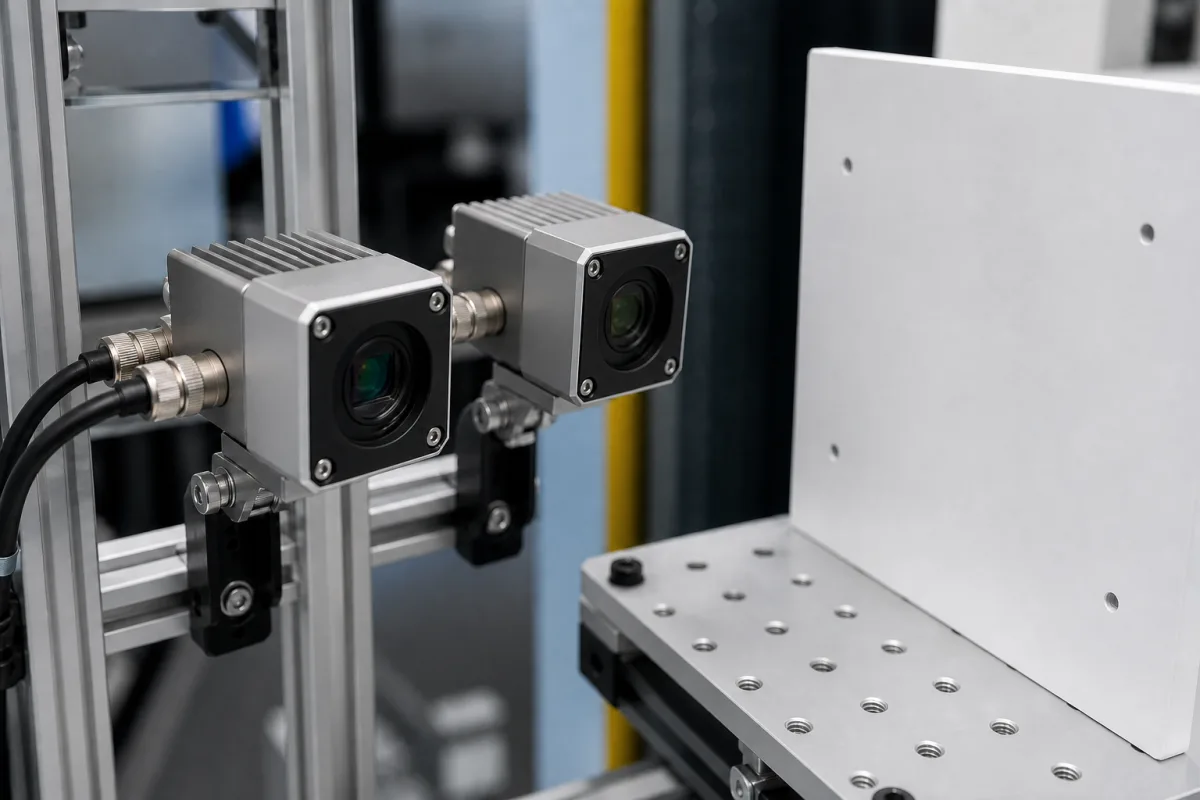
Embedded vision · Sensor, pixel size, field of view, shutter and interface
A camera module is a sensor, a lens and a board. The sensor and lens together set what you see; pixel size and shutter type set how well you see it; the interface decides what it can plug into. Start from the scene, then choose the parts.
Embedded and OEM camera modules with USB, MIPI CSI-2, GMSL, DVP or network output for machines, robots, kiosks, inspection and surveillance products. Complete industrial cameras with their own housings and software are covered only where suppliers list them.
CNFX editorial research · Sources checked October 11, 2026 · 6 sources
Set the field of view from sensor size and focal length
Edmund Optics gives the angular field of view of a fixed focal length lens as AFOV = 2 × arctan(H / 2f), where H is the sensor width and f the focal length: for a given sensor, a shorter focal length gives a wider angle. The field of view also changes with working distance and sensor size, and these paraxial values are approximations. [1]
Editorial calculation with that formula, for a sensor 5.6 mm wide: a 4 mm lens gives about 70° horizontal, an 8 mm lens about 39°.
Edmund Optics adds that short focal length lenses can show more distortion, which changes the real angle, and may not cover larger sensors well. Ask the supplier for the measured horizontal, vertical and diagonal field of view and distortion of the lens fitted. [1]
Give the supplier the scene: object size, working distance, smallest detail to see, motion speed, lighting, and the processor or host and its camera interface.
02
Choose sensor size, pixel size and shutter
Edmund Optics notes that sensor format names such as 1/3 in or 1/2 in come from old Vidicon tubes and do not equal the sensor's dimensions. Edmund Optics states that "Common pixel sizes are between 3 - 10μm" and that "Large pixels have, in general, high charge saturation capacities and high signal-to-noise ratios (SNRs)"; smaller pixels give more resolution for the same sensor size but more blooming and crosstalk. [2]
Edmund Optics writes that the multiplexing configuration of a CMOS sensor "is often coupled with an electronic rolling shutter"; with extra transistors per pixel, a global shutter exposes all pixels at the same time before readout. If objects move fast, ask whether a global-shutter sensor is available, and check exposure time and frame rate at full resolution. [2]
03
Match the interface to the host
Camemake lists modules from 0.3 MP to 200 MP with USB, MIPI CSI-2, GMSL, DVP and SPI outputs; Hampo lists USB, SoC and MIPI modules; CCDCAM lists IP (network) camera modules. Check the interface your processor supports, its drivers, and cable length. [3][4]
For production, ask how the lens is focused and fixed; Sincere describes active alignment in its module manufacturing. Ask for focus and image-quality test results per batch. [6]
04
USB, global-shutter, network, machine-vision, micro and surveillance modules on the linked sites
ELP lists USB modules including a 2 MP global-shutter module with an M12 lens; CCDCAM lists network modules built on IMX-series sensors; Sincere lists machine-vision camera modules; Focuslight lists micro camera modules; Lite-On lists camera modules for surveillance. These are suppliers' own descriptions. [5][3]
05
Image sensor, lens, lens alignment and fixing, board and interface, housing
The alignment-and-fixing row holds focus over the module's life; Sincere describes active alignment in its module manufacturing, so ask how focus is set, fixed and tested per batch. [6]
Resolution, sensor format, pixel size, field of view, focal length and interface for a camera module order
The sensor and optics rows carry Edmund Optics relationships; aperture, temperature, supply, power, weight and dimensions have no published value here and must come from the module datasheet. [1][2]
12 companies list this product among what they make. Company figures are quoted from each
company's own website; every card states where the relationship came from.
CAMEMAKE
Manufacturing site to be confirmed for the order
Lists OEM and embedded camera modules from 0.3 to 200 MP with USB, MIPI CSI-2, GMSL, DVP and SPI outputs.
Explore company information and manufacturing capabilities, then discuss the scope of your project with a relevant supplier.
Share this page
Compiled and source-reviewed by the CNFX editorial team.
Each manufacturer above links to the page on that company's own website where the product is listed, with the date we checked it. How we source and review
· Page last updated 13 October 2026
Buyer questions
How do I calculate a camera module's field of view?
Angular field of view = 2 × arctan(sensor width / (2 × focal length)); for a 5.6 mm wide sensor, a 4 mm lens gives about 70°. [1]
Rolling or global shutter?
A global shutter exposes all pixels at once, which suits fast motion; Edmund Optics says CMOS readout "is often coupled with an electronic rolling shutter", while extra pixel transistors allow a global shutter. [2]
Does a 1/3 inch sensor measure 1/3 inch?
No; Edmund Optics notes the format names are a legacy convention with no direct connection to the sensor's dimensions. [2]
Sources and what still needs a direct check
Sources checked 2026-10-11. Edmund Optics is an optics manufacturer; its Imaging Resource Guide explains sensors, field of view and focal length. Supplier pages describe their own offers.