Editorial Technical Reference

Electrical Test Station

This page explains how Electrical Test Station is classified within Machinery and Equipment Manufacturing. Technical values and manufacturer relationships are research references; confirm the current specification and supplier evidence for each order.

Technical Definition & Core Assembly

A specialized station within an automated production line that performs electrical safety and functional testing on dishwasher components or assemblies.

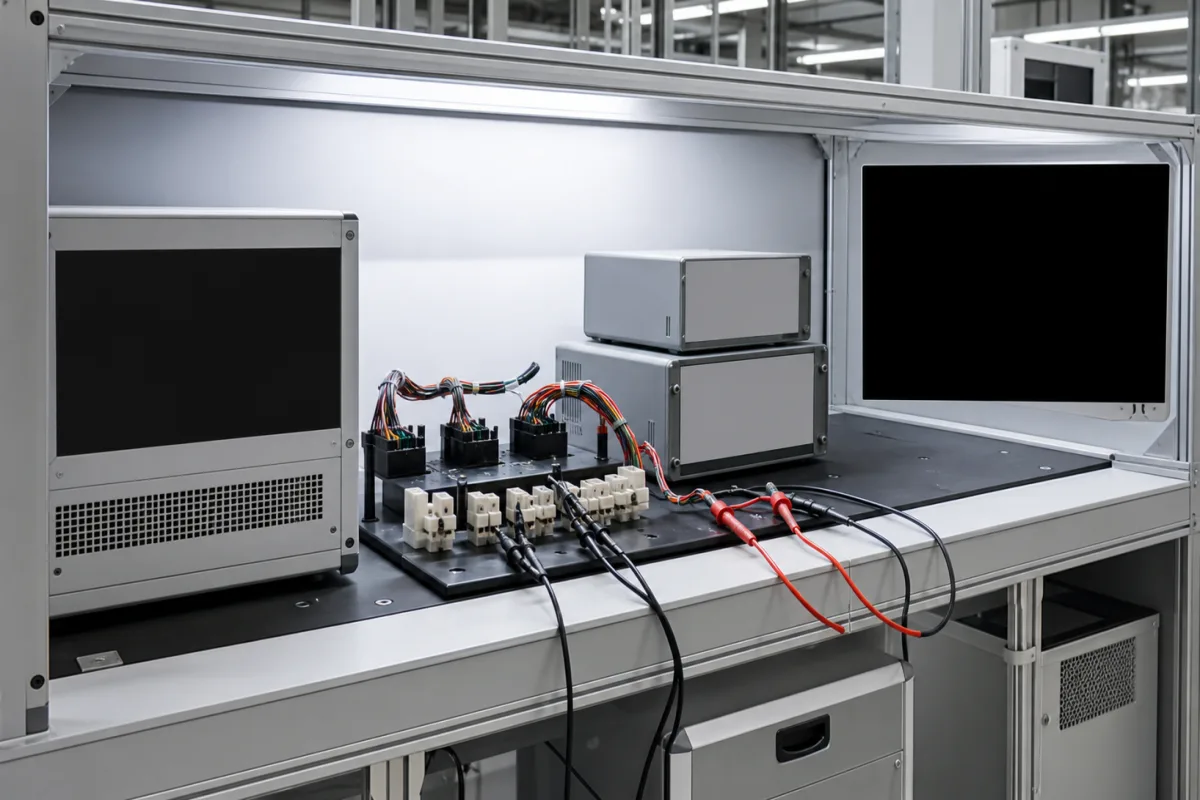
Representative product image. Confirm appearance and specifications with the manufacturer.

Product Specifications

Technical details and manufacturing context for Electrical Test Station

Definition
The Electrical Test Station is a critical component of the Automated Dishwasher Production Line System responsible for verifying electrical integrity, safety compliance, and functional performance of dishwasher electrical systems, including wiring, controls, motors, and heating elements, before final assembly or packaging. The station applies controlled electrical signals (voltage, current, resistance) to test points on the dishwasher unit, measures responses using precision instruments, compares results against predefined safety and performance specifications, and flags any units that fail to meet required standards for further inspection or rework. Constructed with a stainless steel frame, the station integrates electrical test probes, insulated wiring, and a control panel housing. It supports dielectric strength testing at 500–1000 V AC, insulation resistance of at least 2 MΩ at 500 V DC, ground continuity resistance of no more than 0.1 Ω, and leakage current limited to 0.75 mA, all per IEC 60335-1. Test duration is adjustable from 1 to 5 seconds, with a test accuracy of ±1%. Cycle time ranges from 15 to 30 seconds per station, including handling. The station requires a three-phase power supply of 380 V AC ±10% (50/60 Hz) per IEC 60038, operates in ambient temperatures of 5–40 °C, and relative humidity of 20–80% non-condensing. It has an IP54 protection rating per IEC 60529, and pneumatic fixtures require an air supply pressure of 0.5–0.7 MPa per ISO 8573-1. The machine weighs approximately 800–1200 kg, with maximum dimensions of 2000×1500×2200 mm. All listed parameters are reference ranges that must be verified for the specific model and application with the legal manufacturer or supplier. The station is a component of a larger production line and is not sold as a standalone product.
Working Principle
The station applies controlled electrical signals (voltage, current, resistance) to test points on the dishwasher unit, measures responses using precision instruments, compares results against predefined safety and performance specifications, and flags any units that fail to meet required standards for further inspection or rework. The test sequence includes dielectric strength, insulation resistance, ground continuity, and leakage current measurements, each with adjustable duration and accuracy. The station's control system manages the test cycle, records results, and interfaces with the production line for pass/fail decisions.
Common Materials
Stainless steel frame, Electrical test probes, Insulated wiring, Control panel housing
Technical Parameters
ParameterTypical rangeNotes & selection driver
Test Voltage500–1000 V ACDielectric strength test for insulationIEC 60335-1
Insulation Resistance≥2 Minimum at 500 V DCIEC 60335-1
Ground Continuity Resistance≤0.1 ΩMax resistance for protective earthingIEC 60335-1
Leakage Current≤0.75 mATouch current limit for class I appliancesIEC 60335-1
Test Duration1–5 sAdjustable per test requirement
Test Accuracy±1%For voltage and resistance measurements
Cycle Time15–30 sPer station, including handling
Power Supply380 ±10% V ACThree-phase, 50/60 HzIEC 60038
Operating Temperature5–40 °CAmbient conditions for station
Relative Humidity20–80 %Non-condensing
Protection RatingIP54Dust and splash water protectionIEC 60529
Air Supply Pressure0.5–0.7 MPaFor pneumatic fixturesISO 8573-1
Machine Weight800–1200 kgApproximate, depending on configuration
Footprint (L×W×H)2000×1500×2200 mmMax dimensions

Ranges are indicative industry figures for RFQ preparation, not a supplier commitment. Confirm every value and standard with the legal manufacturer before ordering.

Components / BOM
  • Test Probe Array
    Makes electrical contact with test points on dishwasher units
    Material: Copper alloy with gold plating
  • Programmable Power Supply
    Generates precise test voltages and currents
    Material: Electronic components in aluminum housing
  • Measurement Module
    Captures and analyzes electrical response data
    Material: Circuit boards with precision resistors and capacitors
  • Safety Interlock System
    Prevents operation during unsafe conditions
    Material: Stainless steel switches and sensors
  • Control System
    Runs the test sequence, records results and hands pass/fail to the line.

Industrial Ecosystem & Supply Chain Structure

Complementary Systems
Downstream Applications
Specialized Tooling

Application Fit & Sizing Matrix

Operational Limits
pressure: N/A (electrical testing only)
other spec: Voltage Range: 100-240V AC, 50/60Hz; Test Voltage: Up to 1500V AC/DC; Leakage Current: 0.5-10mA adjustable; Insulation Resistance: 0.1-1000MΩ
temperature: 15-35°C (operating environment)
Media Compatibility
✓ Dishwasher control boards ✓ Motor assemblies with electrical connectors ✓ Heating elements and thermostats
Unsuitable: Wet or high-moisture environments without proper IP-rated enclosures
Sizing Data Required
  • Maximum component dimensions (LxWxH)
  • Required test throughput (units/hour)
  • Electrical test specifications (voltage, current, resistance ranges)

Reliability & Engineering Risk Analysis

Failure Mode & Root Cause
Insulation breakdown
Cause: Thermal cycling, moisture ingress, or contamination leading to reduced dielectric strength and eventual arcing or short circuits.
Contact degradation
Cause: Oxidation, pitting, or wear from repeated mechanical cycling, resulting in increased resistance, overheating, or intermittent connections.
Maintenance Indicators
  • Unusual buzzing, arcing sounds, or ozone smell indicating electrical discharge or insulation failure.
  • Visible discoloration, scorch marks, or overheating on components, terminals, or insulation materials.
Engineering Tips
  • Implement regular infrared thermography inspections to detect abnormal heating patterns before catastrophic failure occurs.
  • Maintain controlled environment with proper humidity and dust control, and apply protective coatings on contacts to prevent oxidation and contamination.

Indicative industry ranges for design and RFQ preparation. Confirm the exact figures and applicable standard with the manufacturer before specifying.

Compliance & Manufacturing Standards

Applicable Standards
IEC 61010-1:2010 - Safety requirements for electrical equipment for measurement, control, and laboratory use UL 61010-1 - Standard for Safety of Electrical Equipment for Measurement, Control, and Laboratory Use

Quoted from the published standard.

Manufacturing Precision
  • Voltage Measurement Accuracy: +/-0.5% of reading
  • Resistance Measurement Precision: +/-0.1% of full scale
Quality Inspection
  • Dielectric Withstand Test (Hi-Pot Test)
  • Calibration Verification against NIST-traceable standards

Manufacturers of Electrical Test Station

Manufacturer profiles associated with Electrical Test Station.

Sourcing Electrical Test Station from China?
Tell us your specification and target quantity — we will match it against manufacturer records and come back with the factories that fit.
Request manufacturers We manufacture this

Manufacturer listings support early research and capability understanding. They are not certification, ranking, or transaction guarantees.

Technical documentation
Request current drawings, revision history, and a signed specification sheet.
Manufacturing capability
Verify equipment lists, process limits, capacity, and representative production evidence.
Inspection readiness
Confirm test methods, calibrated equipment, sampling plans, and traceable reports.
Supplier transparency
Check the legal entity, factory address, ownership, certifications, and direct contacts.

CNFX does not score or rank suppliers. Buyers must verify all claims and documents with the legal manufacturer before ordering.

Supply Chain Compatible Machinery & Devices

Heavy-Duty CNC Plasma Cutting Machine

The Heavy-Duty CNC Plasma Cutting Machine is a standalone industrial device designed for cutting conductive metals such as steel, stainless steel, aluminum, and copper alloys.

Explore Specs →
Automated Powder Coating System

Integrated industrial system for applying dry powder coatings to metal substrates.

Explore Specs →
Centrifugal Pump Impeller

The centrifugal pump impeller is a critical rotating component that converts mechanical energy from the motor into kinetic energy in fluid systems.

Explore Specs →
High-Precision CNC Laser Cutting Machine

Computer-controlled industrial machine using focused laser beams to cut sheet metal with micron-level accuracy.

Explore Specs →

Frequently Asked Questions

What standards does the Electrical Test Station reference?

The station references IEC 60335-1 for electrical safety tests, IEC 60038 for power supply voltage, IEC 60529 for protection rating, and ISO 8573-1 for air supply quality. These standards are procurement references; actual compliance must be verified with the manufacturer.

What are the key electrical test parameters?

Key parameters include test voltage of 500–1000 V AC for dielectric strength, insulation resistance ≥2 MΩ at 500 V DC, ground continuity resistance ≤0.1 Ω, and leakage current ≤0.75 mA. Test duration is adjustable from 1 to 5 seconds, with accuracy ±1%.

What are the environmental and utility requirements?

The station operates in 5–40 °C and 20–80% relative humidity (non-condensing). It requires a three-phase 380 V AC ±10% (50/60 Hz) power supply and pneumatic air at 0.5–0.7 MPa. Protection rating is IP54.

How is the station integrated into a production line?

The station is a component of the Automated Dishwasher Production Line System. It interfaces with the line's control system for pass/fail decisions and cycle timing. Cycle time is 15–30 seconds per station, including handling. For integration details, consult the line integrator.

Data Basis

Editorial classification, named public sources where available, and source-reviewed manufacturer records.

Preliminary Technical Classification
This page supports structured research, RFQ preparation, and supplier evaluation. It does not replace buyer-led supplier qualification, standards review, or technical approval.
Buyer enquiry

Request manufacturing insight for Electrical Test Station

Ask for use case, specification boundaries, supplier type, and RFQ preparation information for this product.

Where it goes
Straight to the CNFX editorial desk, and to the manufacturer if this product is linked to a claimed profile. Nothing is broadcast to a supplier list.
Your details stay here
We do not sell or rent enquiry data, and we do not add you to a mailing list. Used only to answer this request.
No commission, no middleman
CNFX is a directory. We take no cut of any order and never negotiate on a supplier's behalf.
What we don't claim
A listing is not an endorsement. Qualify every supplier and verify every figure yourself before ordering.

Your business information is used only to process this request.

Thank you! Your message has been sent. We'll respond within 1–3 business days.
Sorry, we couldn't send your message. Please try again, or email us at contact@cnfx.com.

Need to Manufacture Electrical Test Station?

Compare manufacturer profiles with relevant product and process capability.

Previous Product
Z-axis Ram/Spindle
Last Product
Get QuotesChat