Industry-Verified Manufacturing Data (2026)

Thermal Curing Chamber

Based on aggregated insights from multiple verified factory profiles within the CNFX directory, the standard Thermal Curing Chamber used in the Computer, Electronic and Optical Product Manufacturing sector typically supports operational capacities ranging from standard industrial configurations to heavy-duty production requirements.

Technical Definition & Core Assembly

A canonical Thermal Curing Chamber is characterized by the integration of Heating Element Array and Temperature Sensor. In industrial production environments, manufacturers listed on CNFX commonly emphasize Stainless steel (chamber body) construction to support stable, high-cycle operation across diverse manufacturing scenarios.

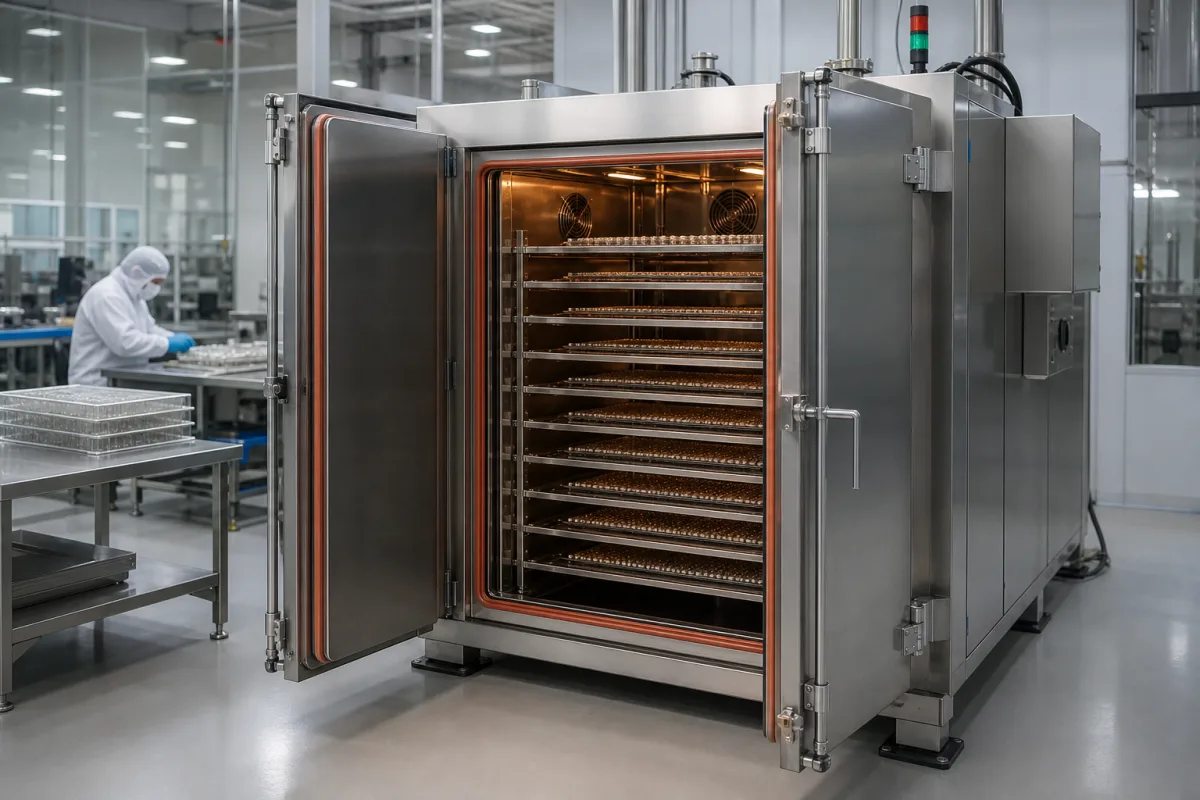
A controlled heating enclosure that accelerates the curing process of LED encapsulation materials through precise temperature management.
Product Specifications

Technical details and manufacturing context for Thermal Curing Chamber

Definition
The Thermal Curing Chamber is a critical subsystem within the Precision LED Encapsulation Machine, designed to provide uniform and controlled heating to LED assemblies after encapsulation material application. It ensures proper cross-linking and hardening of epoxy or silicone encapsulants, optimizing optical properties, mechanical strength, and long-term reliability of the LED package.
Working Principle
The chamber uses electric heating elements (such as resistance heaters or infrared emitters) to raise the internal temperature to a setpoint, typically between 80°C and 150°C. A closed-loop control system with temperature sensors (e.g., thermocouples or RTDs) and a PID controller maintains temperature uniformity (±2°C). Forced air circulation via fans ensures even heat distribution across the product load, while insulation minimizes heat loss. The process follows a predefined time-temperature profile to complete the curing reaction.
Common Materials
Stainless steel (chamber body), Ceramic fiber insulation, Quartz heating elements or resistance wire, Aluminum alloy (air circulation fans)
Technical Parameters
  • Internal chamber dimensions (e.g., 600x600x800 mm) defining the maximum workpiece size capacity. (mm) Per Request
Components / BOM
  • Heating Element Array
    Generates heat through electrical resistance or infrared radiation to raise chamber temperature.
    Material: Quartz tube (IR) or nickel-chromium alloy wire (resistance)
  • Temperature Sensor
    Measures real-time chamber temperature and provides feedback to the control system.
    Material: Stainless steel sheath with thermocouple (Type K) or RTD (Pt100)
  • Circulation Fan
    Forces air movement inside the chamber to ensure uniform temperature distribution.
    Material: Aluminum alloy (impeller), steel (motor housing)
  • Thermal Insulation Layer
    Reduces heat loss to the environment, improving energy efficiency and external safety.
    Material: Ceramic fiber blanket or high-density mineral wool
  • PID Temperature Controller
    Processes sensor input, compares it to the setpoint, and adjusts heater power to maintain precise temperature.
    Material: Electronic components (PCB, microprocessor), plastic/steel enclosure
Engineering Reasoning
40-180°C with ±1.5°C uniformity across chamber volume
Structural deformation at 220°C (aluminum alloy yield strength drops below 55 MPa), insulation breakdown at 250°C (ceramic fiber degradation)
Design Rationale: Thermal expansion coefficient mismatch (aluminum: 23.1×10⁻⁶/°C vs steel fasteners: 11.7×10⁻⁶/°C) causing stress concentration at mounting points
Risk Mitigation (FMEA)
Trigger PID controller integral windup during rapid temperature setpoint changes
Mode: Overshoot exceeding material glass transition temperature (Tg=165°C for silicone encapsulant)
Strategy: Anti-windup algorithm with derivative kick suppression and 2°C/min rate limiting
Trigger Heater element oxidation at cyclic operation above 150°C
Mode: Resistance increase from 18.4Ω to >25Ω causing 30% power delivery reduction
Strategy: Inconel-sheathed heating elements with argon-purged encapsulation and 80% duty cycle limitation

Industry Taxonomies & Aliases

Commonly used trade names and technical identifiers for Thermal Curing Chamber.

Industrial Ecosystem & Supply Chain DNA

Complementary Systems
Downstream Applications
Specialized Tooling

Application Fit & Sizing Matrix

Operational Limits
pressure: Atmospheric to 1.5 bar (positive pressure for inert gas purging)
other spec: Heating rate: 1-10°C/min programmable, uniformity: ±2°C across workspace, chamber volume: 10-1000L standard
temperature: Ambient to 250°C (typical), up to 300°C (max)
Media Compatibility
✓ LED encapsulation silicones (e.g., phenyl-based, methyl-based) ✓ Epoxy molding compounds for LED packaging ✓ Thermoset polymers requiring post-mold cure
Unsuitable: Open-flame or explosive atmosphere (requires inert gas purge for oxygen-sensitive materials)
Sizing Data Required
  • Maximum batch volume (L) or part dimensions
  • Required temperature ramp rate and dwell time profile
  • Ambient conditions and available utilities (power, inert gas supply)

Reliability & Engineering Risk Analysis

Failure Mode & Root Cause
Heating element degradation
Cause: Thermal cycling and oxidation leading to reduced heating efficiency and eventual burnout
Seal failure and insulation breakdown
Cause: Continuous exposure to high temperatures causing gasket deterioration and thermal insulation degradation
Maintenance Indicators
  • Inconsistent temperature readings or significant temperature fluctuations
  • Unusual odors (burning insulation) or audible arcing/popping sounds from electrical components
Engineering Tips
  • Implement regular infrared thermography inspections to detect hot spots and insulation breakdown before catastrophic failure
  • Establish a preventive maintenance schedule for seal replacement and heating element inspection based on operational hours rather than calendar time

Compliance & Manufacturing Standards

Reference Standards
ISO 9001:2015 - Quality management systems ASTM E145-16 - Standard Specification for Gravity-Convection and Forced-Ventilation Ovens CE Marking - Directive 2014/35/EU (Low Voltage Directive)
Manufacturing Precision
  • Temperature Uniformity: +/- 2.5°C across chamber
  • Heating Rate: +/- 5% of specified ramp rate
Quality Inspection
  • Thermal Uniformity Mapping Test
  • Leak Integrity Test (for inert gas/vacuum chambers)

Factories Producing Thermal Curing Chamber

Verified manufacturers with capability to produce this product in China

✓ 96% Supplier Capability Match Found

P Project Engineer from Australia Feb 06, 2026
★★★★★
"Standard OEM quality for Computer, Electronic and Optical Product Manufacturing applications. The Thermal Curing Chamber arrived with full certification."
Technical Specifications Verified
S Sourcing Manager from Singapore Feb 03, 2026
★★★★★
"Great transparency on the Thermal Curing Chamber components. Essential for our Computer, Electronic and Optical Product Manufacturing supply chain."
Technical Specifications Verified
P Procurement Specialist from Germany Jan 31, 2026
★★★★★
"The Thermal Curing Chamber we sourced perfectly fits our Computer, Electronic and Optical Product Manufacturing production line requirements."
Technical Specifications Verified
Verification Protocol

“Feedback is collected from verified sourcing managers during RFQ (Request for Quote) and factory evaluation processes on CNFX. These reports represent historical performance data and technical audit summaries from our B2B manufacturing network.”

16 sourcing managers are analyzing this specification now. Last inquiry for Thermal Curing Chamber from UAE (11m ago).

Supply Chain Compatible Machinery & Devices

Industrial Smart Camera Module

Embedded vision system for industrial automation and quality inspection.

Explore Specs →
Industrial Wireless Power Transfer Module

Wireless power transfer module for industrial equipment applications

Explore Specs →
Industrial Smart Sensor Module

Modular industrial sensor with embedded processing and wireless connectivity

Explore Specs →
Surface Mount Resistor

Passive electronic component for current limiting and voltage division in circuits

Explore Specs →

Frequently Asked Questions

What temperature range does this thermal curing chamber support for LED encapsulation?

Our thermal curing chamber typically operates from ambient temperature up to 300°C, with precise PID control maintaining ±1°C accuracy for optimal LED encapsulation curing.

How does the ceramic fiber insulation improve curing efficiency?

The ceramic fiber insulation minimizes heat loss, ensuring uniform temperature distribution throughout the chamber while reducing energy consumption by up to 30% compared to standard insulation materials.

What safety features are included for electronics manufacturing environments?

The chamber includes over-temperature protection, door safety interlocks, and failsafe cooling systems, with all electrical components rated for industrial use in electronics manufacturing facilities.

Can I contact factories directly on CNFX?

CNFX is an open directory, not a transaction platform. Each factory profile provides direct contact information and production details to help you initiate direct inquiries with Chinese suppliers.

Get Quote for Thermal Curing Chamber

Request technical pricing, lead times, or customized specifications for Thermal Curing Chamber directly from verified manufacturing units.

Your business information is encrypted and only shared with verified Thermal Curing Chamber suppliers.

Thank you! Your message has been sent. We'll respond within 1–3 business days.

Need to Manufacture Thermal Curing Chamber?

Connect with verified factories specializing in this product category

Add Your Factory Contact Us
Previous Product
Thermal Chamber Assembly
Next Product
Thermal Management Interface