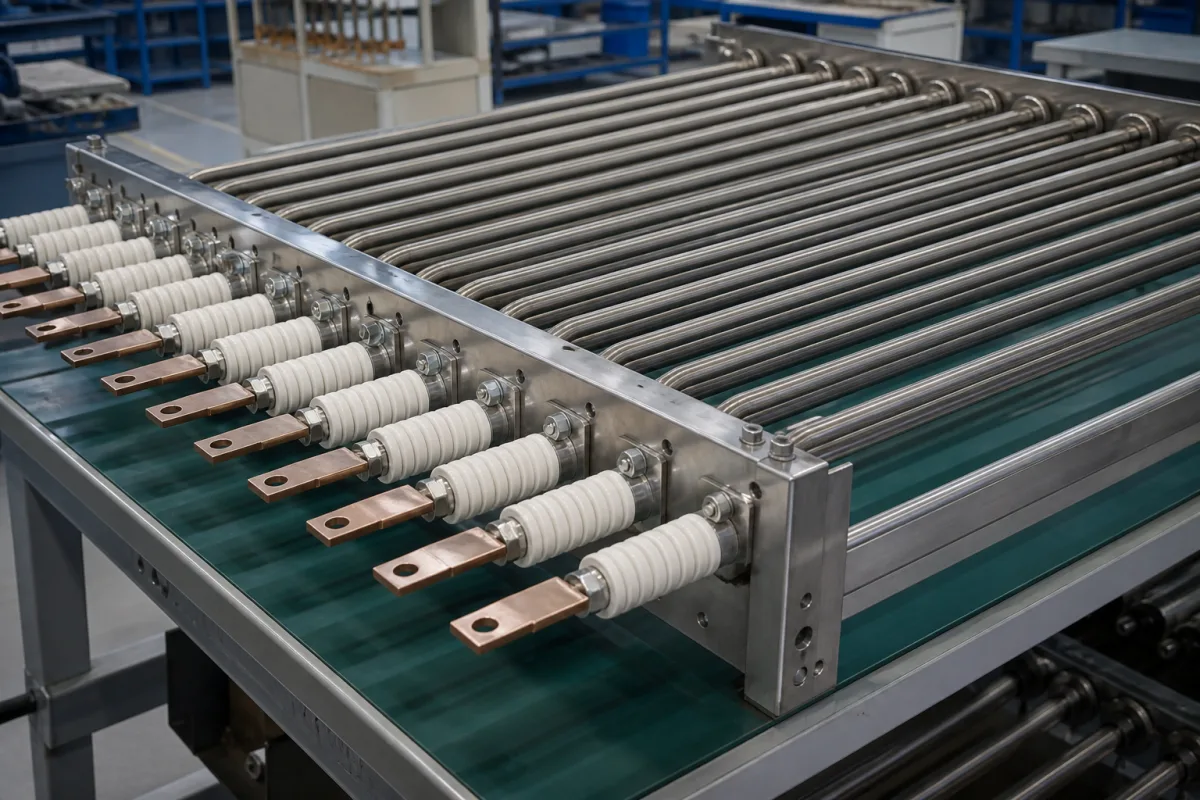
Tubular-element duct heater bank: rows of sheathed elements in a frame across an air stream, sized by face loading and protected by airflow and overtemperature controls
Bank of tubular heating elements across an air duct · kW per square foot of face area against air speed, sheath watt density, inlet-air limits, airflow interlocks, two-stage cutouts and 48 A circuits
When sheathed elements are mounted side by side in one frame and air is blown across them, the result is no longer judged element by element. What matters is how many kilowatts sit on each square foot of duct face, how fast and how evenly the air passes, how hot the incoming air already is, and what stops the bank when the fan fails. This page covers the assembled bank: its face loading and air-speed limits, the sheath loading for high-temperature process air, and the interlocks, cutouts and circuit splitting that duct heater makers build in.
Banks of tubular (sheathed, finned or plain) heating elements mounted in a frame across a forced-air duct, for comfort heating and industrial process air, with their terminal box, thermal cutouts, airflow interlock, contactors and circuit fusing. Individual tubular elements, sheath materials and immersion bundles are covered on the Electric heating element (tubular heater) page; quartz infrared emitter arrays on the Infrared heating zone page; extruder barrel heating on the Barrel heating and cooling system page. Open-coil duct heaters are mentioned only for comparison.
CNFX editorial research · Sources checked October 13, 2026 · 3 sources
Kilowatts per square foot of duct face against air velocity, and the 80 °F inlet limit for finned tubular banks
An electric bank keeps putting out heat as long as it is energised, unlike a steam or hot-water coil, so Marley's Heatrex catalogue says enough airflow must be supplied to prevent overheating and nuisance tripping of the thermal cutouts. The minimum velocity is read from its charts against entering air temperature and kW per square foot of duct cross-section. [1]
Marley's worked example is an open-coil heater: 10 kW in a 24 × 12 in duct is 5 kW per ft², which needs 310 fpm at under 80 °F inlet; 1,000 CFM through 2 ft² gives 500 fpm, so it passes. Finned tubular banks are read from a separate curve in the same catalogue. [1]
Marley sets out why a bank might be built from finned tubular rather than open-coil elements: the coil is enclosed in a grounded sheath so it cannot short when wet or dusty, elements are individually removable through the terminal box, heat conducted along the element evens out hot spots from non-uniform airflow, and the higher thermal inertia gives steadier on/off control. Its finned elements are 80/20 nickel-chromium coils in magnesium oxide inside a stainless tube compacted to 0.475 in (12 mm) outside diameter, for up to 600 V, with a helically wound stainless fin. Against that, Marley credits open coil with the lower pressure drop. [1]
If the heater frame is more than 1 in (25.4 mm) smaller than the duct in length or width, divide by the area inside the sheet-metal enclosure around the elements instead [2]
Indeeco
Velocity coverage
The minimum velocity must be provided at all points over the heater face [2]
Indeeco
Distance from disturbances
At least 4 ft (1,220 mm) from grilles, filters, abrupt size changes, coils or fans; elbows at least 4 ft before and 2 ft (610 mm) after the heater [2][1]
Indeeco; Marley (UL Listing)
Series installation
Not designed for two heaters in series in one duct; large heaters are stacked sections acting as one unit [1][2]
Marley; Indeeco
Give the duct inside dimensions, airflow at the heater (CFM or m³/h), the highest inlet air temperature, and the distance to the nearest fan, elbow, filter or coil upstream and downstream.
02
High-temperature process air: 40 W/in² on the sheath, 1400 °F sheath temperature and at least 200 fpm
For tubular banks heating industrial process air rather than rooms, Tempco's selection checklist sizes the elements by sheath watt density against outlet air temperature and velocity. It lists a maximum watt density of 40 W/in² (6.2 W/cm²), a maximum sheath temperature of 1400 °F (760 °C) and a minimum air velocity of 200 fpm (61 m/min) as limits to adhere to “in most applications”, with 480 V the maximum for UL-certified and 600 V for CSA-certified heaters. [3]
Tempco's free-air sizing formula is kW = SCFM × temperature rise (°F) / 3000, or SCMM × rise (°C) / 47, which it says includes a 6 % safety factor; its table gives 100 kW for 1,000 CFM raised by 300 °F. Element watt density is wattage ÷ (π × element diameter × heated length), and Tempco notes that a lower watt density extends heater life. [3]
Editorial calculation: for an element of the 0.475 in diameter Marley quotes [1], a 2,000 W rating over a 48 in heated length gives 2,000 / (π × 0.475 × 48) ≈ 27.9 W/in² on the bare tube, inside Tempco's 40 W/in² figure; the same element at 3,000 W would be about 41.9 W/in², just over it. These element ratings are hypothetical, used only to show the arithmetic; a finned element spreads heat over more surface than the bare-tube formula counts.
Editorial calculation: Tempco's formula for 1,000 SCFM and a 300 °F rise gives 1,000 × 300 / 3,000 = 100 kW, matching its table.
State the outlet air temperature, air velocity at the heater, the sheath material and the watt density the supplier has used, and ask for the expected sheath temperature at your lowest airflow.
03
No heat without air: the airflow interlock, automatic and manual reset cutouts, contactor ratings and fusing above 48 A
Indeeco's installation instructions require the heater to be wired so that it cannot operate unless air is flowing over it, by a built-in airflow switch, a fan relay or another method. [2]
Indeeco also asks for multi-stage heaters to be wired so that stage 1 is the first on and the last off. [2] Editorial calculation: with Indeeco's three-phase line current formula, kW × 1000 / (V × 1.73), a 60 kW bank at 480 V draws 60,000 / (480 × 1.73) ≈ 72 A, above 48 A, so Marley's overcurrent requirement applies. [2][1]
Protection
What the makers state
Source
Airflow switch
A built-in switch needs at least 0.07 in WC (1.8 mm) of static pressure in the duct; its pickup tube points with the airflow downstream of the fan and against it upstream [2]
Indeeco
Overtemperature
Primary and secondary protection required for UL and NEC compliance, provided as automatic and manual reset cutouts [1]
Marley
Contactors
Primary limit circuit contactors CSA-approved for 250,000 cycles; secondary limit contactors on heaters of 30 kW and less for 6,000 cycles [2]
Indeeco
Disconnecting contactors
UL has required them on open-coil duct heaters since June 2009; not required for finned tubular, where Marley's standard is de-energising contactors [1]
Marley
Overcurrent protection
For heaters drawing more than 48 A the heater maker must provide overcurrent protection, built in or in a remote panel [1]
Marley
Supply wiring
Copper rated 90 °C minimum; all terminal-box wiring insulated for 600 V [2]
Indeeco
Service space
NEC workspace at least 30 in (76 cm) wide by 42 in (107 cm) deep at the terminal box; 5 in (127 mm) free air around SCR cooling fins [1][2]
Marley; Indeeco
Specify the airflow interlock method, cutout types and set points, contactor type, whether fusing is built in, the number of control stages and the supply voltage and phases.
04
What a duct heater bank supplier needs from you
Paste it into your enquiry below or into an email to a maker, then replace every bracket.
Duct: [inside width × height; insulated or not; flanged or slip-in]
Air: [flow; velocity at heater; inlet and outlet temperature]
Load: [kW; stages; SCR or contactor control]
Elements: [finned or plain tubular; sheath material; watt density]
Supply: [voltage; phases; current per circuit]
Protection: [airflow interlock; automatic and manual reset cutouts; fusing]
Site: [distance to fans, elbows, filters; service space]
Explore company information and manufacturing capabilities, then discuss the scope of your project with a relevant supplier.
Share this page
Compiled and source-reviewed by the CNFX editorial team.
Each manufacturer above links to the page on that company's own website where the product is listed, with the date we checked it. How we source and review
· Page last updated 13 October 2026
Buyer questions
How hot can the incoming air be for a finned tubular duct heater?
Marley Heatrex and Indeeco both give 80 °F (27 °C) as the maximum inlet air temperature for finned tubular duct heaters, against 100 °F for open coil. [1][2]
What watt density suits a high-temperature process air heater?
Tempco's checklist lists 40 W/in², a 1400 °F sheath and at least 200 fpm as limits to adhere to “in most applications”, with watt density read against outlet temperature and air velocity. [3]
What protection does a duct heater bank need?
An airflow interlock, primary and secondary overtemperature cutouts (automatic and manual reset), suitable contactors, and maker-supplied overcurrent protection above 48 A. [2][1]
Sources and what still needs a direct check
Sources checked 2026-10-13. Face loading, element construction and UL/NEC points come from Marley Engineered Products' Heatrex commercial duct heater catalogue; installation, airflow switch and contactor rules from Indeeco's duct heater instructions ENM-2077-01; sheath loading for process air from Tempco's tubular process duct heater checklist.