Industry-Verified Manufacturing Data (2026)

Thermal Chamber Assembly

Based on aggregated insights from multiple verified factory profiles within the CNFX directory, the standard Thermal Chamber Assembly used in the Computer, Electronic and Optical Product Manufacturing sector typically supports operational capacities ranging from standard industrial configurations to heavy-duty production requirements.

Technical Definition & Core Assembly

A canonical Thermal Chamber Assembly is characterized by the integration of Insulated Chamber Housing and Heating Element Array. In industrial production environments, manufacturers listed on CNFX commonly emphasize Stainless steel (chamber housing) construction to support stable, high-cycle operation across diverse manufacturing scenarios.

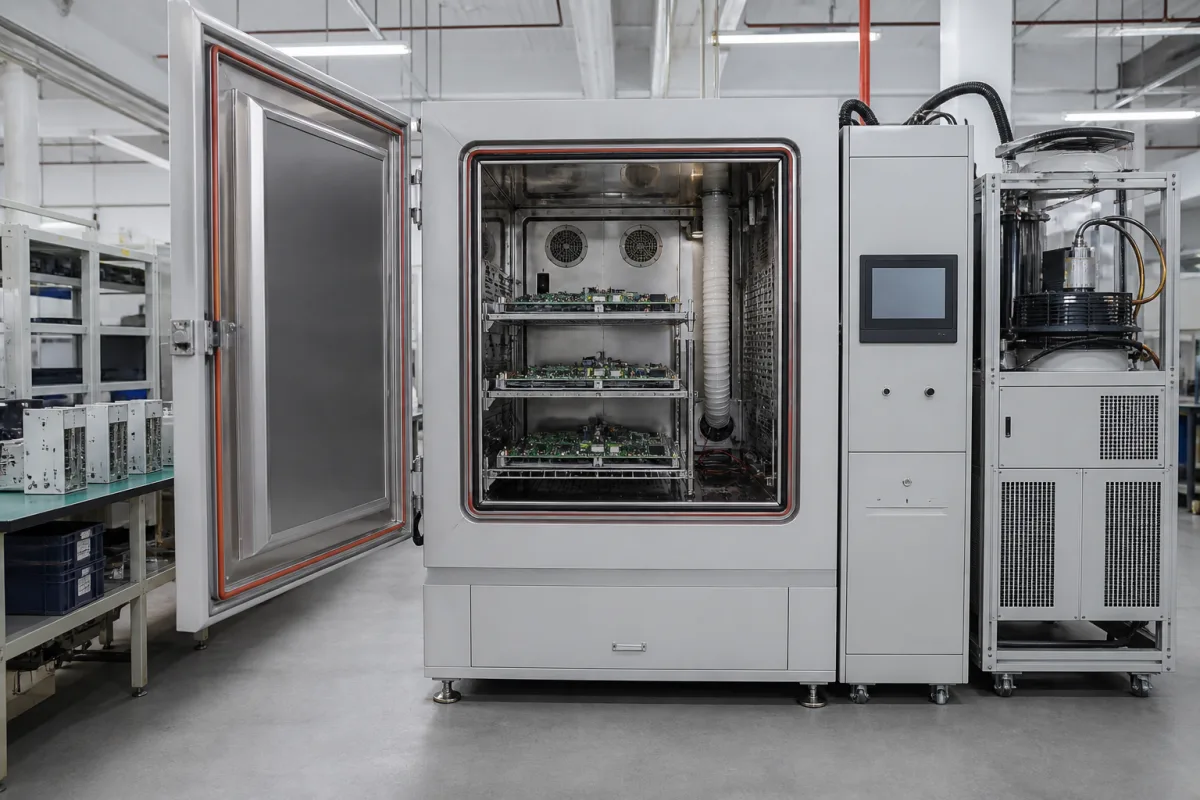
A controlled-environment enclosure designed to subject computer motherboards to precise temperature cycling during burn-in testing.
Product Specifications

Technical details and manufacturing context for Thermal Chamber Assembly

Definition
The Thermal Chamber Assembly is a critical subsystem within the Automated Computer Motherboard Burn-In Tester that creates and maintains specific temperature profiles to stress-test motherboards, ensuring reliability by simulating extreme operating conditions and accelerating potential failure mechanisms.
Working Principle
Utilizes heating elements, refrigeration systems, and precise temperature sensors to rapidly cycle between high and low temperature setpoints, controlled by a programmable logic controller that monitors and adjusts conditions based on predefined test protocols.
Common Materials
Stainless steel (chamber housing), Insulation materials (thermal barriers), Copper/aluminum (heat exchange surfaces), High-temperature plastics (internal fixtures)
Technical Parameters
  • Temperature range typically from -40°C to +150°C with ±0.5°C accuracy (°C) Per Request
Components / BOM
  • Insulated Chamber Housing
    Provides thermal isolation and structural integrity
    Material: Stainless steel with polyurethane insulation
  • Heating Element Array
    Raises chamber temperature according to programmed profiles
    Material: Nickel-chromium alloy heating wires
  • Refrigeration System
    Cools chamber to sub-ambient temperatures
    Material: Copper tubing with refrigerant
  • Temperature Sensors
    Monitor chamber temperature at multiple points for feedback control
    Material: Platinum resistance thermometers (PT100)
  • Air Circulation System
    Ensures uniform temperature distribution throughout chamber
    Material: Aluminum fan blades with brushless DC motor
  • Motherboard Fixture Tray
    Secures motherboards in position during testing
    Material: High-temperature resistant polymer
Engineering Reasoning
-40°C to +150°C with ±0.5°C stability
Heater element burnout at 180°C continuous operation, compressor seizure at -60°C refrigerant temperature
Design Rationale: Thermal fatigue from 10,000+ thermal cycles causing microcracks in heating coil windings, refrigerant phase change failure below triple point temperature
Risk Mitigation (FMEA)
Trigger PID controller integral windup during rapid temperature transitions
Mode: Overshoot exceeding 15°C beyond setpoint causing motherboard component delamination
Strategy: Anti-windup compensation with 0.1-second sampling rate and 5°C/min maximum ramp rate limit
Trigger Condensate accumulation on evaporator coils during humidity testing at 85% RH
Mode: Ice formation blocking airflow, reducing heat transfer coefficient by 70%
Strategy: Defrost cycle activation at 2-hour intervals with 45°C hot gas bypass for 5 minutes

Industry Taxonomies & Aliases

Commonly used trade names and technical identifiers for Thermal Chamber Assembly.

Industrial Ecosystem & Supply Chain DNA

Complementary Systems
Downstream Applications
Specialized Tooling

Application Fit & Sizing Matrix

Operational Limits
pressure: Atmospheric to 1.5 bar (sealed chamber operation)
other spec: Temperature ramp rate: 5-10°C/min, Humidity control: 20-80% RH (if equipped)
temperature: -40°C to +150°C (typical range for motherboard testing)
Media Compatibility
✓ Dry air/nitrogen environment ✓ Inert gas atmosphere (Argon) ✓ Low-concentration cleanroom air
Unsuitable: Corrosive chemical vapor environments (acid/alkali mists)
Sizing Data Required
  • Maximum motherboard dimensions (LxWxH)
  • Required temperature cycling profile (min/max temps, dwell times)
  • Number of units to be tested simultaneously

Reliability & Engineering Risk Analysis

Failure Mode & Root Cause
Heating Element Degradation
Cause: Cyclic thermal stress and oxidation from repeated heating/cooling cycles, leading to element embrittlement, hot spots, and eventual burnout.
Seal Failure (Door or Chamber)
Cause: Compression set and hardening of elastomeric seals due to prolonged exposure to high temperatures, combined with mechanical wear from frequent door operation, resulting in loss of thermal integrity and temperature uniformity.
Maintenance Indicators
  • Significant temperature overshoot/undershoot or inability to maintain setpoint (±5°C or more deviation under stable conditions)
  • Audible arcing, buzzing from electrical components, or unusual mechanical noises from fans/blowers during operation
Engineering Tips
  • Implement a controlled cooldown protocol after high-temperature cycles to minimize thermal shock on heating elements and refractory materials, extending their fatigue life.
  • Establish a preventive maintenance schedule for seal inspection and replacement based on cumulative operational hours at elevated temperatures, rather than waiting for visible failure.

Compliance & Manufacturing Standards

Reference Standards
ISO 17025:2017 - General requirements for the competence of testing and calibration laboratories ANSI/ASHRAE 110-2016 - Method of Testing Performance of Laboratory Fume Hoods DIN 12880:2007 - Laboratory equipment; electrical heated drying ovens; safety requirements and testing
Manufacturing Precision
  • Temperature Uniformity: +/-1.0°C across working volume
  • Chamber Door Seal Gap: ≤0.5mm when closed
Quality Inspection
  • Thermal Cycling Endurance Test (500 cycles minimum)
  • Leak Detection Test (helium mass spectrometry for vacuum chambers)

Factories Producing Thermal Chamber Assembly

Verified manufacturers with capability to produce this product in China

✓ 92% Supplier Capability Match Found

S Sourcing Manager from United States Jan 28, 2026
★★★★★
"Standard OEM quality for Computer, Electronic and Optical Product Manufacturing applications. The Thermal Chamber Assembly arrived with full certification."
Technical Specifications Verified
P Procurement Specialist from United Arab Emirates Jan 25, 2026
★★★★☆
"Great transparency on the Thermal Chamber Assembly components. Essential for our Computer, Electronic and Optical Product Manufacturing supply chain. (Delivery took slightly longer than expected, but technical support was excellent.)"
Technical Specifications Verified
T Technical Director from Australia Jan 22, 2026
★★★★★
"The Thermal Chamber Assembly we sourced perfectly fits our Computer, Electronic and Optical Product Manufacturing production line requirements."
Technical Specifications Verified
Verification Protocol

“Feedback is collected from verified sourcing managers during RFQ (Request for Quote) and factory evaluation processes on CNFX. These reports represent historical performance data and technical audit summaries from our B2B manufacturing network.”

13 sourcing managers are analyzing this specification now. Last inquiry for Thermal Chamber Assembly from Germany (1h ago).

Supply Chain Compatible Machinery & Devices

Industrial Smart Camera Module

Embedded vision system for industrial automation and quality inspection.

Explore Specs →
Industrial Wireless Power Transfer Module

Wireless power transfer module for industrial equipment applications

Explore Specs →
Industrial Smart Sensor Module

Modular industrial sensor with embedded processing and wireless connectivity

Explore Specs →
Surface Mount Resistor

Passive electronic component for current limiting and voltage division in circuits

Explore Specs →

Frequently Asked Questions

What temperature range does this thermal chamber assembly support for motherboard testing?

Our thermal chamber assembly typically supports a wide temperature range from -40°C to +150°C, with precise control for motherboard burn-in testing and thermal cycling applications.

How does the insulation in the chamber maintain temperature stability during testing?

The chamber uses multi-layer thermal barrier insulation materials between the stainless steel housing and internal fixtures, minimizing heat transfer and ensuring consistent temperature distribution across all motherboard test positions.

What safety features are included for testing high-value computer motherboards?

The assembly includes redundant temperature sensors, automatic shutdown protocols for temperature excursions, and high-temperature plastic fixtures that prevent electrical shorts while securely holding motherboards during thermal cycling tests.

Can I contact factories directly on CNFX?

CNFX is an open directory, not a transaction platform. Each factory profile provides direct contact information and production details to help you initiate direct inquiries with Chinese suppliers.

Get Quote for Thermal Chamber Assembly

Request technical pricing, lead times, or customized specifications for Thermal Chamber Assembly directly from verified manufacturing units.

Your business information is encrypted and only shared with verified Thermal Chamber Assembly suppliers.

Thank you! Your message has been sent. We'll respond within 1–3 business days.

Need to Manufacture Thermal Chamber Assembly?

Connect with verified factories specializing in this product category

Add Your Factory Contact Us
Previous Product
Test Signal Generator
Next Product
Thermal Curing Chamber