Industry-Verified Manufacturing Data (2026)

Transceiver

Based on aggregated insights from multiple verified factory profiles within the CNFX directory, the standard Transceiver used in the Computer, Electronic and Optical Product Manufacturing sector typically supports operational capacities ranging from standard industrial configurations to heavy-duty production requirements.

Technical Definition & Core Assembly

A canonical Transceiver is characterized by the integration of Transmitter Driver and Receiver Comparator. In industrial production environments, manufacturers listed on CNFX commonly emphasize Semiconductor (Silicon) construction to support stable, high-cycle operation across diverse manufacturing scenarios.

A device that both transmits and receives signals in communication systems.

Product Specifications

Technical details and manufacturing context for Transceiver

Definition
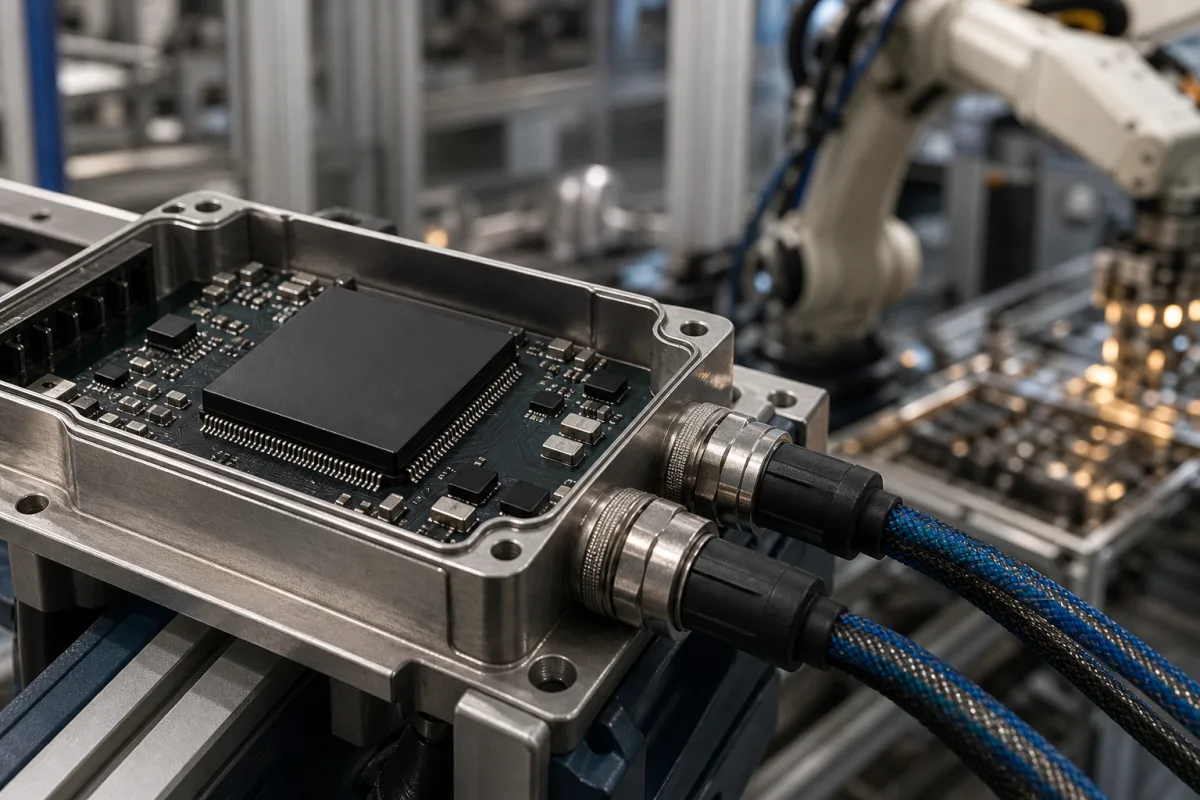
A transceiver is an electronic component within communication interfaces (such as CAN, Ethernet, or other industrial protocols) that combines the functions of a transmitter and a receiver into a single unit. It is responsible for converting digital data from a controller into physical signals suitable for transmission over a network medium, and conversely, for receiving incoming physical signals and converting them back into digital data for processing.
Working Principle
The transceiver operates by modulating digital data from a controller (e.g., a microcontroller or FPGA) onto a carrier signal for transmission, typically involving voltage level shifting, signal conditioning, and line driving. On the receive side, it detects incoming signals, performs amplification, noise filtering, and demodulation to recover the original digital data, which is then passed to the controller. For protocols like CAN, it also handles bus arbitration and error detection signaling.
Common Materials
Semiconductor (Silicon), Copper, Plastic (Encapsulation)
Technical Parameters
  • Data transmission rate (e.g., 1 Mbps for CAN, 10/100/1000 Mbps for Ethernet). (Mbps) Per Request
Components / BOM
  • Transmitter Driver
    Amplifies and conditions the digital signal for transmission onto the communication line.
    Material: Semiconductor
  • Receiver Comparator
    Detects and amplifies incoming signals, converting them back to digital logic levels.
    Material: Semiconductor
  • Line Protection Circuitry
    Protects the transceiver from voltage spikes, electrostatic discharge (ESD), and bus faults.
    Material: Semiconductor, Resistors
Engineering Reasoning
1.8-3.6 V DC input voltage, -40 to +85 °C ambient temperature, 0-100% relative humidity (non-condensing)
Input voltage exceeding 3.8 V causes permanent semiconductor junction breakdown, temperature exceeding 125 °C initiates thermal runaway in laser diodes, humidity exceeding 85% RH at 40 °C initiates electrochemical migration
Design Rationale: Avalanche breakdown in semiconductor junctions at 3.8 V, carrier density collapse in laser diodes at 125 °C due to Auger recombination, dendritic growth between copper traces at 85% RH/40 °C via electrochemical potential of 0.337 V
Risk Mitigation (FMEA)
Trigger Electrostatic discharge (ESD) event exceeding 2 kV HBM
Mode: Gate oxide rupture in CMOS circuitry
Strategy: Integrated silicon-controlled rectifier (SCR) ESD protection with 1.5 kV clamping voltage
Trigger Thermal cycling between -40 °C and +85 °C at 10 cycles/hour
Mode: Solder joint fatigue cracking due to CTE mismatch (17 ppm/°C for FR4 vs 24 ppm/°C for SAC305)
Strategy: Underfill epoxy with 12 ppm/°C CTE and corner bond reinforcement

Industry Taxonomies & Aliases

Commonly used trade names and technical identifiers for Transceiver.

Applied To / Applications

This component is essential for the following industrial systems and equipment:

Industrial Ecosystem & Supply Chain DNA

Complementary Systems
Downstream Applications
Specialized Tooling

Application Fit & Sizing Matrix

Operational Limits
pressure: 0 to 100 psi
other spec: Signal Frequency Range: 1 MHz to 10 GHz
temperature: -40°C to +85°C
Media Compatibility
✓ Fiber Optic Cables ✓ Coaxial Cables ✓ Ethernet Networks
Unsuitable: High-EMI Industrial Environments
Sizing Data Required
  • Required Data Rate (Mbps/Gbps)
  • Transmission Distance (meters/kilometers)
  • Signal Modulation Type

Reliability & Engineering Risk Analysis

Failure Mode & Root Cause
Signal degradation
Cause: Connector contamination or wear, leading to increased insertion loss and reduced signal integrity.
Thermal runaway
Cause: Inadequate cooling or excessive ambient temperature, causing overheating and component failure.
Maintenance Indicators
  • Intermittent or complete loss of signal transmission
  • Unusual heat emission or audible fan noise from the unit
Engineering Tips
  • Implement regular cleaning and inspection of optical/electrical connectors to prevent contamination
  • Ensure proper ventilation and monitor ambient temperature to maintain optimal operating conditions

Compliance & Manufacturing Standards

Reference Standards
ISO/IEC 11801: Information technology - Generic cabling for customer premises ANSI/TIA-568.2-D: Balanced Twisted-Pair Telecommunications Cabling and Components Standards CE Marking: Directive 2014/30/EU (Electromagnetic Compatibility) and Directive 2014/35/EU (Low Voltage)
Manufacturing Precision
  • Connector Mating Surface Flatness: 0.05mm
  • Optical Fiber Alignment Tolerance: +/- 0.5μm
Quality Inspection
  • Bit Error Rate (BER) Test
  • Return Loss Measurement

Factories Producing Transceiver

Verified manufacturers with capability to produce this product in China

✓ 93% Supplier Capability Match Found

S Sourcing Manager from Germany Jan 16, 2026
★★★★★
"Found 44+ suppliers for Transceiver on CNFX, but this spec remains the most cost-effective."
Technical Specifications Verified
P Procurement Specialist from Brazil Jan 13, 2026
★★★★☆
"The technical documentation for this Transceiver is very thorough, especially regarding technical reliability. (Delivery took slightly longer than expected, but technical support was excellent.)"
Technical Specifications Verified
T Technical Director from Canada Jan 10, 2026
★★★★★
"Reliable performance in harsh Computer, Electronic and Optical Product Manufacturing environments. No issues with the Transceiver so far."
Technical Specifications Verified
Verification Protocol

“Feedback is collected from verified sourcing managers during RFQ (Request for Quote) and factory evaluation processes on CNFX. These reports represent historical performance data and technical audit summaries from our B2B manufacturing network.”

7 sourcing managers are analyzing this specification now. Last inquiry for Transceiver from India (11m ago).

Supply Chain Compatible Machinery & Devices

Industrial Smart Camera Module

Embedded vision system for industrial automation and quality inspection.

Explore Specs →
Industrial Wireless Power Transfer Module

Wireless power transfer module for industrial equipment applications

Explore Specs →
Industrial Smart Sensor Module

Modular industrial sensor with embedded processing and wireless connectivity

Explore Specs →
Surface Mount Resistor

Passive electronic component for current limiting and voltage division in circuits

Explore Specs →

Frequently Asked Questions

What materials are used in this transceiver's construction?

This transceiver utilizes semiconductor silicon for core components, copper for conductive elements, and plastic for encapsulation and protection.

What are the key components in the transceiver's bill of materials (BOM)?

The BOM includes a transmitter driver for signal transmission, a receiver comparator for signal reception and processing, and line protection circuitry to safeguard against electrical surges.

What industries commonly use this type of transceiver?

This transceiver is designed for computer, electronic, and optical product manufacturing industries, where reliable signal transmission and reception are critical for communication systems.

Can I contact factories directly on CNFX?

CNFX is an open directory, not a transaction platform. Each factory profile provides direct contact information and production details to help you initiate direct inquiries with Chinese suppliers.

Get Quote for Transceiver

Request technical pricing, lead times, or customized specifications for Transceiver directly from verified manufacturing units.

Your business information is encrypted and only shared with verified Transceiver suppliers.

Thank you! Your message has been sent. We'll respond within 1–3 business days.

Need to Manufacture Transceiver?

Connect with verified factories specializing in this product category

Add Your Factory Contact Us
Previous Product
Transaction State Manager
Next Product
Transceiver Circuit