Editorial Technical Reference

Communication Interface (e.g., CAN, Ethernet)

This page explains how Communication Interface (e.g., CAN, Ethernet) is classified within Motor Vehicle Manufacturing. Technical values and manufacturer relationships are research references; confirm the current specification and supplier evidence for each order.

Technical Definition & Core Assembly

A hardware and software component within an Electronic Control Unit (ECU) that enables data exchange with other systems using standardized protocols.
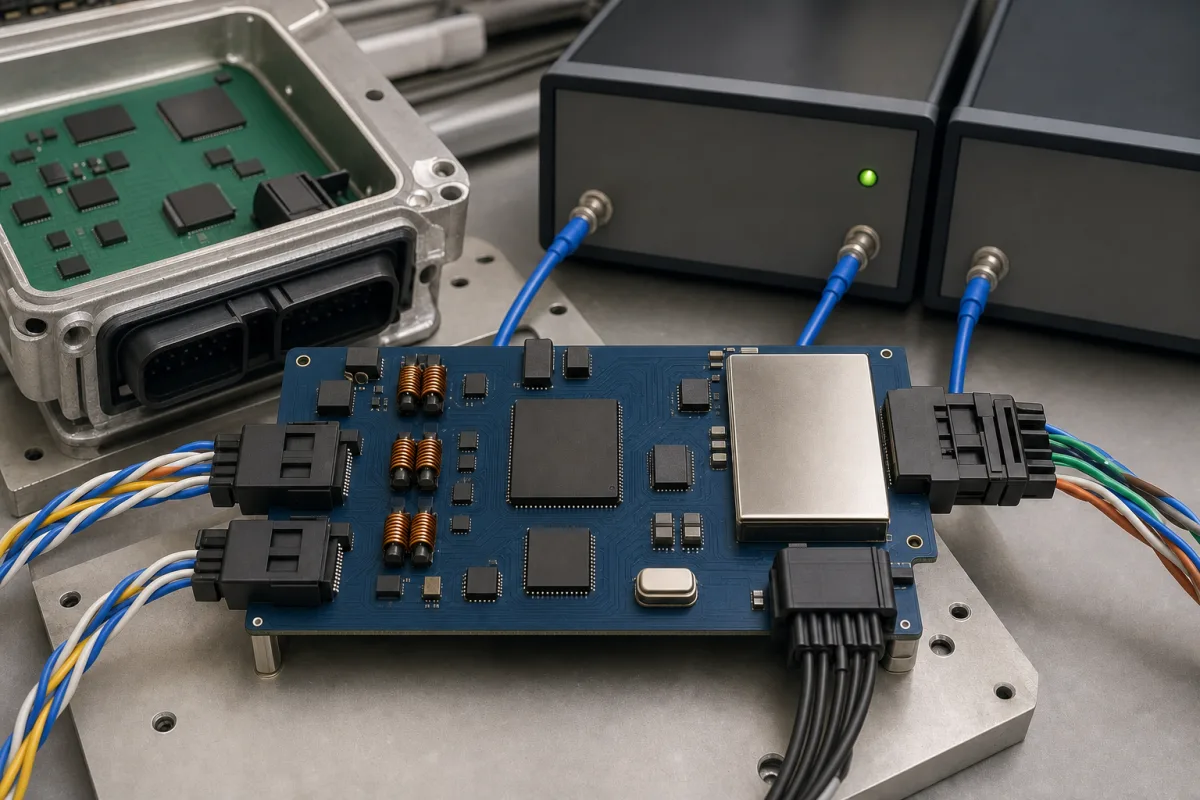
Communication Interface (e.g., CAN, Ethernet) in a manufacturing environment
Representative product image. Confirm appearance and specifications with the manufacturer.

Product Specifications

Technical details and manufacturing context for Communication Interface (e.g., CAN, Ethernet)

Definition
A communication interface in an Electronic Control Unit (ECU) is the dedicated subsystem responsible for transmitting and receiving data to and from external devices, networks, or other ECUs. It implements specific communication protocols (like CAN, LIN, FlexRay, or Ethernet) to ensure reliable, standardized, and often real-time data transfer, which is critical for vehicle/system control, diagnostics, and sensor/actuator integration. The interface typically consists of a transceiver (hardware) that converts digital signals from the ECU's microcontroller into the physical layer signals of the protocol (e.g., differential voltage for CAN, electrical pulses for Ethernet). Protocol-specific controller hardware or software (firmware/drivers) manages data framing, error checking, addressing, and bus arbitration (for multi-master systems like CAN) to ensure data integrity and proper network communication. This component is used in motor vehicle manufacturing as a part of the ECU, enabling communication with other ECUs, sensors, actuators, and diagnostic tools. The interface supports various data rates, for example, CAN up to 1 Mbps and Automotive Ethernet from 100 Mbps to 1 Gbps or higher, depending on the specific implementation. Materials typically include silicon for integrated circuits, copper for connectors and traces, and plastic for connector housing. When selecting or verifying a communication interface, it is essential to confirm the exact protocol, data rate, and physical layer requirements for the specific vehicle application. Always verify model-specific values and standards with the legal manufacturer or supplier, as the directory provides reference ranges only.
Working Principle
The interface typically consists of a transceiver (hardware) that converts digital signals from the ECU's microcontroller into the physical layer signals of the protocol (e.g., differential voltage for CAN, electrical pulses for Ethernet). Protocol-specific controller hardware or software (firmware/drivers) manages data framing, error checking, addressing, and bus arbitration (for multi-master systems like CAN) to ensure data integrity and proper network communication.
Common Materials
Silicon (for integrated circuits), Copper (for connectors and traces), Plastic (for connector housing)
Technical Parameters

What to specify in your RFQ

  • Data transmission rate (e.g., CAN: up to 1 Mbps, Automotive Ethernet: 100 Mbps to 1 Gbps+) in Mbps

These are the quantities to specify to the manufacturer when sizing or requesting a quote. The manufacturer's own documentation governs the exact figures and applicable standard.

Components / BOM
  • Transceiver
    Converts logic-level signals from the microcontroller to the physical layer signals of the communication protocol (e.g., differential voltages for CAN) and vice-versa.
    Material: Silicon
  • Protocol Controller
    Hardware module or firmware that handles protocol-specific tasks like message framing, error detection, arbitration, and flow control.
    Material: Silicon
  • Connector Part
    Physical port for attaching communication cables or bus lines to the ECU.
    Material: Plastic housing with metal (e.g., copper alloy) contacts

Applied To / Applications

This component is essential for the following industrial systems and equipment:

Industrial Ecosystem & Supply Chain Structure

Complementary Systems
Downstream Applications
Specialized Tooling

Application Fit & Sizing Matrix

Operational Limits
pressure: N/A (electronic component, not fluid handling)
other spec: EMC compliance: ISO 7637-2, ISO 11452-2; Vibration: 10-2000 Hz, 10g; Humidity: 5-95% RH non-condensing
temperature: -40°C to +85°C (operational), -40°C to +125°C (storage)
Media Compatibility
✓ Automotive CAN bus networks ✓ Industrial Ethernet/IP networks ✓ J1939 heavy equipment systems
Unsuitable: High-voltage arc environments (e.g., welding stations, plasma cutting) due to EMI susceptibility
Sizing Data Required
  • Required data throughput (Mbps) and latency (ms)
  • Number of nodes/ECUs in network topology
  • Protocol-specific requirements (e.g., CAN baud rate, Ethernet PHY type)

Reliability & Engineering Risk Analysis

Failure Mode & Root Cause
Signal Degradation
Cause: Electromagnetic interference (EMI) from nearby high-power equipment, improper shielding, or cable damage leading to data corruption, packet loss, or communication errors.
Physical Connector Failure
Cause: Vibration-induced loosening, corrosion from environmental contaminants (moisture, chemicals), or mechanical wear from repeated mating cycles, resulting in intermittent or lost connections.
Maintenance Indicators
  • Intermittent or complete loss of communication between devices, often accompanied by error logs indicating timeouts, CRC errors, or invalid packets.
  • Visible corrosion, bent pins, or loose connectors at interface points, sometimes with audible crackling or popping from electrical arcing in severe cases.
Engineering Tips
  • Implement robust EMI shielding and proper grounding practices, including the use of shielded cables, ferrite cores, and maintaining safe distances from high-noise sources like motors or variable frequency drives.
  • Use locking connectors, apply anti-corrosion coatings, and perform regular torque checks on connections in high-vibration environments to prevent mechanical degradation.

Indicative industry ranges for design and RFQ preparation. Confirm the exact figures and applicable standard with the manufacturer before specifying.

Compliance & Manufacturing Standards

Applicable Standards
ISO 11898-1:2015 (CAN bus) ISO/IEC 8802-3:2017 (Ethernet) CE Marking (EMC Directive 2014/30/EU)

Quoted from the published standard.

Manufacturing Precision
  • Connector Pin Alignment: +/-0.15mm
  • Signal Integrity: Eye Diagram Mask Compliance (per IEEE 802.3)
Quality Inspection
  • Electromagnetic Compatibility (EMC) Testing
  • Protocol Conformance Testing (e.g., CANopen, Ethernet/IP)

Manufacturers of Communication Interface (e.g., CAN, Ethernet)

Manufacturer profiles associated with Communication Interface (e.g., CAN, Ethernet).

Sourcing Communication Interface (e.g., CAN, Ethernet) from China?
Tell us your specification and target quantity — we will match it against manufacturer records and come back with the factories that fit.
Request manufacturers We manufacture this

Manufacturer listings support early research and capability understanding. They are not certification, ranking, or transaction guarantees.

Share this page
Technical documentation
Request current drawings, revision history, and a signed specification sheet.
Manufacturing capability
Verify equipment lists, process limits, capacity, and representative production evidence.
Inspection readiness
Confirm test methods, calibrated equipment, sampling plans, and traceable reports.
Supplier transparency
Check the legal entity, factory address, ownership, certifications, and direct contacts.

CNFX does not score or rank suppliers. Buyers must verify all claims and documents with the legal manufacturer before ordering.

Supply Chain Compatible Machinery & Devices

Automotive Wireless Power Transfer System

The Automotive Wireless Power Transfer System is an integrated solution for contactless charging of electric vehicles.

Explore Specs →
Automotive Active Suspension Damping System

The Automotive Active Suspension Damping System is an advanced suspension solution designed for motor vehicles.

Explore Specs →
Ground Assembly Unit

A foundational structural component that provides stable mounting and alignment for equipment within an industrial system.

Explore Specs →
Vehicle Assembly Unit

A modular component within an industrial system responsible for assembling vehicle structures and subassemblies.

Explore Specs →

Frequently Asked Questions

What protocols does this communication interface support?

The interface supports standardized protocols such as CAN, LIN, FlexRay, or Ethernet, depending on the specific implementation. The exact protocol must be confirmed with the manufacturer for the intended application.

What data rates are possible?

Data rates vary by protocol: CAN typically supports up to 1 Mbps, while Automotive Ethernet can range from 100 Mbps to 1 Gbps or higher. These are reference ranges; verify the actual rate for your model.

What materials are used in this component?

Common materials include silicon for integrated circuits, copper for connectors and traces, and plastic for connector housing. Material grades and specifications should be confirmed with the supplier.

How do I verify the interface meets my requirements?

Check the technical datasheet for the specific protocol, data rate, and physical layer characteristics. Always confirm with the legal manufacturer or supplier, as directory information is for reference only.

Data Basis

Editorial classification, named public sources where available, and source-reviewed manufacturer records.

Preliminary Technical Classification
This page supports structured research, RFQ preparation, and supplier evaluation. It does not replace buyer-led supplier qualification, standards review, or technical approval.
Buyer enquiry

Request manufacturing insight for Communication Interface (e.g., CAN, Ethernet)

Ask for use case, specification boundaries, supplier type, and RFQ preparation information for this product.

Where it goes
Straight to the CNFX editorial desk, and to the manufacturer if this product is linked to a claimed profile. Nothing is broadcast to a supplier list.
Your details stay here
We do not sell or rent enquiry data, and we do not add you to a mailing list. Used only to answer this request.
No commission, no middleman
CNFX is a directory. We take no cut of any order and never negotiate on a supplier's behalf.
What we don't claim
A listing is not an endorsement. Qualify every supplier and verify every figure yourself before ordering.

Your business information is used only to process this request.

Thank you! Your message has been sent. We'll respond within 1–3 business days.
Sorry, we couldn't send your message. Please try again, or email us at [email protected].

Need to Manufacture Communication Interface (e.g., CAN, Ethernet)?

Compare manufacturer profiles with relevant product and process capability.

Previous Product
Vehicle Assembly Unit
Last Product
Get QuotesChat