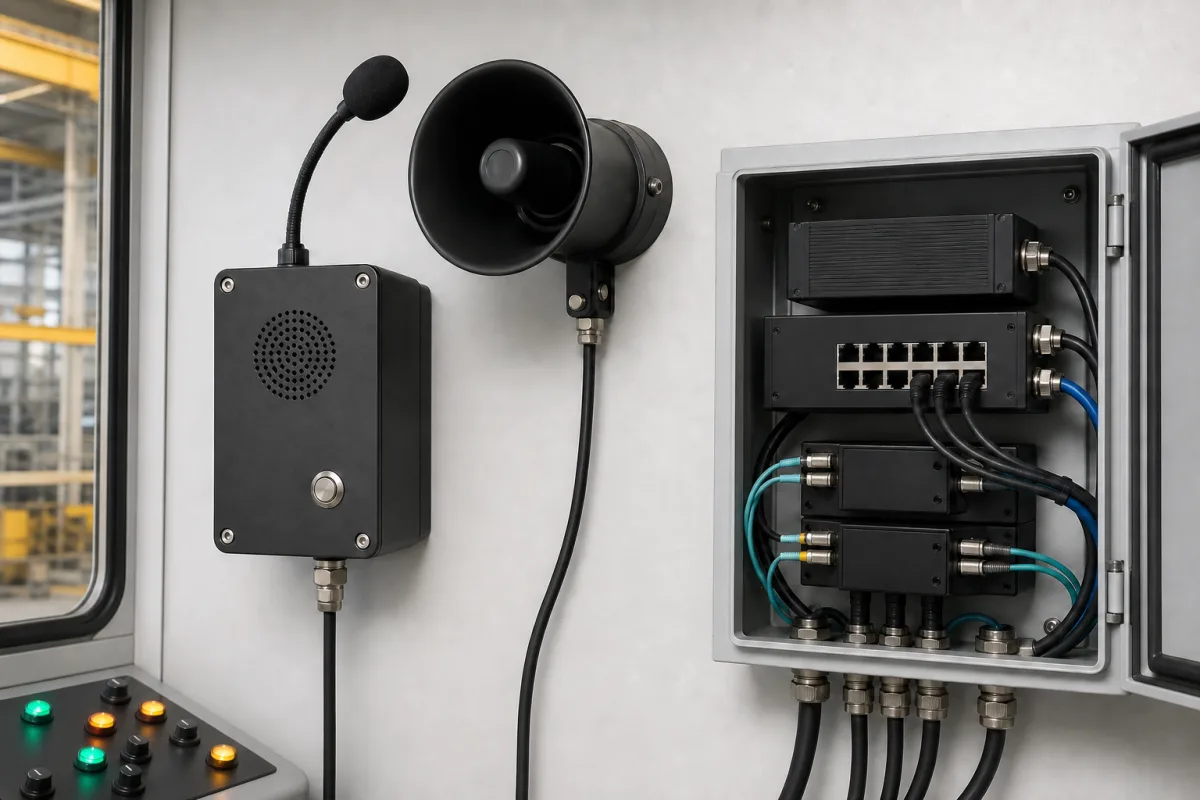
Crane cab and remote-operation communication system (intercom, signalling and data link)
Crane cab and control-room communications · Hands-free voice, intercom stations and the data link for remote crane operation
A crane cab and remote-operation communication system is the equipment that lets a crane operator talk with signal persons and the control room, and, on cranes run from a remote station, carries the control commands and camera video between the crane and that station. It combines intercom or radio stations and loudspeakers in the cab, a network or radio link, and the switches and converters that join them. Ask three things first: which voice paths the job needs and whether reception must be hands-free, how much bandwidth and delay the data link allows, and what environment the cab and crane-side equipment must survive.
Communication systems for crane cabs and crane control rooms: hands-free voice signalling between operator and signal persons, IP or SIP intercom stations and loudspeakers in cabs and control rooms, and the wireless, fibre or 5G links that carry control and video for remote-operated cranes. Handheld two-way radios (walkie-talkies), analog and DMR, are covered on the Two-way radio page. Marine bridge talkback, public broadcast systems and microwave components are outside this page.
CNFX editorial research · Sources checked October 12, 2026 · 3 sources
For cranes and derricks in US construction, OSHA's 29 CFR 1926.1420 sets three requirements for signals sent by radio, telephone or other electronic means: the devices must be tested on site before operations begin to ensure transmission is effective, clear and reliable; signals must go through a dedicated channel, except that multiple cranes or derricks and one or more signal persons may share one dedicated channel to coordinate, and work on or beside railway tracks may be coordinated with other equipment; and the operator's reception of signals must be by a hands-free system. [1]
Fixed intercom stations serve the cab and control room. Zenitel lists its TCIS-3 SIP audio intercom with full open duplex, automatic gain and volume control, acoustic echo cancellation and noise cancellation, a 10 W class D amplifier and speaker, a maximum sound pressure level of 106 dB at 0.5 m and a G.722 frequency range of 200 Hz to 7,000 Hz. It is rated IP66 and IK08, runs from –40 °C to 70 °C, is powered by PoE (IEEE 802.3af) or 24 V DC (16–48 V), draws 1.8 W idle and up to 12 W depending on volume, measures 180 × 120 × 73 mm and weighs 0.8 kg. [2]
Editorial calculation: 106 dB at 0.5 m falls by about 6 dB per doubling of distance in free field, so roughly 100 dB at 1 m and 94 dB at 2 m; cab noise and reflections change this, so ask for a test in the actual cab. [2]
Give the supplier the crane type and number of cranes, the voice paths needed (operator–signal person, cab–control room, cab–ground), whether hands-free reception and a dedicated channel are required, the cab noise level, the network and power available (PoE or 24 V DC), the remote-operation data needs (control, number and resolution of cameras), the link type (Wi-Fi, fibre, 5G), the delay limit, the environment (temperature, dust, vibration) and the ingress rating.
02
Size the data link for remote crane operation
Dalian Baosteel Metallurgy (DBM) describes the communication system of its steel-mill remote crane control system as wireless access points, antennas, signal converters and optical fibre, with the crane terminal and the remote control terminal linked over a 5G network. DBM states an uplink rate of 200 Mbps, a downlink rate of 1.2 Gbps and a communication delay of 20 ms, which it says meets the needs of real-time PLC control commands, high-definition video transmission and video monitoring. [3]
DBM states that 5G base-station position detection gives a positioning accuracy of 10 cm, that the system detects communication failure between the crane PLC and the management station, and that on a communication failure the crane stops automatically at its current position. Multiple high-definition cameras on the crane give the operator an all-round view from the control room, with 4K remote monitoring. [3]
Editorial calculation: at 20 ms delay, a crane moving at 1 m/s travels 2 cm before a command arrives; scale this by your crane's travel and hoist speeds to judge whether the delay is acceptable. The 200 Mbps uplink carries the camera video from the crane, so divide it by the per-camera bit rate to check how many streams fit. [3]
03
Compare the voice and data elements
The published figures come from a regulation, an intercom maker and a crane automation supplier. They describe different parts of one system.
Element
Source
Figures or requirements stated
Electronic signalling to the operator
OSHA 1926.1420
Tested on site; dedicated channel; hands-free reception [1]
Cab or control-room intercom station
Zenitel TCIS-3
106 dB at 0.5 m; IP66, IK08; –40 to 70 °C; PoE or 16–48 V DC [2]
Remote-operation data link
DBM remote crane control
5G; 200 Mbps up, 1.2 Gbps down; 20 ms; stop on link failure [3]
04
Transceivers, intercoms, network gear and failure detection
Part
Role
Fix in the order
Transceiver
Radio, Wi-Fi access point or 5G terminal on the crane. [3]
1 company lists this product among what they make. Company figures are quoted from each
company's own website; every card states where the relationship came from.
Dalian BaoSteel Metallurgy Group Co., Ltd.
Manufacturing site to be confirmed for the order
Lists a remote crane control system whose communication system uses wireless access points, antennas, signal converters, optical fibre and a 5G link.
Explore company information and manufacturing capabilities, then discuss the scope of your project with a relevant supplier.
Share this page
Compiled and source-reviewed by the CNFX editorial team.
Each manufacturer above links to the page on that company's own website where the product is listed, with the date we checked it. How we source and review
· Page last updated 13 October 2026
Buyer questions
What does OSHA require for radio signals to a crane operator?
29 CFR 1926.1420 requires on-site testing of the devices before operations, a dedicated channel with limited exceptions, and hands-free reception by the operator. [1]
How fast must a remote crane data link be?
DBM cites 200 Mbps uplink, 1.2 Gbps downlink and 20 ms delay for the 5G link of its steel-mill remote crane control system. [3]
How loud is an industrial IP intercom?
Zenitel lists its TCIS-3 at a maximum of 106 dB SPL at 0.5 m, with a 10 W class D amplifier and IP66 rating. [2]
Sources and what still needs a direct check
Sources checked 2026-10-12. 29 CFR 1926.1420 is a US Department of Labor (OSHA) regulation; Zenitel and DBM describe their own products.