Industry-Verified Manufacturing Data (2026)

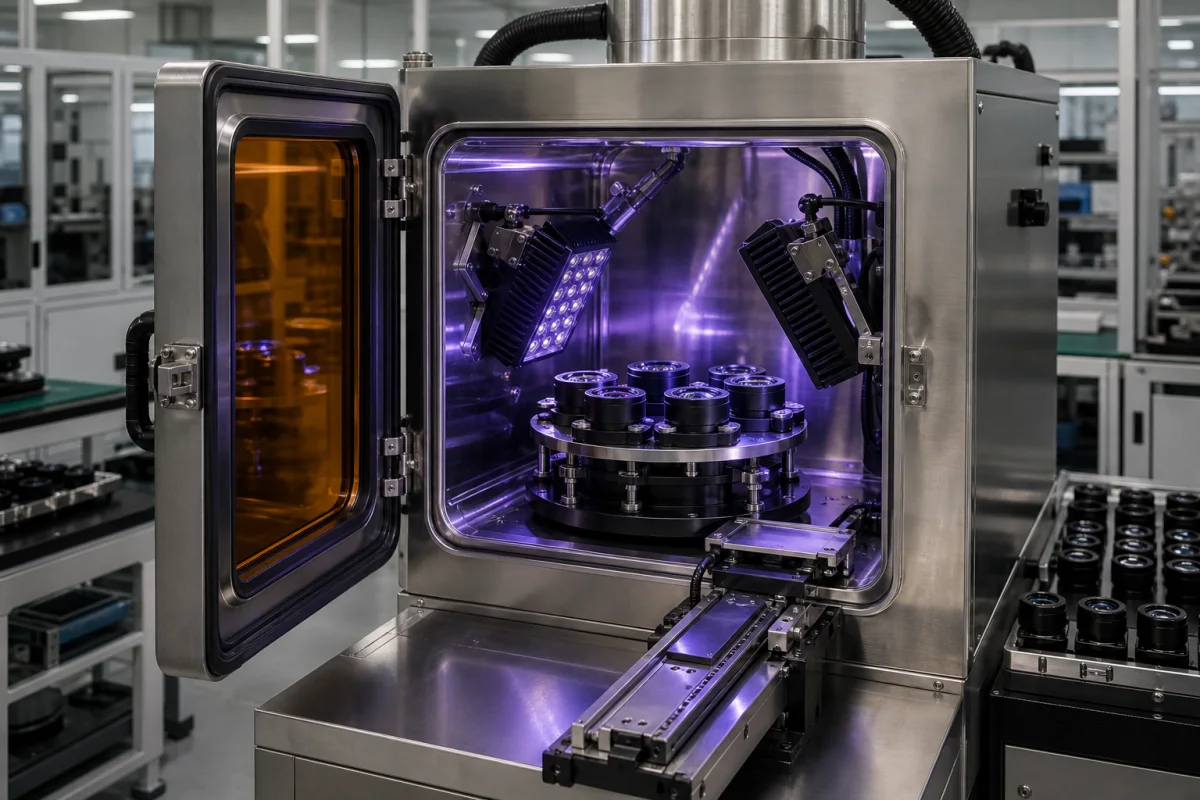
UV Curing Chamber

Based on aggregated insights from multiple verified factory profiles within the CNFX directory, the standard UV Curing Chamber used in the Computer, Electronic and Optical Product Manufacturing sector typically supports operational capacities ranging from standard industrial configurations to heavy-duty production requirements.

Technical Definition & Core Assembly

A canonical UV Curing Chamber is characterized by the integration of UV Lamp Array and Reflector Assembly. In industrial production environments, manufacturers listed on CNFX commonly emphasize Stainless Steel (chassis/enclosure) construction to support stable, high-cycle operation across diverse manufacturing scenarios.

A specialized enclosure that uses ultraviolet light to rapidly cure adhesives, coatings, or resins applied to optical lenses during assembly.

Product Specifications

Technical details and manufacturing context for UV Curing Chamber

Definition
The UV Curing Chamber is a critical component within the Automated Multi-Stage Lens Assembly and Testing System. It is responsible for the final bonding and sealing stage, where UV-curable adhesives or coatings applied to lens elements, mounts, or housings are exposed to controlled ultraviolet radiation. This process triggers photopolymerization, transforming the liquid adhesive into a solid, durable bond within seconds, ensuring precise optical alignment and structural integrity are maintained before the lens proceeds to final testing stages.
Working Principle
The chamber houses high-intensity UV lamps (typically mercury vapor, LED, or microwave-powered) that emit light in the UVA spectrum (315-400 nm). This UV radiation is directed onto the lens assembly, which has been treated with a photopolymer adhesive. The photons are absorbed by photoinitiators within the adhesive, generating free radicals or cations that initiate a rapid chain-reaction polymerization, curing the material from a liquid to a solid state. The chamber often includes reflective surfaces to maximize UV exposure uniformity, cooling systems to manage heat, and safety interlocks to prevent operator exposure.
Common Materials
Stainless Steel (chassis/enclosure), Fused Quartz or High-Purity Silica Glass (UV-transmissive window), Aluminum (reflectors/heat sinks), UV-resistant polymers (seals, gaskets)
Technical Parameters
  • Peak wavelength of UV emission, typically 365 nm for standard acrylic adhesives. (nm) Customizable
Components / BOM
  • UV Lamp Array
    Generates the ultraviolet radiation required for photopolymerization.
    Material: Quartz glass envelope, tungsten electrodes, mercury/gas fill
  • Reflector Assembly
    Directs and focuses UV light onto the workpiece for uniform exposure.
    Material: Polished aluminum with protective coating
  • Cooling System
    Manages heat generated by UV lamps to prevent thermal damage to lenses or chamber components.
    Material: Aluminum heat sinks, fans, or water-cooling channels
  • Safety Interlock & Viewport
    Prevents chamber operation when open and allows visual monitoring through a UV-blocking window.
    Material: Steel frame, polycarbonate or laminated glass with UV filter
Engineering Reasoning
365-405 nm wavelength, 100-500 mW/cm² intensity, 20-80°C chamber temperature
UV lamp output below 80 mW/cm² at 385 nm wavelength, chamber temperature exceeding 95°C, or wavelength deviation beyond ±5 nm from target
Design Rationale: UV lamp mercury vapor pressure drop below 0.1 Pa causing spectral shift, quartz envelope devitrification reducing transmission below 85%, or thermal expansion mismatch between aluminum housing and quartz windows exceeding 12 μm/m·K differential
Risk Mitigation (FMEA)
Trigger UV lamp electrode sputtering at 10^-3 Torr pressure causing tungsten deposition on quartz
Mode: UV output attenuation to 60% of nominal intensity within 500 operating hours
Strategy: Implement getter material (titanium-zirconium alloy) in lamp envelope to maintain 10^-5 Torr vacuum and reduce sputtering rate by 90%
Trigger Polymerization inhibitor accumulation (hydroquinone derivatives) at 0.1% concentration in resin
Mode: Incomplete curing with gel fraction below 85% and residual monomer above 15%
Strategy: Integrate inline FTIR spectroscopy with feedback control to adjust UV dose to 3-5 J/cm² based on real-time monomer conversion monitoring

Industry Taxonomies & Aliases

Commonly used trade names and technical identifiers for UV Curing Chamber.

Industrial Ecosystem & Supply Chain DNA

Complementary Systems
Downstream Applications
Specialized Tooling

Application Fit & Sizing Matrix

Operational Limits
pressure: Atmospheric (no pressure requirements)
temperature: Ambient to 60°C (operating environment)
uv intensity: 100-500 mW/cm² (adjustable)
exposure time: 5-300 seconds (programmable)
chamber dimensions: Customizable, typical 300x300x300mm to 1000x1000x1000mm
Media Compatibility
✓ UV-curable optical adhesives (e.g., epoxy, acrylic) ✓ UV-curable lens coatings (anti-reflective, scratch-resistant) ✓ UV-curable potting compounds for optical assemblies
Unsuitable: High-humidity environments (>80% RH) or areas with significant particulate contamination
Sizing Data Required
  • Maximum lens dimensions and batch quantity per cycle
  • Required UV intensity and wavelength (typically 365nm or 395nm) for specific curing chemistry
  • Production throughput requirements (curing time per batch vs. total daily volume)

Reliability & Engineering Risk Analysis

Failure Mode & Root Cause
UV Lamp Degradation
Cause: Gradual reduction in UV output due to aging of mercury vapor lamps, electrode wear, or phosphor coating deterioration, leading to insufficient curing energy and inconsistent product quality.
Reflector Surface Contamination
Cause: Accumulation of dust, ozone byproducts, or volatile organic compounds on aluminum or dichroic reflectors, reducing UV intensity through absorption and scattering, often exacerbated by poor chamber sealing or inadequate filtration.
Maintenance Indicators
  • Audible high-frequency buzzing or flickering from UV lamps, indicating ballast failure or imminent lamp burnout.
  • Visible yellowing, hazing, or opaque spots on quartz lamp sleeves or reflector surfaces, signaling contamination that critically reduces UV transmission.
Engineering Tips
  • Implement a lamp-hour tracking system with preventive replacement at 70-80% of rated life, and use a calibrated radiometer to verify UV intensity matches specifications monthly, adjusting power or lamp position as needed.
  • Maintain positive pressure with HEPA-filtered air in the chamber, install post-cure ozone destruct units, and clean reflectors/sleeves quarterly with IPA using lint-free wipes to prevent performance loss from contamination.

Compliance & Manufacturing Standards

Reference Standards
ISO 9001:2015 - Quality Management Systems CE Marking - EU Directive 2014/35/EU (Low Voltage Directive) ANSI/UL 61010-1 - Safety Requirements for Electrical Equipment for Measurement, Control, and Laboratory Use
Manufacturing Precision
  • UV Intensity Uniformity: +/- 15% across curing area
  • Temperature Control: +/- 2°C during operation
Quality Inspection
  • UV Wavelength Verification Test
  • Safety Interlock Functionality Test

Factories Producing UV Curing Chamber

Verified manufacturers with capability to produce this product in China

✓ 97% Supplier Capability Match Found

S Sourcing Manager from Canada Mar 01, 2026
★★★★★
"As a professional in the Computer, Electronic and Optical Product Manufacturing sector, I confirm this UV Curing Chamber meets all ISO standards."
Technical Specifications Verified
P Procurement Specialist from United States Feb 26, 2026
★★★★☆
"Standard OEM quality for Computer, Electronic and Optical Product Manufacturing applications. The UV Curing Chamber arrived with full certification. (Delivery took slightly longer than expected, but technical support was excellent.)"
Technical Specifications Verified
T Technical Director from United Arab Emirates Feb 23, 2026
★★★★★
"Great transparency on the UV Curing Chamber components. Essential for our Computer, Electronic and Optical Product Manufacturing supply chain."
Technical Specifications Verified
Verification Protocol

“Feedback is collected from verified sourcing managers during RFQ (Request for Quote) and factory evaluation processes on CNFX. These reports represent historical performance data and technical audit summaries from our B2B manufacturing network.”

8 sourcing managers are analyzing this specification now. Last inquiry for UV Curing Chamber from Poland (39m ago).

Supply Chain Compatible Machinery & Devices

Industrial IoT Gateway

Edge computing device connecting industrial equipment to cloud platforms.

Explore Specs →
Modular Industrial Edge Computing Device

Rugged computing platform for industrial data processing at the network edge

Explore Specs →
Industrial Smart Camera Module

Embedded vision system for industrial automation and quality inspection.

Explore Specs →
Industrial Wireless Power Transfer Module

Wireless power transfer module for industrial equipment applications

Explore Specs →

Frequently Asked Questions

What materials are used in the UV-transmissive windows and why?

The chamber uses fused quartz or high-purity silica glass for UV-transmissive windows because these materials offer excellent UV transmission (typically >90% at 365nm), high thermal stability, and resistance to UV degradation, ensuring consistent curing performance over time.

How does the safety interlock system work in this UV curing chamber?

The safety interlock automatically shuts off UV lamps when the chamber door is opened, preventing accidental UV exposure. Combined with a UV-blocking viewport, it allows visual monitoring without risk, meeting industrial safety standards for optical manufacturing environments.

What types of optical components can this UV chamber cure?

This chamber is designed for curing adhesives, coatings, and resins on various optical components including camera lenses, microscope optics, laser system elements, and precision optical assemblies, with uniform curing across the entire chamber workspace.

Can I contact factories directly on CNFX?

CNFX is an open directory, not a transaction platform. Each factory profile provides direct contact information and production details to help you initiate direct inquiries with Chinese suppliers.

Get Quote for UV Curing Chamber

Request technical pricing, lead times, or customized specifications for UV Curing Chamber directly from verified manufacturing units.

Your business information is encrypted and only shared with verified UV Curing Chamber suppliers.

Thank you! Your message has been sent. We'll respond within 1–3 business days.

Need to Manufacture UV Curing Chamber?

Connect with verified factories specializing in this product category

Add Your Factory Contact Us
Previous Product
User Interface Panel
Next Product
UV Curing Module