UV LED curing lamps and modules for adhesives, conformal coatings and inks on production lines · Wavelength, peak irradiance, emitting window or curing area, air or water cooling, scalability, controller and compliance
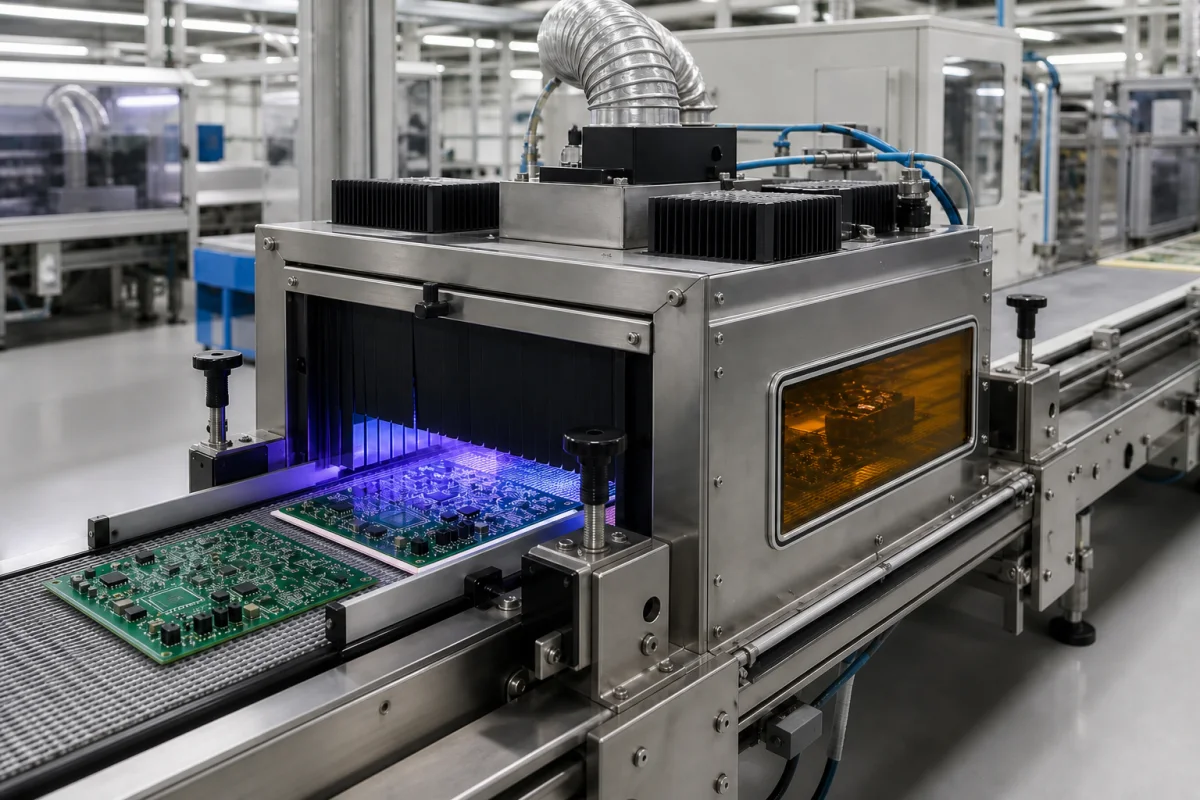
A UV curing module is the light source that cures UV- or light-curable adhesives, conformal coatings and inks in seconds as parts pass beneath it or sit under it. LED modules emit in narrow bands, so the material and the lamp must be matched. Ask three things first: which wavelength the adhesive, coating or ink is formulated for, what irradiance and dose it needs at the actual working distance, and what curing area, line speed and cooling the line can accommodate.
UV LED curing lamps, line and flood emitters and their controllers, supplied as modules for integration into conveyors, coating lines, printing presses and assembly stations. Mercury-arc lamp systems are compared only where makers list them; UV-C germicidal lamps (see UV-C germicidal lamp), complete conformal coating machines and curing ovens (see industrial ovens) are outside this page.
CNFX editorial research · Sources checked October 11, 2026 · 4 sources
Match the wavelength and irradiance to the material
Phoseon states that its UV LED curing products use 365 nm, 385 nm, 395 nm and 405 nm wavelengths. Its air-cooled FireJet lamp is listed at 8 W/cm² at 365 nm and 16 W/cm² at 385, 395 and 405 nm, and its water-cooled FirePower lamp at 12 W/cm² at 365 nm and 20 W/cm² at 385, 395 and 405 nm. Phoseon notes that peak irradiance is measured at the UV emitting window. [1][2][3]
Dymax describes its light-curing systems as using moderate- to high-intensity LED or UV/visible light to cure light-curable adhesives, coatings and UV inks, with LED systems at 365, 385 and 405 nm alongside UV/visible lamp systems. It lists line-curing emitters delivering over 4.2 W/cm² across their curing zones. [4]
Editorial note: irradiance stated at the emitting window falls with distance, so ask for irradiance and dose at the working distance you will use, measured with a radiometer suited to the wavelength.
Give the supplier the adhesive, coating or ink and its recommended wavelength and dose, the working distance, part or web width, line speed or exposure time, required curing area, available cooling (air or water), controller and interlock requirements, mounting space and the compliance marks needed.
02
Size the curing area, scaling and cooling
Phoseon lists the FireJet with emitting windows of 75, 150, 225, 300 and 375 × 20 mm and the FirePower with 225 and 350 × 20 mm, and states that the FireEdge and FireJet lamps are designed to be scaled by mounting them end-to-end. Its air-cooled family comprises FireJet, FireEdge and FireFly, and its water-cooled family FirePower and FireLine; it states that its systems are CE, RoHS and REACH compliant. [1][2][3]
Dymax lists LED flood emitters with a 50 × 50 mm active curing area and line emitters with a 5 × 50 mm cure area, either grouped with one controller to cover larger zones, and stackable line emitters covering 25 × 75 mm or 25 × 150 mm; it also lists all-in-one units combining emitter, controller and power supply. [4]
Editorial calculation: five 75 mm FireJet windows mounted end-to-end span the same 375 mm length as the longest single window listed (5 × 75 mm). [2]
03
Trace the parts of a UV LED curing module
This is a functional reference built from the sources cited; it is not one maker's design.
Fill the specification fields with values for your process
A UV curing module selection needs values for your material and line. The table explains each field, gives published values where a reviewed source states them, and says what to obtain from the supplier.
Explore company information and manufacturing capabilities, then discuss the scope of your project with a relevant supplier.
Share this page
Compiled and source-reviewed by the CNFX editorial team.
Published product pages show what a company offers, not tested performance. Confirm the legal seller, factory and scope for your order. How we source and review
· Page last updated 13 October 2026
Buyer questions
Which wavelengths do UV LED curing modules use?
Published modules use 365, 385, 395 and 405 nm; the material must be formulated for the chosen wavelength. [1][4]
Where is UV LED irradiance measured?
One maker states peak irradiance is measured at the UV emitting window, so irradiance at the part depends on distance. [3]
How are UV LED curing areas extended?
Makers mount lamps end-to-end or group more than one emitter on a controller to cover longer or larger zones. [1][4]
Sources and what still needs a direct check
Sources checked 2026-10-11. Sources are two makers' product pages for specific UV LED curing lamps and emitters, cited as examples of the parameters a UV curing specification covers, not endorsements.