Industry-Verified Manufacturing Data (2026)

Reflector Assembly

Based on aggregated insights from multiple verified factory profiles within the CNFX directory, the standard Reflector Assembly used in the Machinery and Equipment Manufacturing sector typically supports operational capacities ranging from standard industrial configurations to heavy-duty production requirements.

Technical Definition & Core Assembly

A canonical Reflector Assembly is characterized by the integration of Reflective Body / Housing and Reflective Surface Coating. In industrial production environments, manufacturers listed on CNFX commonly emphasize Polished Aluminum construction to support stable, high-cycle operation across diverse manufacturing scenarios.

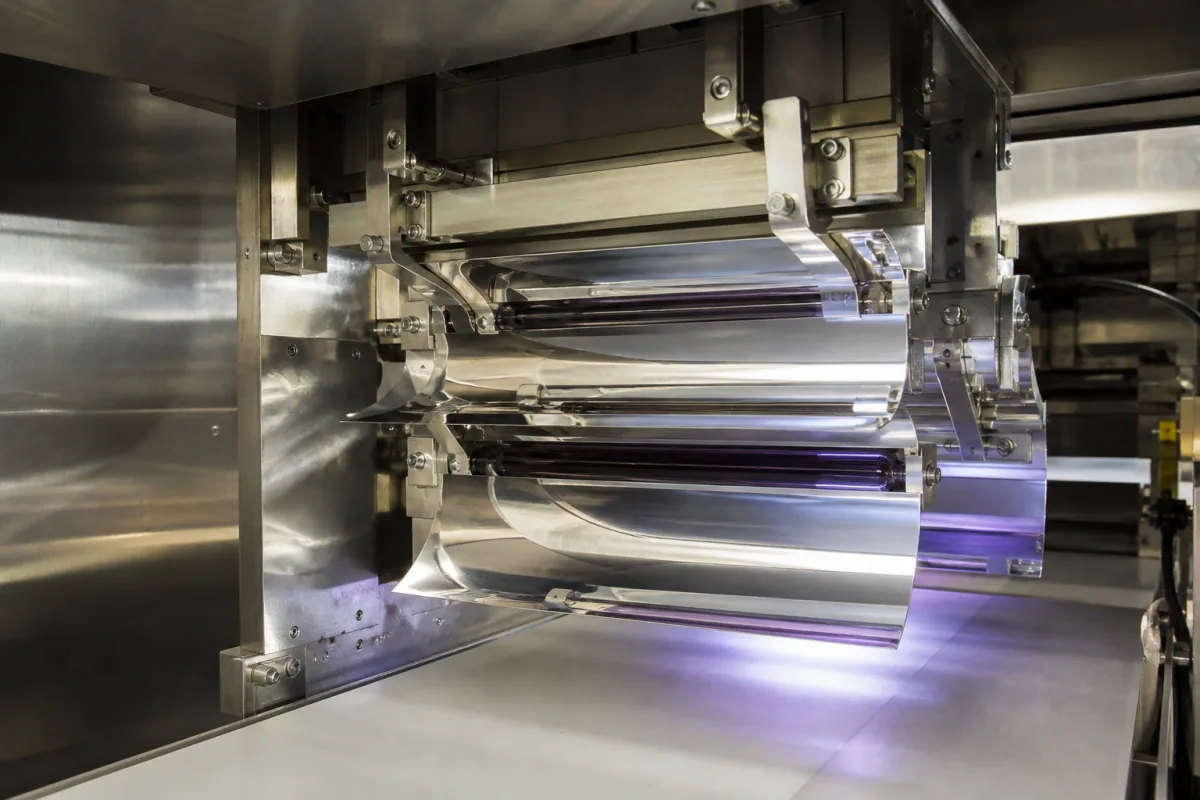
A precision optical assembly designed to direct and focus UV radiation within a curing chamber.
Product Specifications

Technical details and manufacturing context for Reflector Assembly

Definition
The Reflector Assembly is a critical component of a UV Curing Chamber, responsible for efficiently collecting, directing, and focusing ultraviolet (UV) light emitted from the lamp source onto the target substrate. It ensures uniform and intense irradiation, which is essential for initiating and controlling photopolymerization reactions in coatings, inks, adhesives, and resins.
Working Principle
The assembly operates on the principle of specular reflection. Its internal reflective surfaces, typically parabolic or elliptical in geometry, are engineered to capture UV light emitted in all directions from the lamp. This light is then redirected into a controlled, focused beam or pattern, maximizing energy delivery to the curing zone and minimizing losses.
Common Materials
Polished Aluminum, Enhanced Aluminum Alloy (e.g., with protective coating)
Technical Parameters
  • Overall assembly dimensions (Length x Width x Height) to fit the designated chamber mounting. (mm) Standard Spec
Components / BOM
  • Reflective Body / Housing
    Forms the primary optical structure with the precise reflective surface geometry (e.g., parabolic trough).
    Material: Aluminum Alloy
  • Reflective Surface Coating
    A specialized, highly reflective finish (e.g., enhanced aluminum, dichroic coating) applied to the body to maximize UV reflectance and durability.
    Material: Enhanced Aluminum / Protective Dielectric Coating
  • Mounting Brackets / Frame
    Provides secure mechanical attachment points to integrate the assembly into the UV curing chamber structure and align it with the lamp.
    Material: Stainless Steel or Aluminum
  • Cooling Fins / Heat Sink (if applicable)
    Dissipates heat generated by the absorbed fraction of radiation and proximity to the UV lamp, preventing overheating.
    Material: Aluminum
Engineering Reasoning
200-400 nm wavelength, 15-45° incident angle, 0.5-3.0 mW/cm² irradiance
Aluminum coating degradation at 150°C, fused silica substrate fracture at 120 MPa tensile stress, reflectance drop below 85% at 365 nm
Design Rationale: Thermal expansion mismatch (Aluminum CTE 23.1×10⁻⁶/°C vs fused silica 0.55×10⁻⁶/°C) causing coating delamination, UV-induced photodegradation of dielectric layers at photon energies >4.43 eV
Risk Mitigation (FMEA)
Trigger UV ozone generation at 185 nm wavelength
Mode: Aluminum oxide layer formation increasing surface roughness to Ra>50 nm
Strategy: Multi-layer dielectric coating (SiO₂/TiO₂) with 99.5% reflectance at 185-400 nm
Trigger Thermal cycling between 20-120°C at 5°C/min rate
Mode: Interfacial shear stress exceeding 45 MPa adhesive strength
Strategy: Graded CTE interlayer (Al-SiC composite with 8.2×10⁻⁶/°C CTE)

Industry Taxonomies & Aliases

Commonly used trade names and technical identifiers for Reflector Assembly.

Applied To / Applications

This component is essential for the following industrial systems and equipment:

Industrial Ecosystem & Supply Chain DNA

Complementary Systems
Downstream Applications
Specialized Tooling

Application Fit & Sizing Matrix

Operational Limits
humidity: 10% to 60% RH non-condensing
pressure: Atmospheric to 1.5 bar absolute
temperature: 20°C to 80°C (operating), -10°C to 100°C (storage)
uv intensity: Up to 500 mW/cm² at 365 nm wavelength
Media Compatibility
✓ UV-curable inks and coatings ✓ Epoxy adhesives requiring UV activation ✓ Photoresist materials in semiconductor manufacturing
Unsuitable: High particulate environments with abrasive slurry concentrations above 5% by weight
Sizing Data Required
  • Required UV intensity at target surface (mW/cm²)
  • Curing chamber dimensions and reflector focal length
  • Spectral output range of UV source (nm)

Reliability & Engineering Risk Analysis

Failure Mode & Root Cause
Corrosion-induced degradation
Cause: Exposure to corrosive environments (e.g., moisture, chemicals) leading to material breakdown, loss of reflectivity, and structural weakening.
Mechanical fatigue cracking
Cause: Cyclic thermal expansion/contraction or vibration stresses causing micro-cracks that propagate, compromising structural integrity and optical alignment.
Maintenance Indicators
  • Visible discoloration, pitting, or haze on reflective surfaces indicating corrosion or contamination
  • Audible rattling or abnormal vibration during operation suggesting loose components or structural fatigue
Engineering Tips
  • Implement regular non-destructive testing (e.g., ultrasonic inspection) to detect early-stage fatigue cracks before catastrophic failure
  • Apply protective coatings and maintain controlled environmental conditions (humidity, temperature) to minimize corrosion and thermal stress

Compliance & Manufacturing Standards

Reference Standards
ISO 9001:2015 - Quality management systems ANSI/IES RP-16-17 - Nomenclature and definitions for illuminating engineering DIN 67520-1 - Reflectors for road lighting - Part 1: Requirements and testing
Manufacturing Precision
  • Surface flatness: ≤ 0.1 mm per 100 mm
  • Mounting hole alignment: ± 0.05 mm
Quality Inspection
  • Surface reflectivity measurement (spectrophotometric analysis)
  • Dimensional verification using coordinate measuring machine (CMM)

Factories Producing Reflector Assembly

Verified manufacturers with capability to produce this product in China

✓ 97% Supplier Capability Match Found

T Technical Director from Canada Feb 07, 2026
★★★★★
"Impressive build quality. Especially the technical reliability is very stable during long-term operation."
Technical Specifications Verified
P Project Engineer from United States Feb 04, 2026
★★★★☆
"As a professional in the Machinery and Equipment Manufacturing sector, I confirm this Reflector Assembly meets all ISO standards. (Delivery took slightly longer than expected, but technical support was excellent.)"
Technical Specifications Verified
S Sourcing Manager from United Arab Emirates Feb 01, 2026
★★★★★
"Standard OEM quality for Machinery and Equipment Manufacturing applications. The Reflector Assembly arrived with full certification."
Technical Specifications Verified
Verification Protocol

“Feedback is collected from verified sourcing managers during RFQ (Request for Quote) and factory evaluation processes on CNFX. These reports represent historical performance data and technical audit summaries from our B2B manufacturing network.”

18 sourcing managers are analyzing this specification now. Last inquiry for Reflector Assembly from Germany (13m ago).

Supply Chain Compatible Machinery & Devices

Heavy-Duty CNC Plasma Cutting Machine

Industrial machine for precision metal cutting using plasma arc technology

Explore Specs →
Automated Assembly Line System

Integrated production system for sequential component assembly operations

Explore Specs →
Automated Powder Coating System

Integrated industrial system for applying dry powder coatings to metal substrates.

Explore Specs →
Centrifugal Pump Impeller

Rotating component that transfers energy to fluid in centrifugal pumps.

Explore Specs →

Frequently Asked Questions

What materials are used in this reflector assembly?

This reflector assembly is constructed from polished aluminum and enhanced aluminum alloys, often with protective coatings to ensure durability and optimal reflective performance in UV curing applications.

How does this assembly improve UV curing efficiency?

The precision optical design directs and focuses UV radiation within the curing chamber, maximizing energy utilization and ensuring consistent curing results across machinery and equipment manufacturing processes.

What components are included in the assembly?

The assembly includes a reflective body/housing, reflective surface coating, mounting brackets/frame, and optional cooling fins or heat sinks to manage thermal output during operation.

Can I contact factories directly on CNFX?

CNFX is an open directory, not a transaction platform. Each factory profile provides direct contact information and production details to help you initiate direct inquiries with Chinese suppliers.

Get Quote for Reflector Assembly

Request technical pricing, lead times, or customized specifications for Reflector Assembly directly from verified manufacturing units.

Your business information is encrypted and only shared with verified Reflector Assembly suppliers.

Thank you! Your message has been sent. We'll respond within 1–3 business days.

Need to Manufacture Reflector Assembly?

Connect with verified factories specializing in this product category

Add Your Factory Contact Us
Previous Product
Reference Target
Next Product
Refrigeration System