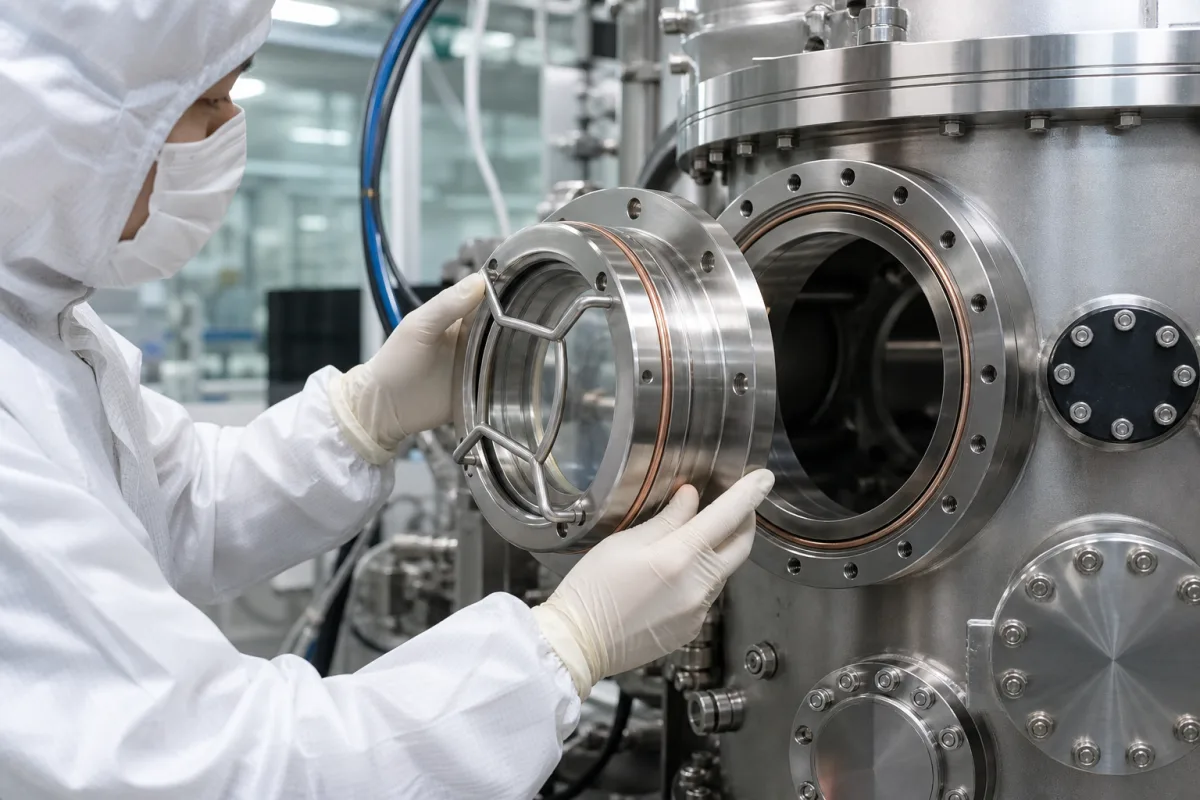
Viewport assembly for vacuum coating chambers: a bakeable CF window on a copper gasket, with a shutter that keeps the coating off the glass
Thin-film coating chambers · CF-flanged 7056 glass, fused silica or sapphire windows, bake limits from 200 to 400 °C, 10 °C/min heating, annealed copper gaskets and shutters that keep sputtered or evaporated material off the glass
A coating chamber needs a window so the operator can watch the plasma, the source and the substrate, yet the walls and fittings inside the chamber collect stray coating, and so does the inside of that window. The viewport assembly here is the glass sealed into a stainless CF flange, the copper gasket that seals it to the chamber port, and the shutter or guard that decides how long the window stays clear.
Ultra-high and high vacuum viewport assemblies for physical vapour deposition and other thin-film coating chambers: glass-to-metal sealed 7056 borosilicate, fused silica or sapphire windows on CF (ConFlat-compatible) or KF/ISO flanges, their bake and pressure limits, copper-gasket installation, and in-chamber shutters that stop deposition on the window. Round and obround sight glasses and viewing ports for process vessels, tanks, chamber doors and pipelines are covered on the Viewing port page; sight-glass fittings for general process duty on the Sight glass assembly page; and windows in hot alkaline, hot water or steam service, with mica discs and FEP screens, on the Observation window for hot alkaline and steam service page.
CNFX editorial research · Sources checked October 13, 2026 · 6 sources
Bake-out limits for 7056 glass, fused silica and sapphire windows, and why two suppliers quote different numbers
The window material and the flange seal set how hot a viewport port can be baked. The two suppliers reviewed agree on the order of the materials but not on the numbers, so the rating has to be read for the exact part.
Pfeiffer describes 7056 glass as giving a large distortion-free viewing area at low cost, and quartz as transmitting ultraviolet better and resisting thermal shock better; anti-reflective coatings and sapphire are offered on request. [1] Accu-Glass seals its 7056 glass to an expansion-matched Kovar (Ni-Fe-Co) sleeve, and offers narrow-band anti-reflective coatings at 780 nm and 1064 nm and a broadband 780–1064 nm coating on its 4.50 inch CF part, which has a 2.69 inch view diameter. [4]
Accu-Glass limits heating and cooling to a 10 °C per minute maximum thermal gradient, applied uniformly and symmetrically, and asks for the window to be wrapped in multiple layers of aluminium foil so the rim is not baked while the glass sits in open air. [3] Editorial calculation: at that limit, bringing a 7056 viewport from 20 °C to the 250 °C Accu-Glass bake limit takes at least (250 − 20) / 10 = 23 minutes, and at least as long again to cool, before any hold time. [3]
Window and flange
Pfeiffer Vacuum+Fab Solutions (Nor-Cal)
Accu-Glass Products
Corning 7056 borosilicate on a CF metal-seal flange
Repeated bakeouts to 400 °C, pressures to 10⁻¹¹ Torr [1]
250 °C maximum bake in the installation precautions [3]; the zero-length CF range page says rated to 350 °C, while the 4.50 inch CF part VPG-2.7-450 lists 250 °C bake and 1×10⁻¹⁰ Torr [4]
Ask for the maximum bake temperature, the ramp-rate limit and the helium leak rate of the exact part number, not the product family, and state whether the chamber bake will run hotter than the lowest-rated item on the port.
02
Keeping sputtered or evaporated material off the inside of the window
US patent 5,413,688 (1995) explains the problem in a DC reactive sputtering line running at about 3 millitorr: some coating material lands everywhere except the substrate, including the inside surface of the viewports, and over time it obscures the view, so the viewports have to be removed and cleaned or replaced, with chamber downtime. [6]
The patented answer is a shutter mounted inside the chamber over the window: a fixed semicircular half covers the top of the glass, and a second semicircular half pivots at the centre. The moving half carries a magnetic edge that couples through the glass to an actuator outside, so the operator swings it open to look and closes it again without breaching the vacuum. [6]
Catalogue shutters reach the same result with a rotary feedthrough or a bellows. Pfeiffer's shutters fit behind a viewport on a CF port, use one overlapping plate that opens 90° through an all-metal rotary motion feedthrough with a locking screw, come in DN 40, 63, 100 and 150 CF (2.75, 4.5, 6 and 8 inch OD), and are recommended for evaporation, sputtering and degassing. [2] Accu-Glass's AccuFlex shutter uses a flexible stainless steel foil blade on an edge-welded AM-350 bellows, swings 90°, needs a mating CF port with a tube bore of at least 2.375 inch, and is leak tested to 5×10⁻¹⁰ std cc/s helium; the foil is meant to be replaced when coating build-up stiffens it. [5]
Accu-Glass states that an assembly's rating must be taken down to that of its lowest-rated component. [5] Editorial calculation: a 7056 CF viewport rated by Pfeiffer to 400 °C behind a Pfeiffer shutter rated to 150 °C gives a port that can only be baked to 150 °C. [1][2]
03
Fitting the window to the port: annealed copper gaskets, quarter-turn tightening and the direction of the pressure rating
Accu-Glass rates its viewports for a maximum differential pressure of 15 psig and states that this rating depends on direction, so a viewport must never be turned round from its recommended installation. [3]
For UHV service it asks for fully annealed copper gaskets and for CF bolts to be tightened gradually in a criss-cross pattern in multiple quarter-turn cycles, noting that the flange faces do not have to be brought metal to metal to seal. [3]
The same precautions treat the window as fragile under point loads: nothing may touch the glass or the metal frame it is sealed into, nothing may fall into the gap between that frame and the flange because the gap gives the window its flexibility, and a scratched, pitted, nicked or chipped viewport must be discarded rather than put under vacuum. [3]
04
Data for a coating-chamber viewport assembly
Paste it into your enquiry below or into an email to a maker, then replace every bracket.
Port: [CF or KF/ISO size; tube bore; orientation; pressure side]
Window: [7056 glass, fused silica or sapphire; view diameter; AR coating and wavelength]
Vacuum: [base pressure; helium leak rate required]
Bake: [chamber bake temperature; ramp rate; foil or jacket]
Process: [sputtering, evaporation or other; material deposited]
Shutter: [none, rotary plate, flexible foil or magnetic; manual or motorised; bake rating]
Accessories: [guard; gaskets; bolts]
Explore company information and manufacturing capabilities, then discuss the scope of your project with a relevant supplier.
Share this page
Compiled and source-reviewed by the CNFX editorial team.
Each manufacturer above links to the page on that company's own website where the product is listed, with the date we checked it. How we source and review
· Page last updated 13 October 2026
Buyer questions
How hot can a 7056 glass CF viewport be baked?
Pfeiffer states repeated bakeouts to 400 °C for its glass CF viewports; Accu-Glass gives 250 °C in its precautions and for its 4.50 inch CF part. Check the exact part's rating. [1][3][4]
Why are quartz viewports baked cooler than glass ones?
Both Pfeiffer and Accu-Glass limit fused silica or quartz CF viewports to 200 °C, below their 7056 glass ratings. [1][3]
How do I stop coating building up on a viewport?
Fit a shutter inside the port that stays closed during deposition and opens for viewing; US 5,413,688 couples it magnetically through the glass, and catalogue shutters use a rotary feedthrough or bellows. [6][2][5]
How fast can a viewport be heated?
Accu-Glass sets a 10 °C per minute maximum thermal gradient, heating and cooling uniformly. [3]
Sources and what still needs a direct check
Sources checked 2026-10-13. Pfeiffer Vacuum+Fab Solutions (Nor-Cal) viewport and shutter pages, Accu-Glass Products' installation precautions, CF viewport and AccuFlex shutter pages, and US patent 5,413,688 on a shutter for a sputter-coating chamber viewport.