Embedded radio modules · FCC modular approval conditions, antenna and power limits, transmit power versus receiver sensitivity
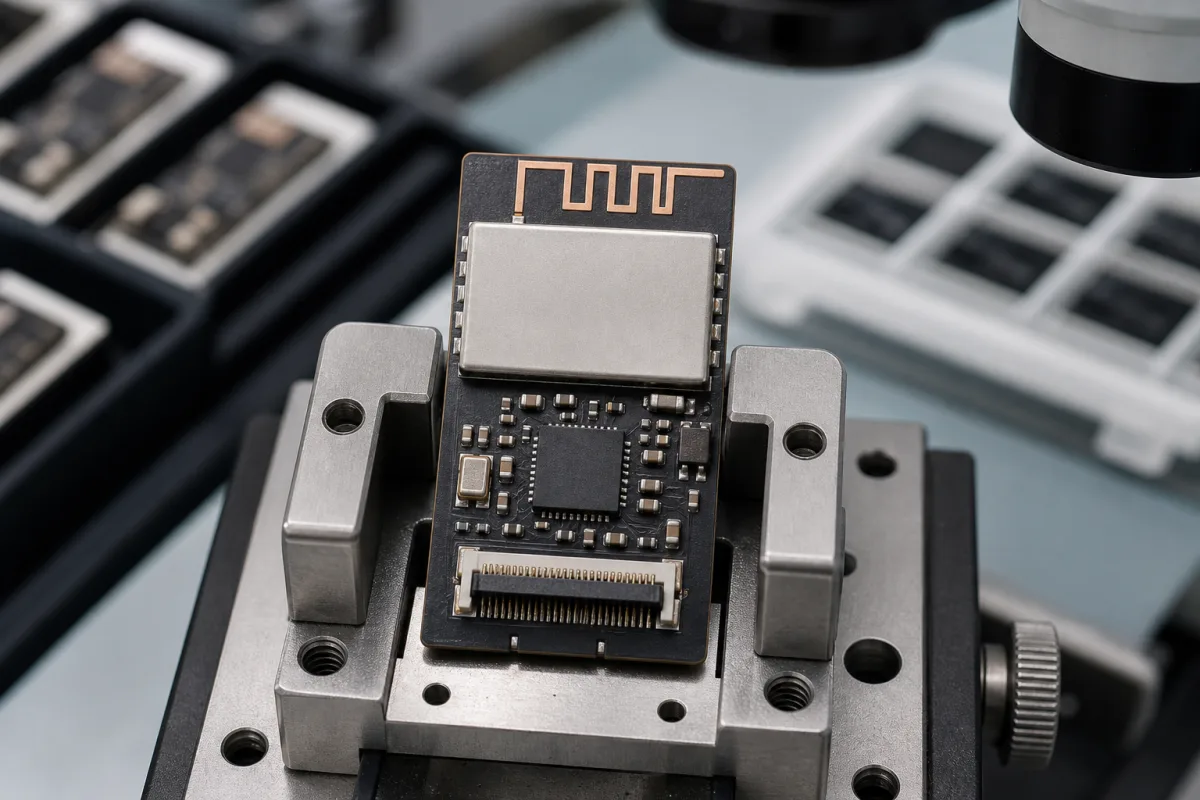
A wireless module is a shielded circuit board carrying a radio transceiver and, depending on the design, a microcontroller, a crystal, power regulation and either a PCB antenna or an antenna connector, soldered into a host product to add Wi-Fi, Bluetooth, LoRa, Sub-GHz or cellular links. Ask three things first: which regulatory approvals the module holds and with which antennas, what transmit power and receiver sensitivity it achieves at the data rate you need, and what layout and antenna rules the host board must follow.
Pre-certified radio modules (Wi-Fi, Bluetooth LE, Zigbee, LoRa, Sub-GHz and cellular) supplied for soldering or plugging into host products. Bare radio chips, finished gateways and routers, and wired I/O modules are outside this page.
CNFX editorial research · Sources checked October 11, 2026 · 4 sources
Under 47 CFR 15.212, a single modular transmitter is a self-contained transmitter built into a host. To obtain modular approval its radio elements need their own shielding, buffered modulation/data inputs, its own power supply regulation, and an antenna that is permanently attached or uses a unique coupler; it is tested stand-alone and must carry its own FCC ID label or an electronic display of it. If the label is hidden once installed, the host must carry an exterior label such as "Contains FCC ID: XYZMODEL1". [1]
The same section allows a limited modular approval where a module does not meet every condition, or where RF exposure compliance is shown only for particular configurations; the applicant must then state how control of the end product is maintained. The module must also meet any RF exposure requirements in its final configuration. [1]
Espressif's ESP32-C3-MINI-1U datasheet shows how this reaches the buyer: its external antenna should not exceed 2.33 dBi, the gain of the antenna used for certification, and a different antenna type or gain may need additional testing. Its PCB-antenna sibling specifies an antenna keepout zone on the host board. [3] Editorial note: ask for the grant or certificate for each market, the list of approved antennas, and the host integration instructions before you design the board.
Give the supplier the protocol and band, target markets and certifications, range and data rate needed, antenna type (PCB, external, connector), host interface, supply voltage, power budget and sleep current, ambient temperature, enclosure material and production volume.
02
Budget the link from transmit power and sensitivity
Espressif's ESP32-C3-MINI-1 datasheet, measured at the antenna port at 3.3 V and 25 °C, gives a typical Wi-Fi transmit power of 20.5 dBm at 802.11b 1 Mbps and 18.0 dBm at 802.11g 54 Mbps, and a receiver sensitivity of −98.0 dBm at 1 Mbps and −76.2 dBm at 54 Mbps. [3]
Editorial calculation: the allowed path loss between two such modules, before antenna gains and fade margin, is 20.5 − (−98.0) = 118.5 dB at 1 Mbps but 18.0 − (−76.2) = 94.2 dB at 54 Mbps, a 24.3 dB difference. Compare modules at the data rate you will actually use, from the same type of table. [3]
In the US, 47 CFR 15.247 limits digitally modulated systems in the 902–928 MHz, 2400–2483.5 MHz and 5725–5850 MHz bands to 1 W of conducted output power, based on antennas of up to 6 dBi; with a higher-gain antenna, conducted power must be reduced by the amount the gain exceeds 6 dBi, except for fixed point-to-point links. [2] Editorial calculation: 1 W is 30 dBm; with a 9 dBi antenna on a non-point-to-point system, conducted power falls to 27 dBm.
The same datasheet lists an operating supply of 3.0 to 3.6 V, ambient ratings of −40 to 85 °C or −40 to 105 °C by variant, and moisture sensitivity level 3, with soldering required within 168 hours of opening the bag under factory conditions. [3]
03
Compare what suppliers offer
Suppliers linked to this page list wireless modules; each card links to the page reviewed.
Listings cover LoRa, Sub-GHz, Bluetooth, Wi-Fi, Zigbee and Matter modules, cellular IoT modules, and wireless modules built for utility metering and sensors. Ask each for certificates by market and the antennas they cover.
04
Check Canada's power and e.i.r.p. limits for 2.4 GHz modules
Innovation, Science and Economic Development Canada (ISED) sets certification requirements for these radios in RSS-247 (Issue 4, July 24, 2025; Amendment 1, October 8, 2026). Equipment it covers is Category I and needs a technical acceptance certificate from ISED's Certification and Engineering Bureau or a certificate from a recognized certification body. For digital transmission systems in 2400–2483.5 MHz it sets a conducted power spectral density of no more than 8 dBm in any 3 kHz band, a peak conducted output power of no more than 1 W and an e.i.r.p. of no more than 4 W. [4]
Frequency hopping systems in that band need at least 15 hopping channels; peak conducted output power may reach 1.0 W with 75 or more channels but only 0.125 W with fewer, and e.i.r.p. stays within 4 W. [4]
Editorial calculation: 1 W is 30 dBm and 4 W is 36 dBm, so a transmitter at full conducted power reaches the e.i.r.p. limit with a 6 dBi antenna. Espressif's 20.5 dBm typical transmit power at 802.11b 1 Mbps plus its 2.33 dBi certification antenna gives about 22.8 dBm, roughly 13 dB below that limit. [3][4]
05
Trace the module components
This is a functional reference built from the sources cited; it is not one maker's specification.
Part
Role
Fix in the order
RF transceiver
Transmits and receives; sets power and sensitivity. [3]
Frequency reference; may sit outside the shield. [1]
Frequency and tolerance.
06
Fill the specification fields with values for your product
A wireless module quotation needs values for your product. The table explains each field, gives published values where a reviewed source states them, and says what to obtain from the supplier.
Explore company information and manufacturing capabilities, then discuss the scope of your project with a relevant supplier.
Share this page
Compiled and source-reviewed by the CNFX editorial team.
Published product pages show what a company offers, not tested performance. Confirm the legal seller, factory and scope for your order. How we source and review
· Page last updated 13 October 2026
Buyer questions
What makes a module 'modular approved' under FCC rules?
Per 47 CFR 15.212: its own shielding, buffered inputs, own power regulation, an attached or unique-coupler antenna, stand-alone testing and its own FCC ID label. [1]
Can I fit a higher-gain antenna?
Only within the approval; Espressif says a different antenna type or gain may need additional testing, and 15.247 cuts allowed conducted power above 6 dBi. [3][2]
Why does range drop at higher data rates?
Sensitivity worsens with rate; Espressif lists −98.0 dBm at 1 Mbps but −76.2 dBm at 54 Mbps. [3]
What certification does a 2.4 GHz wireless module need in Canada?
ISED's RSS-247 classes this equipment as Category I, needing a technical acceptance certificate from ISED or a certificate from a recognized certification body; 2.4 GHz digital transmission systems are limited to 1 W peak conducted power and 4 W e.i.r.p. [4]
Sources and what still needs a direct check
Sources checked 2026-10-11. The eCFR is the official US regulation text. Espressif is a module maker and its datasheet describes its own module; values are examples, not limits.