Industry-Verified Manufacturing Data (2026)

Bushings

Based on aggregated insights from multiple verified factory profiles within the CNFX directory, the standard Bushings used in the Electrical Equipment Manufacturing sector typically supports operational capacities ranging from standard industrial configurations to heavy-duty production requirements.

Technical Definition & Core Assembly

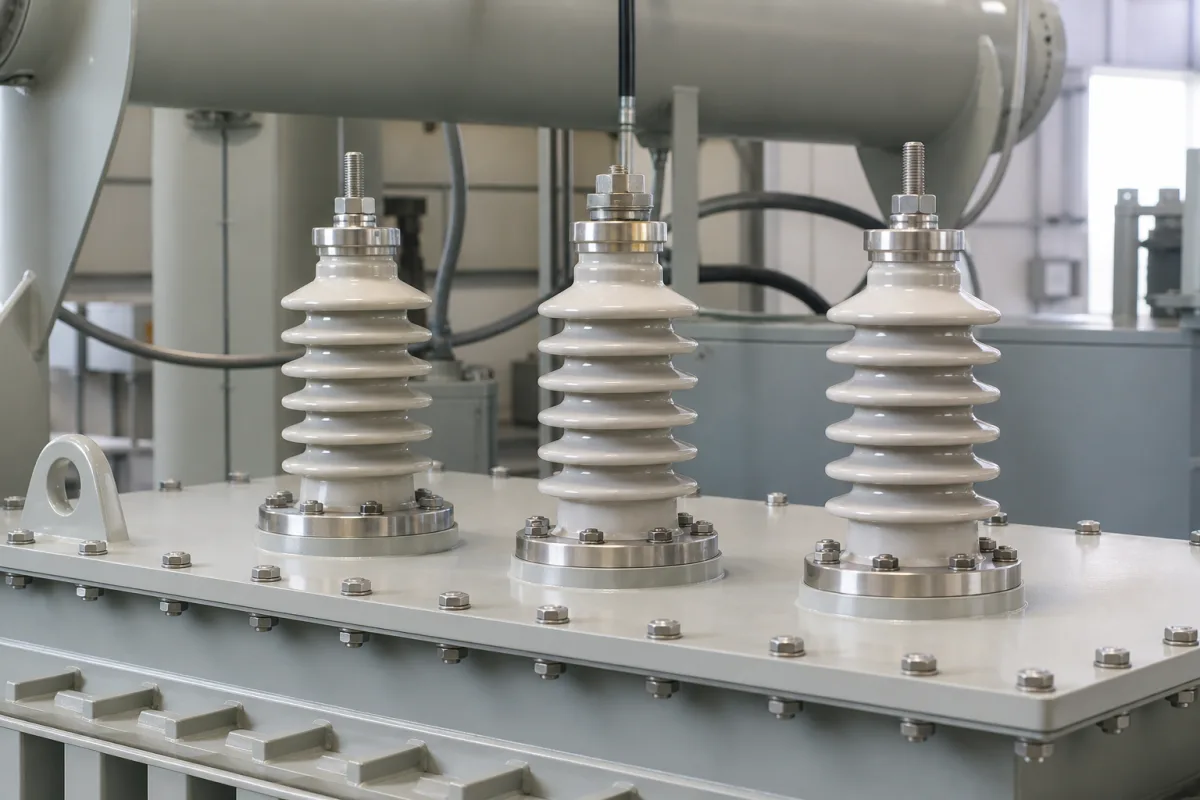
A canonical Bushings is characterized by the integration of Conductor and Insulator Body. In industrial production environments, manufacturers listed on CNFX commonly emphasize Porcelain construction to support stable, high-cycle operation across diverse manufacturing scenarios.

Insulating devices that provide electrical connection and mechanical support for conductors passing through grounded transformer enclosures.
Product Specifications

Technical details and manufacturing context for Bushings

Definition
Bushings are critical insulating components in power transformers that allow high-voltage conductors to safely pass through the grounded transformer tank or enclosure. They provide electrical insulation between the conductor and the grounded tank while maintaining mechanical support and sealing integrity. Bushings must withstand electrical stresses, thermal cycling, and environmental conditions while preventing oil leakage in oil-filled transformers.
Working Principle
Bushings work by creating a graded insulation system that distributes electrical stress along the length of the bushing. They consist of a central conductor surrounded by insulating materials (typically porcelain, epoxy resin, or composite materials) with capacitive grading layers to control electric field distribution. The insulation system prevents flashover and corona discharge while maintaining the electrical connection between internal transformer windings and external power lines.
Common Materials
Porcelain, Epoxy resin, Composite polymer, Copper conductor, Aluminum conductor
Technical Parameters
  • Rated voltage and insulation level (kV) Customizable
Components / BOM
  • Conductor
    Carries electrical current through the bushing
    Material: Copper or aluminum
  • Insulator Body
    Provides main electrical insulation and mechanical strength
    Material: Porcelain, epoxy resin, or composite polymer
  • Flange
    Mounting interface to transformer tank with sealing gasket
    Material: Cast iron or aluminum
  • Capacitive Grading Layers
    Controls electric field distribution to prevent corona and flashover
    Material: Conductive foil or coating
  • Terminal Connector
    External connection point for power lines
    Material: Copper or aluminum alloy
Engineering Reasoning
0-35 kV, -40°C to 105°C, 0-100% relative humidity
Dielectric breakdown at >35 kV/mm electric field strength, mechanical failure at >50 MPa compressive stress, thermal degradation at >105°C continuous operation
Design Rationale: Dielectric breakdown due to exceeding material's dielectric strength (35 kV/mm for porcelain), thermal aging causing polymer chain scission in epoxy resin at Arrhenius rate constant k=1.5×10⁻⁴ s⁻¹ at 105°C, mechanical fatigue from cyclic loading exceeding S-N curve endurance limit
Risk Mitigation (FMEA)
Trigger Partial discharge exceeding 5 pC at 1.2× rated voltage
Mode: Tracking erosion creating conductive carbonized paths
Strategy: Corona shielding with semiconductive coatings maintaining surface resistivity 10⁵-10⁸ Ω/sq
Trigger Thermal cycling >10°C/min gradient across porcelain-epoxy interface
Mode: Interfacial delamination creating moisture ingress paths
Strategy: Stress-graded interfaces with coefficient of thermal expansion matched to 8×10⁻⁶/°C

Industry Taxonomies & Aliases

Commonly used trade names and technical identifiers for Bushings.

Applied To / Applications

This component is essential for the following industrial systems and equipment:

Industrial Ecosystem & Supply Chain DNA

Complementary Systems
Downstream Applications
Specialized Tooling

Application Fit & Sizing Matrix

Operational Limits
pressure: Up to 15 psi (1 bar) differential pressure
other spec: Voltage rating: 1-36 kV, Creepage distance: 50-500 mm depending on voltage class
temperature: -40°C to +105°C continuous, up to +130°C short-term
Media Compatibility
✓ Mineral transformer oil ✓ Silicone transformer fluid ✓ Dry air/nitrogen environments
Unsuitable: High-pressure SF6 gas environments with rapid decompression cycles
Sizing Data Required
  • Conductor diameter (mm)
  • System voltage rating (kV)
  • Enclosure penetration diameter (mm)

Reliability & Engineering Risk Analysis

Failure Mode & Root Cause
Abrasive wear
Cause: Contamination ingress (dust, dirt, metal particles) leading to scoring and material removal from bearing surfaces
Fatigue cracking
Cause: Cyclic loading beyond design limits causing progressive material failure and spalling
Maintenance Indicators
  • Excessive vibration or audible knocking during operation
  • Visible material degradation (cracking, flaking, or discoloration) on bushing surfaces
Engineering Tips
  • Implement proper filtration and sealing systems to prevent contaminant ingress into lubrication
  • Establish regular alignment checks and load monitoring to prevent overloading beyond design specifications

Compliance & Manufacturing Standards

Reference Standards
ISO 3547: Plain bearings - Wrapped bushes ANSI/AGMA 2001-D04: Fundamental Rating Factors and Calculation Methods for Involute Spur and Helical Gear Teeth DIN 1494: Plain bearings - Sintered metal bushes
Manufacturing Precision
  • Bore diameter tolerance: ±0.02 mm
  • Wall thickness variation: ±0.05 mm
Quality Inspection
  • Dimensional verification with coordinate measuring machine (CMM)
  • Hardness testing (Rockwell or Brinell scale)

Factories Producing Bushings

Verified manufacturers with capability to produce this product in China

✓ 98% Supplier Capability Match Found

P Procurement Specialist from Singapore Feb 08, 2026
★★★★★
"Reliable performance in harsh Electrical Equipment Manufacturing environments. No issues with the Bushings so far."
Technical Specifications Verified
T Technical Director from Germany Feb 05, 2026
★★★★★
"Testing the Bushings now; the technical reliability results are within 1% of the laboratory datasheet."
Technical Specifications Verified
P Project Engineer from Brazil Feb 02, 2026
★★★★★
"Impressive build quality. Especially the technical reliability is very stable during long-term operation."
Technical Specifications Verified
Verification Protocol

“Feedback is collected from verified sourcing managers during RFQ (Request for Quote) and factory evaluation processes on CNFX. These reports represent historical performance data and technical audit summaries from our B2B manufacturing network.”

15 sourcing managers are analyzing this specification now. Last inquiry for Bushings from USA (36m ago).

Supply Chain Compatible Machinery & Devices

Transformer Winding Machine

Industrial machine for winding copper wire onto transformer cores

Explore Specs →
Circuit Breaker Trip Unit

Protective control module for electrical circuit breakers

Explore Specs →
Circuit Breaker Arc Chute

Electrical component that extinguishes arcs in circuit breakers

Explore Specs →
Medium Voltage Switchgear Assembly Line

Automated production system for assembling medium voltage electrical switchgear.

Explore Specs →

Frequently Asked Questions

What are the main materials used in electrical bushings for transformer applications?

Electrical bushings for transformers typically use porcelain for traditional high-voltage applications, epoxy resin for excellent insulation and moisture resistance, and composite polymers for lightweight durability. Conductors are made from copper for superior conductivity or aluminum for cost-effective solutions.

How do capacitive grading layers improve bushing performance in transformers?

Capacitive grading layers in transformer bushings distribute electrical stress evenly along the insulator body, preventing localized voltage concentrations that could cause insulation breakdown. This enhances reliability, extends service life, and allows for more compact bushing designs in electrical equipment.

What are the key components in a typical bushing bill of materials (BOM) for electrical manufacturing?

A standard bushing BOM includes the conductor (copper or aluminum), insulator body (porcelain, epoxy, or composite), mounting flange, capacitive grading layers for voltage distribution, and terminal connectors for secure electrical connections to transformer windings and external circuits.

Can I contact factories directly on CNFX?

CNFX is an open directory, not a transaction platform. Each factory profile provides direct contact information and production details to help you initiate direct inquiries with Chinese suppliers.

Get Quote for Bushings

Request technical pricing, lead times, or customized specifications for Bushings directly from verified manufacturing units.

Your business information is encrypted and only shared with verified Bushings suppliers.

Thank you! Your message has been sent. We'll respond within 1–3 business days.

Need to Manufacture Bushings?

Connect with verified factories specializing in this product category

Add Your Factory Contact Us
Previous Product
Busbar System
Next Product
Cable Gland