Industry-Verified Manufacturing Data (2026)

Ceramic Glass Cooktop

Based on aggregated insights from multiple verified factory profiles within the CNFX directory, the standard Ceramic Glass Cooktop used in the Electrical Equipment Manufacturing sector typically supports operational capacities ranging from standard industrial configurations to heavy-duty production requirements.

Technical Definition & Core Assembly

A canonical Ceramic Glass Cooktop is characterized by the integration of Heating Zone and Control Panel Area. In industrial production environments, manufacturers listed on CNFX commonly emphasize Ceramic glass (typically Schott CERAN or similar) construction to support stable, high-cycle operation across diverse manufacturing scenarios.

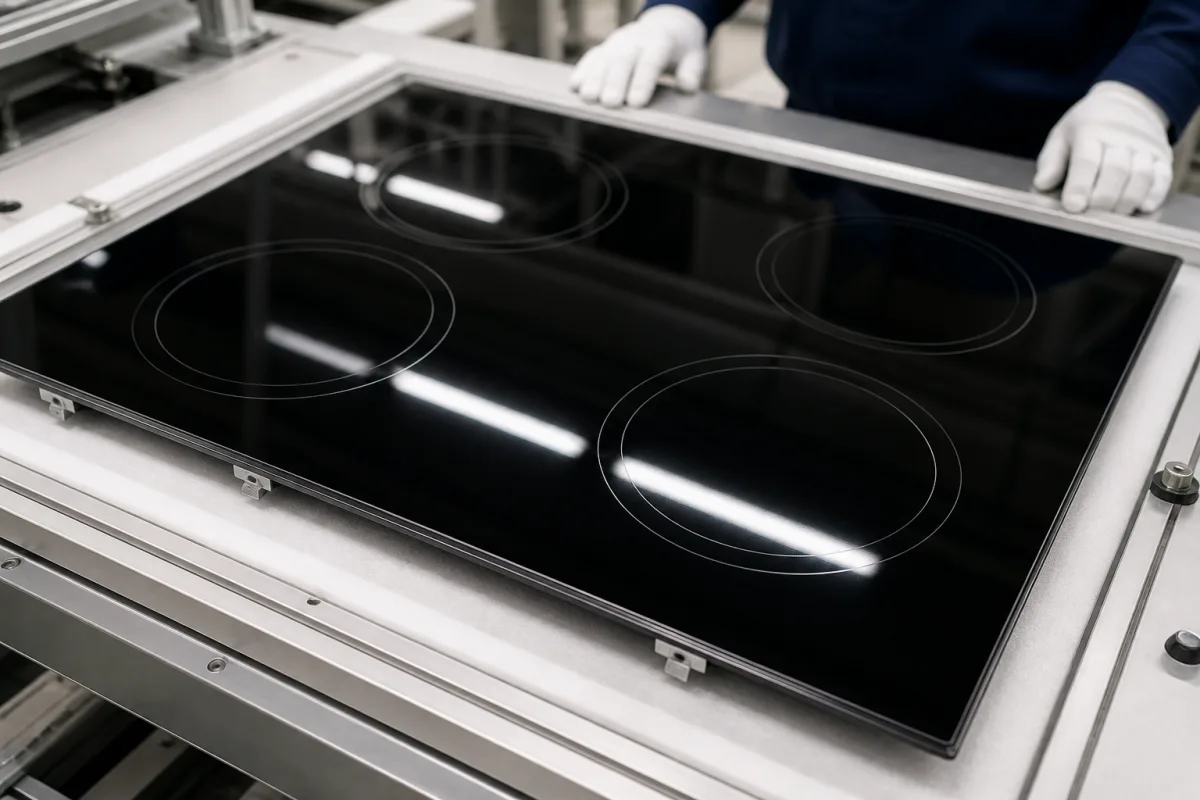
The flat, heat-resistant glass surface of an induction cooktop that provides the cooking interface.
Product Specifications

Technical details and manufacturing context for Ceramic Glass Cooktop

Definition
A ceramic glass cooktop is the smooth, durable surface component of a programmable induction cooktop that serves as the cooking platform. It houses the induction coils beneath and provides a sealed, easy-to-clean interface where cookware is placed. This component must withstand rapid temperature changes while maintaining structural integrity and aesthetic appearance.
Working Principle
The ceramic glass cooktop itself does not generate heat but serves as a protective and functional surface. Induction coils beneath the glass generate electromagnetic fields that directly heat compatible ferromagnetic cookware placed on top. The glass remains relatively cool to touch (except for residual heat from the cookware) while providing thermal insulation and mechanical protection for the internal components.
Common Materials
Ceramic glass (typically Schott CERAN or similar)
Technical Parameters
  • Thickness of the ceramic glass panel, typically ranging from 4-8mm depending on cooktop size and model (mm) Customizable
Components / BOM
  • Heating Zone
    Designated area on the glass surface where induction coils are positioned beneath to create cooking zones
    Material: ceramic_glass
  • Control Panel Area
    Section of the glass surface that may incorporate touch controls or display indicators
    Material: ceramic_glass
  • Edge Sealing
    Protective sealing around the perimeter to prevent moisture ingress and provide finished appearance
    Material: silicone_rubber
Engineering Reasoning
20-550°C
570°C (glass transition temperature of ceramic glass)
Design Rationale: Thermal stress-induced microcrack propagation due to coefficient of thermal expansion mismatch between ceramic glass (α=3.2×10⁻⁶/K) and underlying heating elements (α=16×10⁻⁶/K)
Risk Mitigation (FMEA)
Trigger Thermal shock from rapid temperature differential exceeding 300°C/min
Mode: Radial fracture propagation from surface microcracks
Strategy: Embedded nickel-chromium alloy heating elements with controlled ramp-up rate of 50°C/min
Trigger Mechanical impact exceeding 2.5 J energy transfer
Mode: Concentric fracture patterns from point impact
Strategy: Ion-exchange strengthened glass surface with compressive stress layer of 700 MPa

Industry Taxonomies & Aliases

Commonly used trade names and technical identifiers for Ceramic Glass Cooktop.

Industrial Ecosystem & Supply Chain DNA

Complementary Systems
Downstream Applications
Specialized Tooling

Application Fit & Sizing Matrix

Operational Limits
pressure: Atmospheric to 1 bar (non-pressure vessel application)
other spec: Max thermal shock resistance: ΔT ≤ 200°C/min, surface hardness: 6-7 Mohs, electrical insulation: >10 kV/mm
temperature: Typically -20°C to 300°C (operational), up to 600°C (peak transient)
Media Compatibility
✓ Induction-compatible cookware (ferromagnetic) ✓ Dry cooking surfaces ✓ Standard kitchen cleaning agents (pH 6-8)
Unsuitable: Abrasive cleaning pads (e.g., steel wool) or concentrated acidic/alkaline cleaners
Sizing Data Required
  • Required cooking zone dimensions and count
  • Induction coil power rating (kW) and frequency
  • Installation cutout dimensions and countertop material compatibility

Reliability & Engineering Risk Analysis

Failure Mode & Root Cause
Thermal stress cracking
Cause: Rapid temperature changes from cold to hot or localized overheating from small cookware create thermal gradients exceeding the ceramic glass's fracture toughness, leading to microcracks that propagate into visible fractures.
Surface degradation and loss of optical clarity
Cause: Abrasive cleaning agents, harsh scrubbing pads, or spilled sugary/salty substances that crystallize upon heating chemically etch and microscopically scratch the smooth glass surface, causing permanent cloudiness, reduced heat transfer efficiency, and weakened structural integrity.
Maintenance Indicators
  • Audible clicking or popping sounds during heating or cooling cycles, indicating internal stress or microcrack propagation within the glass.
  • Visible spiderweb-like cracks (even hairline) or localized discoloration/browning that does not wipe clean, signaling imminent failure or compromised heating elements.
Engineering Tips
  • Always use flat-bottomed cookware matching the burner size to ensure even heat distribution and avoid thermal shock; allow the cooktop to cool gradually after use before cleaning.
  • Clean only with manufacturer-approved ceramic glass cleaners and non-abrasive cloths immediately after spills cool to prevent etching; avoid sliding cookware to prevent abrasive scratches.

Compliance & Manufacturing Standards

Reference Standards
ISO 8442-1:1997 (Materials and articles in contact with foodstuffs) ANSI Z21.1 (Household Cooking Gas Appliances - includes electric cooktops) CE Marking (EU Directive 2014/35/EU for Low Voltage Equipment)
Manufacturing Precision
  • Surface Flatness: ≤ 0.5 mm across cooking zone
  • Heating Element Alignment: +/- 1.5 mm from center
Quality Inspection
  • Thermal Shock Resistance Test (rapid temperature change)
  • Leakage Current and Electric Strength Test (safety verification)

Factories Producing Ceramic Glass Cooktop

Verified manufacturers with capability to produce this product in China

✓ 93% Supplier Capability Match Found

S Sourcing Manager from Germany Jan 12, 2026
★★★★★
"As a professional in the Electrical Equipment Manufacturing sector, I confirm this Ceramic Glass Cooktop meets all ISO standards."
Technical Specifications Verified
P Procurement Specialist from Brazil Jan 09, 2026
★★★★☆
"Standard OEM quality for Electrical Equipment Manufacturing applications. The Ceramic Glass Cooktop arrived with full certification. (Delivery took slightly longer than expected, but technical support was excellent.)"
Technical Specifications Verified
T Technical Director from Canada Jan 06, 2026
★★★★★
"Great transparency on the Ceramic Glass Cooktop components. Essential for our Electrical Equipment Manufacturing supply chain."
Technical Specifications Verified
Verification Protocol

“Feedback is collected from verified sourcing managers during RFQ (Request for Quote) and factory evaluation processes on CNFX. These reports represent historical performance data and technical audit summaries from our B2B manufacturing network.”

14 sourcing managers are analyzing this specification now. Last inquiry for Ceramic Glass Cooktop from Mexico (1h ago).

Supply Chain Compatible Machinery & Devices

Transformer Winding Machine

Industrial machine for winding copper wire onto transformer cores

Explore Specs →
Circuit Breaker Trip Unit

Protective control module for electrical circuit breakers

Explore Specs →
Circuit Breaker Arc Chute

Electrical component that extinguishes arcs in circuit breakers

Explore Specs →
Medium Voltage Switchgear Assembly Line

Automated production system for assembling medium voltage electrical switchgear.

Explore Specs →

Frequently Asked Questions

What is the primary material used in ceramic glass cooktops?

Ceramic glass cooktops are primarily made from specialized ceramic glass, typically Schott CERAN or similar materials, which offer excellent heat resistance, durability, and a smooth cooking surface.

How does the heating zone work on a ceramic glass cooktop?

Heating zones on ceramic glass cooktops use induction technology to generate heat directly in compatible cookware. The ceramic glass surface remains relatively cool while transferring electromagnetic energy to the pot or pan for efficient cooking.

What are the key components in a ceramic glass cooktop BOM?

The main components in a ceramic glass cooktop bill of materials include the Control Panel Area (for user interface), Edge Sealing (for safety and aesthetics), and Heating Zones (induction elements beneath the glass surface).

Can I contact factories directly on CNFX?

CNFX is an open directory, not a transaction platform. Each factory profile provides direct contact information and production details to help you initiate direct inquiries with Chinese suppliers.

Get Quote for Ceramic Glass Cooktop

Request technical pricing, lead times, or customized specifications for Ceramic Glass Cooktop directly from verified manufacturing units.

Your business information is encrypted and only shared with verified Ceramic Glass Cooktop suppliers.

Thank you! Your message has been sent. We'll respond within 1–3 business days.

Need to Manufacture Ceramic Glass Cooktop?

Connect with verified factories specializing in this product category

Add Your Factory Contact Us
Previous Product
Capacitor Bank Array
Next Product
Chamber Housing