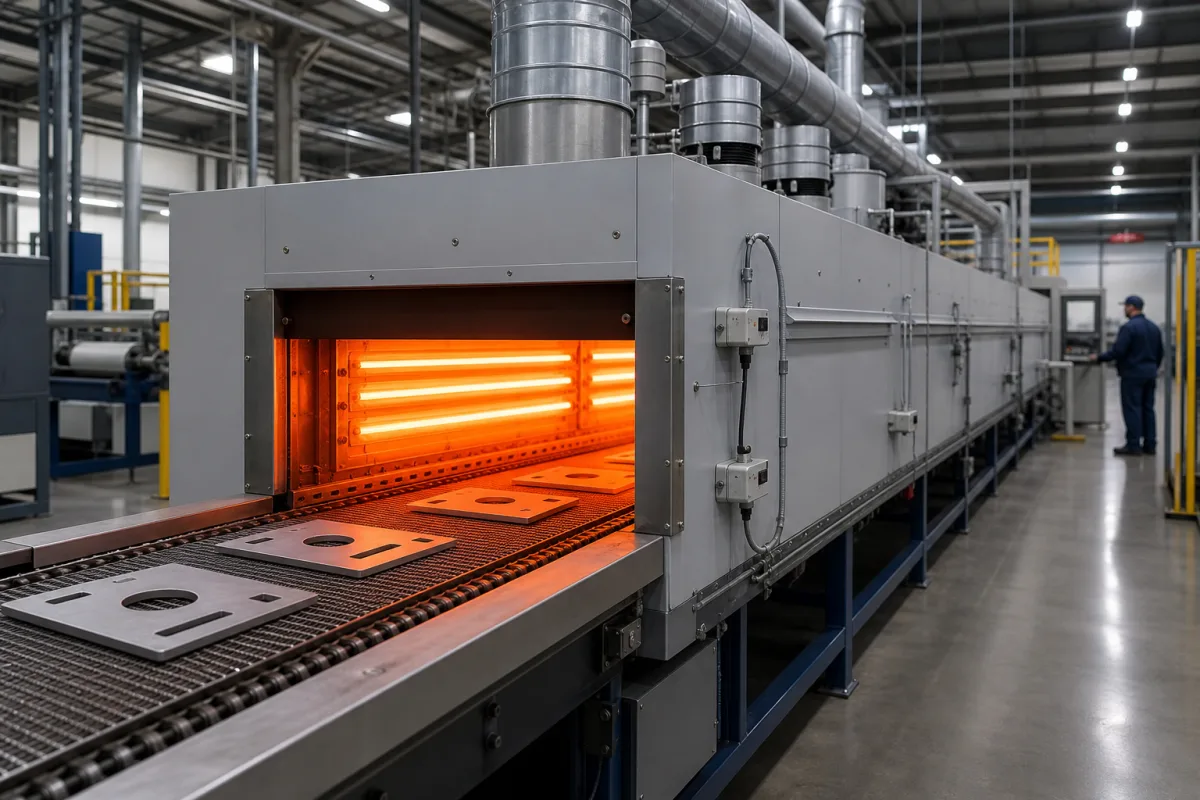
Infrared heating zone (quartz emitter array and the heated length of each lamp)
Infrared heating zones in conveyor and process lines · emitter type and wavelength, W/cm and kW/m², heated length and cold ends, response and inrush
An infrared heating zone is a section of a conveyor oven, dryer or forming line in which an array of quartz infrared emitters heats the product by radiation, and which can be controlled separately from other zones along the line. Ask three things first: which emitter type and wavelength suit the material, what power per centimetre of heated length and per square metre of zone area the emitters deliver, and how the active heated length of each lamp, its cold ends and its switching behaviour fit the machine.
Radiant heating zones built from quartz infrared emitters (short-wave, fast-response medium-wave, carbon and medium-wave) in conveyor ovens, dryers and forming lines, and the custom lamps that define them. Batch hot-air ovens are covered on the Industrial hot air oven page; gas burners, induction heating and resistance band heaters are outside this page.
CNFX editorial research · Sources checked October 12, 2026 · 4 sources
Choose the emitter type by material, power density and response
Heraeus Noblelight's infrared emitter brochure states that short-wave radiation can penetrate deep into some solid materials for uniform through-heating, while medium-wave radiation "is absorbed mostly in the outer surface" and is "particularly well absorbed by many plastics, glass and especially water". For its twin-tube emitters it lists: short-wave at < 200 W/cm, 1,800-2,400 °C filament, 1.0-1.4 µm peak, 200 kW/m² and 1 s response; fast-response medium-wave at 80 W/cm, 1,400-1,800 °C, > 1.4 µm, 150 kW/m² and 1-2 s; standard medium-wave at 18, 20 or 25 W/cm, 800-950 °C, 2.4-2.7 µm, 60 kW/m² and 60-90 s; and carbon medium-wave at 80 W/cm, 1,200 °C, 2 µm, 150 kW/m² and 1-2 s. [1]
The same brochure warns that an emitter can reach peak current in a very short time when switched on, giving switch-on current factors of 12-17 for short-wave, 10-13 for fast-response medium-wave, 1-1.05 for medium-wave and 0.8 for carbon, and says this needs to be considered in system design. A gold reflector, it states, virtually doubles the infrared radiation reaching the product. [1]
Editorial calculation: a 3,000 W short-wave emitter on 400 V draws 3,000 ÷ 400 = 7.5 A when running (treating it as a resistive load), so at a switch-on factor of 12-17 the inrush is about 90 to 128 A; size fuses, contactors or thyristor controllers for that, or ask the supplier for soft-start. [1]
Give the supplier the product material and thickness, target temperature and heating time, line speed and width, working distance, zone length and number of control zones, supply voltage and phases, emitter type and reflector, heated length and total length of each lamp, mounting and cooling, and the controller.
02
Lay out the heated length, cold ends and zone power
Huidrey, a maker of custom quartz infrared lamps, states that cold ends, active filament length and heating-zone position are confirmed separately from the overall lamp length, and that voltage, wattage, overall and heated lengths, reflector position, caps and mounting can be changed when a catalogue lamp does not fit. For a new design it asks for the heated material and its absorption, the target temperature, cycle time and line speed, the available length, width and working distance, and the voltage, phases and control zones. [2][3]
Heraeus's catalogue rows show heated against total length: a medium-wave 2,000 W, 230 V emitter has 800 mm heated and 900 mm total, and a carbon 8,000 W, 400 V emitter has 1,000 mm heated and 1,145 mm total. [1] Huidrey lists industrial uses including sheet preheating with fast start-up and zone control, paint and powder curing, and continuous web lines with multiple controlled heating zones. [4]
Editorial calculation: the medium-wave 2,000 W over 80 cm heated is 25 W/cm, and the carbon 8,000 W over 100 cm is 80 W/cm, matching the listed maximum specific power; the carbon lamp's 1,145 - 1,000 = 145 mm of unheated length must fall outside the product width. A zone 1.0 m long and 0.5 m wide at the carbon limit of 150 kW/m² takes at most 0.5 × 150 = 75 kW, about nine 8 kW lamps. [1]
03
Huidrey quartz infrared lamps by wavelength and tube form
Huidrey lists custom and replacement quartz infrared lamps in short-wave, fast-response medium-wave and medium-wave, single and twin tube, with reflectors and custom heating zones. Ask for the specific power, heated length and response of the lamp quoted.
04
Emitters, reflectors, holders and cold ends in one heating zone
The reflector and holders decide where the emitter's output lands, and the cold ends are the part of each lamp that must stay outside the heated product width.
Part
Role
Fix in the order
Infrared emitters
Radiant heat; type sets wavelength and response. [1]
Type, W/cm, heated length.
Reflector
Gold reflector virtually doubles radiation to the product. [1]
Unheated ends and connections outside the product. [2][1]
Total length, caps, leads.
Zone controller
Switches or controls each zone; inrush for SW. [1][3]
Control type and current rating.
Conveyor and housing
Carry the product through the zone.
Width, speed, distance.
05
Zone power, heated length, response time and inrush for quartz emitters
Response time and inrush separate the emitter types: about 1 s for short-wave against 60 to 90 s for medium-wave, and 12 to 17 times running current at switch-on for short-wave.
Field
What it means and published values
Ask the supplier for
Heating power (kW)
Sum of emitters; limited by kW/m² of zone area. [1]
Huidrey lists custom and replacement quartz infrared lamps in short-wave and medium-wave forms with reflectors.
HUIDREY THERMAL TECHNOLOGY Co., Ltd
Manufacturing site to be confirmed for the order
Lists custom and replacement quartz infrared lamps in short-wave, fast-response medium-wave and medium-wave types with custom heating zones and reflectors.
Explore company information and manufacturing capabilities, then discuss the scope of your project with a relevant supplier.
Share this page
Compiled and source-reviewed by the CNFX editorial team.
Each manufacturer above links to the page on that company's own website where the product is listed, with the date we checked it. How we source and review
· Page last updated 13 October 2026
Buyer questions
How fast do infrared emitters respond?
Heraeus lists 1 s for short-wave, 1-2 s for fast-response medium-wave and carbon, and 60-90 s for standard medium-wave twin tubes. [1]
What power density can an infrared zone reach?
Heraeus gives up to 200 kW/m² for short-wave, 150 kW/m² for fast medium-wave and carbon, and 60 kW/m² for medium-wave. [1]
Why plan for inrush current?
Heraeus gives switch-on current factors of 12-17 for short-wave emitters, against 0.8 for carbon. [1]
What is the heating zone of an infrared lamp?
Huidrey describes it as the active filament length and its position, confirmed separately from the overall lamp length and cold ends. [2]
Sources and what still needs a direct check
Sources checked 2026-10-12. Heraeus Noblelight's brochure (reviewed from a hosted copy) gives emitter data; Huidrey describes its own custom lamp design inputs and applications.