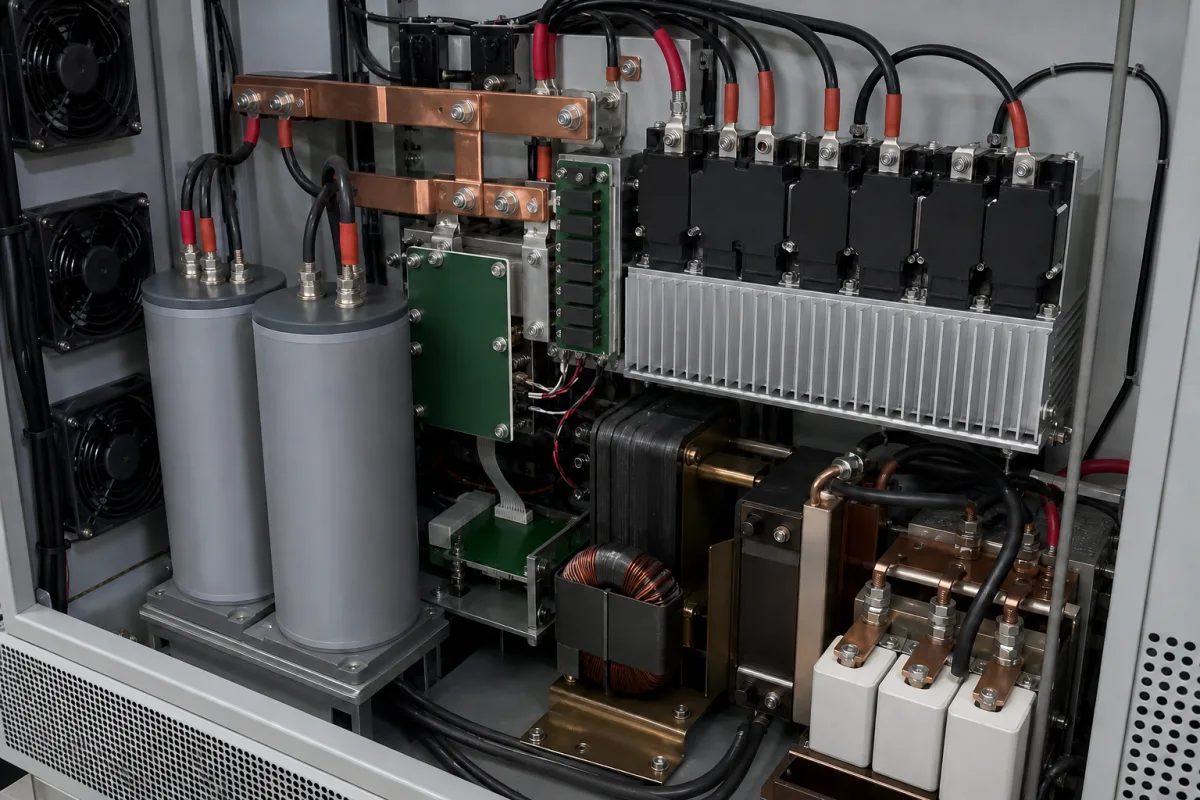
The illustrated cabinet is the power stage of an industrial charger: IGBT modules on a heatsink, a transformer and choke, DC-link capacitors and copper busbars. Behind it sits the controller that decides what voltage and current reach the battery. For a valve-regulated lead-acid battery floating across a DC system, that controller's settings and output quality are what the battery maker and the IEC/EN standards specify, and they set the battery's service life as much as the cells do.
Covers chargers and charging controllers that keep stationary valve-regulated lead-acid (VRLA) batteries on float in DC systems and UPS: float and boost voltages, temperature compensation, charge current limits, voltage regulation and ripple, and the effect of temperature on life. The original definition of a charging controller also covers solar charge controllers, which are on MPPT Controller (9750), and EV chargers, which are on EV Charging Pile (10235); rectifier bridges as components are on Rectifier Bridge (4440).
CNFX editorial research · Sources checked October 13, 2026 · 3 sources
Float at 2.275 V/cell, boost at 2.45–2.5 V/cell, both moved by −3 mV/cell/°C
RPower's manual for its OGiV HP VRLA batteries gives the settings a charging controller has to hold, with charging procedures and limits referred to DIN 41773 (IUU0 characteristic).
Float is 2.275 V/cell ±0.005 V at 20 °C, compensated at −3 mV/cell/°C; RPower makes compensation mandatory above 40 °C to avoid thermal runaway. Boost is allowed for quick recharge if the current does not exceed 0.25C(A) and falls to 0.01C before float is resumed. In switch-mode operation a three-phase boost charges at 2.45–2.5 V/cell until current falls to 0.07C(A) after time t1, continues for t2 = 0.5·t1, then returns to float.
For a 108-cell string, float is 108 × 2.275 = 245.7 V at 20 °C and 242.5 V at 30 °C after compensation, and boost at 2.45 V/cell is 264.6 V (Editorial calculation). A 300 Ah battery limits boost current to 75 A at 0.25C (Editorial calculation), which the charger must supply on top of the standing DC load.
Temperature °C
Boost charge V/cell
Maintenance (float) charge V/cell
−10
2.58
2.36
0
2.53
2.33
10
2.48
2.30
20
2.45
2.28
30
2.40
2.24
40
2.34
2.21
The figures are RPower's for OGiV HP; other VRLA designs state their own float, boost and compensation values.
02
Regulation better than ±1%, peaks within ±2.5%, AC current under 5 A per 100 Ah
The Eurobat guide to IEC/EN 60896 standards for VRLA batteries and RPower's manual set limits on what the charger may put across the battery besides the DC voltage.
Applied to the 108-cell example at 245.7 V float, ±1% regulation is ±2.46 V and the ±2.5% envelope is ±6.14 V; a 300 Ah battery may carry up to 15 A of AC current on float (Editorial calculation). These are the numbers to check on the charger's test report, not only its nameplate.
Eurobat attributes reduced life and performance to excessive ripple on the DC supply across the battery; CPS adds that AC ripple raises water loss, temperature and corrosion.
Limit
Value
Source
Voltage regulation, 5–100% load, battery disconnected
Better than ±1%
Eurobat
Peak-to-peak including regulation limits, battery disconnected, load connected
Within ±2.5% of recommended float voltage
Eurobat
AC current through the battery on float or standby
≤ 5 A per 100 Ah nominal capacity
RPower
AC current during recharge up to 2.4 V/cell
Up to 0.1C(A), for a very short time
RPower
AC ripple voltage, charger and load
< 1%
CPS (for optimum life)
Eurobat's limits are measured with the battery disconnected, which is how a charger can be tested before the battery is connected.
03
Temperature against life: 50% per 10 °C, ageing ×2 at 30 °C and ×4 at 40 °C
Both the Eurobat guide and the CPS paper tie the controller's temperature handling to battery life.
Eurobat states a 50% life reduction per 10 °C constant increase above 20 °C, and that adjusting float voltage to temperature may reduce this effect; above 40 °C rising float current can lead to thermal runaway. The CPS table is the same rule in multiplier form: a battery held at 30 °C ages twice as fast as at 20 °C.
CPS also limits what compensation can do: a temperature probe in the battery enclosure feeding the charger only reduces the chance of under- or overcharging; it does not remove the life penalty of the higher temperature itself.
Battery temperature °C
Ageing multiplier (CPS, from FIAMM data)
20
1
25
1.41
30
2.00
35
2.86
40
4.00
Life figures assume constant temperature; cycling between temperatures needs the battery maker's guidance.
04
What to specify for a stationary battery charger
Paste it into your enquiry below or into an email to a maker, then replace every bracket.
Give the battery type, cell count and capacity, the maker's float and boost voltages and compensation factor, the standing DC load, the required recharge time, ambient temperature range, and the supply. Ask for float and boost settings range, temperature-compensation input and slope, current limit, voltage regulation from 5% to 100% load with the battery disconnected, peak-to-peak ripple, AC current into the battery, and the boost-charge timing logic.
1 company lists this product among what they make. Company figures are quoted from each
company's own website; every card states where the relationship came from.
ZHEJIANG ETEK ELECTRICAL TECHNOLOGY CO.LTD.
TBC
ETEK lists an EV Charging Controller in its EV charger range, alongside low-voltage protection devices and solar DC components. It is a controller for EV charging rather than a stationary battery charger as discussed above; ratings TBC, location TBC.
Explore company information and manufacturing capabilities, then discuss the scope of your project with a relevant supplier.
Share this page
Compiled and source-reviewed by the CNFX editorial team.
Each manufacturer above links to the page on that company's own website where the product is listed, with the date we checked it. How we source and review
· Page last updated 13 October 2026
Buyer questions
What float voltage does a VRLA battery need?
RPower specifies 2.275 V/cell ±0.005 V at 20 °C for its OGiV HP batteries, with −3 mV/cell/°C compensation, mandatory above 40 °C. [1]
How much ripple may a charger put on the battery?
Eurobat recommends regulation better than ±1% between 5% and 100% load and a peak-to-peak envelope within ±2.5% of float voltage; RPower limits AC current on float to 5 A per 100 Ah. [2][1]
How much does temperature shorten battery life?
Eurobat gives 50% life reduction per 10 °C above 20 °C; CPS's table shows ageing twice as fast at 30 °C and four times at 40 °C. [2][3]
Does a temperature-compensated charger prevent the life loss?
CPS states that a battery temperature probe feeding the charger only reduces the chance of under- or overcharging. [3]
Sources and what still needs a direct check
Sources checked 2026-10-13. A battery maker's VRLA manual, the Eurobat guide to IEC/EN 60896 for VRLA batteries, and a UPS service company's paper on battery life.