Power Supply Unit
View system integration details
This page explains how Voltage Regulator is classified within Electrical Equipment Manufacturing. Technical values and manufacturer relationships are research references; confirm the current specification and supplier evidence for each order.
An electronic component that maintains a constant output voltage level regardless of changes in input voltage or load conditions.
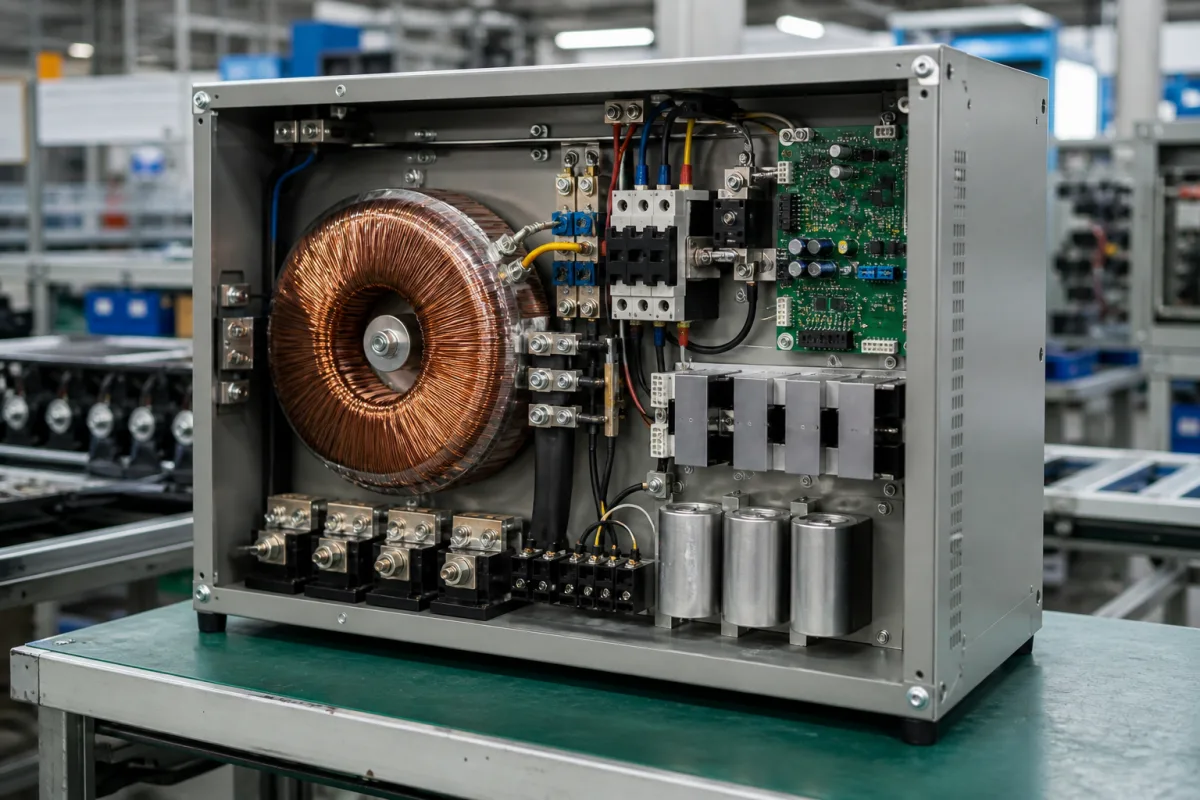
Technical details and manufacturing context for Voltage Regulator
What to specify in your RFQ
These are the quantities to specify to the manufacturer when sizing or requesting a quote. The manufacturer's own documentation governs the exact figures and applicable standard.
| efficiency: | 70-95% (depends on topology and operating conditions) |
| temperature: | -40°C to +125°C (operating range, typical for industrial-grade components) |
| voltage range: | Input: 4.5V to 40V DC (typical), Output: 1.2V to 37V adjustable (example range) |
| line regulation: | ±0.01% to ±0.1% (output voltage change per input voltage change) |
| load regulation: | ±0.1% to ±1% (output voltage change from no-load to full-load) |
| current capacity: | Up to 5A continuous (depends on package and cooling) |
Indicative industry ranges for design and RFQ preparation. Confirm the exact figures and applicable standard with the manufacturer before specifying.
Quoted from the published standard.
A practical evidence checklist for RFQ preparation and supplier evaluation.
Compare the published product scope and source details, then include your specifications and quantity in an enquiry.
Manufacturer profiles associated with Voltage Regulator.
Explore company information and manufacturing capabilities, then discuss the scope of your project with a relevant supplier.
Ask for use case, specification boundaries, supplier type, and RFQ preparation information for this product.
According to the directory, the output voltage rating typically ranges from 1.2V to 48V, depending on the application. However, the exact range for a specific model must be confirmed with the manufacturer or supplier.
It uses a feedback loop that compares the actual output voltage to a reference voltage. When a discrepancy is detected, it adjusts its pass element (such as a transistor) to increase or decrease current flow, thereby stabilizing the output voltage.
Common types include linear regulators, which use series pass transistors, and switching regulators, which use pulse-width modulation. Each type has different efficiency and noise characteristics.
The materials on file include semiconductor silicon, copper, epoxy resin, and ceramic substrate. These materials are typical for construction, but specific material grades should be verified with the manufacturer.
This component is essential for the following industrial systems and equipment:
Editorial classification, named public sources where available, and source-reviewed manufacturer records.
Compare manufacturer profiles with relevant product and process capability.