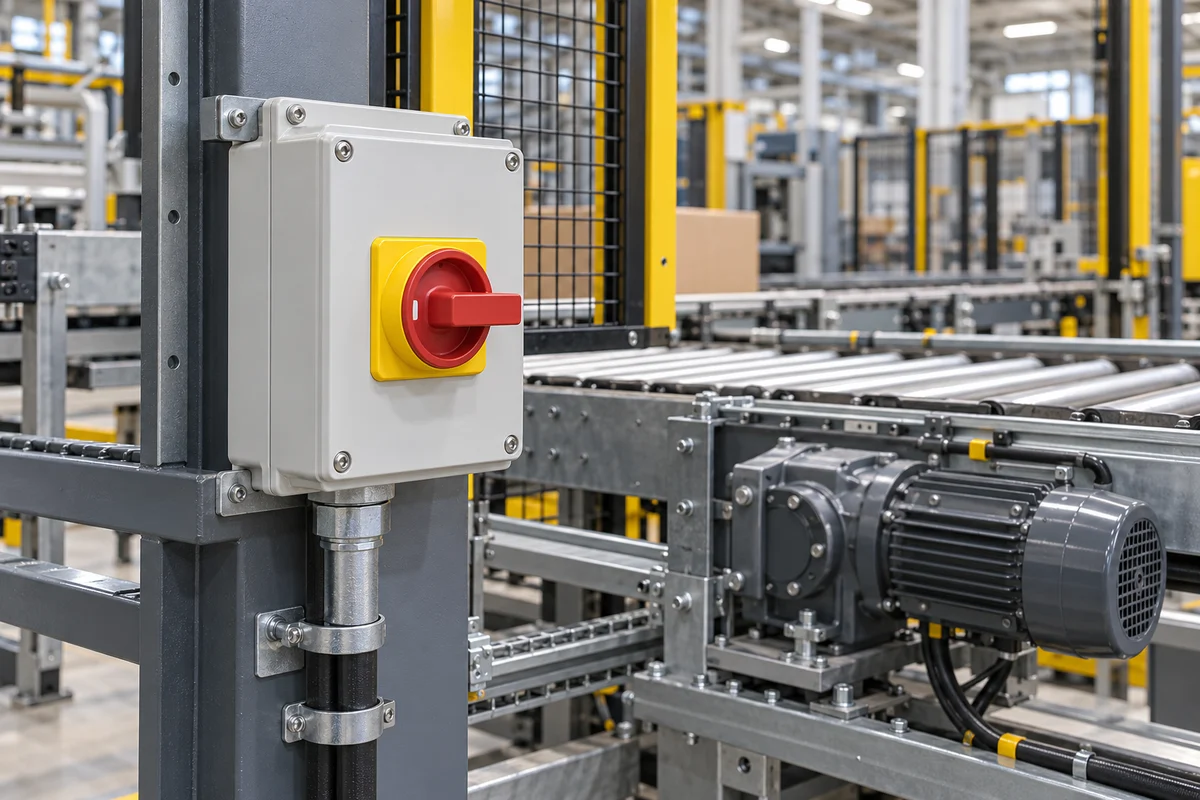
Select the isolation function, then check what current the device can switch. This guide connects the contact assembly, handle and fuse arrangement to the ratings that matter at your actual voltage and load.
CNFX editorial research · Sources checked October 9, 2026 · 15 sources
IEC 60947-3:2020+AMD1:2025 CSV, edition 4.1, is the consolidated edition published on 25 April 2025. Its public scope covers switches, disconnectors, switch-disconnectors and fuse-combination units, with accessories, in distribution and motor circuits up to 1000 V AC or 1500 V DC. These are the standard’s scope limits, not ratings automatically assigned to a product. [1]
Disconnector
Provides the isolation function. A disconnector designation by itself does not establish a load-switching rating; the making and breaking duty must be stated for the selected device. [2]
Switch-disconnector
Combines isolation with making and breaking current, up to the rating of its utilization category [2].
Fuse-combination unit
A switch or disconnector combined with fuses, such as a fuse switch-disconnector; its ratings depend on the fuse-links fitted [4].
The IEC summary describes changes from the earlier edition, including DC critical-load-current tests and conditional short-circuit ratings with circuit-breaker protection. The full standard was not read. Ask for the offered model’s test basis and edition; this guide does not certify compliance with the 2025 amendment. [1]
02
Follow the contact path and the operating linkage
This is a functional component / BOM reference for the switchgear constructions described here. The catalogues show functions and accessories, but do not supply a production BOM with internal material grades or interchangeable spare-part numbers. [2][5]
Operating the handle moves the contact mechanism; opening the main contacts interrupts the conductive path. ABB describes quick-make / quick-break action and positive position indication in its OT range. Its contact-function diagrams also distinguish main contacts from auxiliary signalling contacts. An auxiliary contact is not the power pole. [2]
Component
What it does in the assembly
Materials / supply boundary
Main contact assembly
Carries the power circuit when closed and creates the separation when open. The permitted switching duty belongs to the complete device and utilization category. [2]
The cited OT and YCHR8 documents do not specify the internal contact alloy or plating. Do not select a replacement from a generic “copper alloy” label.
Operating mechanism, shaft and handle
Transfers the manual input to the switch. Front, side and door-coupled arrangements are separate catalogue configurations. [2]
Handle, shaft and coupling must match the switch and panel arrangement; the sources do not establish stainless steel as the universal mechanism material.
Insulating body and terminal protection
Supports and separates live parts; terminal covers and the surrounding enclosure affect access to them. CNC distinguishes open and closed front protection. [2][5]
No PA66, PBT or other resin grade is established by these sources. An IP rating is not a declaration of polymer composition.
Restricts a defined action: for example, an ABB accessory may lock the handle OFF, or a mechanical interlock may prevent two switches being ON together. The action depends on the accessory and switch family. [2]
An interlock is not automatically a load-sensing device. Confirm the permitted states and exact compatible accessory; do not assume the OT125F accepts every interlock in the catalogue.
Fuse-link and carrier · fuse-combination units
The fuse provides the overcurrent protection specified for the combination; the carrier locates the selected fuse system. YCHR8 has separate switch / fuse relationship tables. [5]
Specify fuse type, dimensions and rating as part of the order. A fuse-link listed as an option must still be coordinated with the switch’s operational rating.
For its positive-indication arrangement, ABB states that welded main contacts prevent the handle reaching OFF and prevent padlocking in that position. This describes a mechanical indication feature; a handle position alone does not establish absence of voltage throughout an installation. [2]
03
The utilization category sets the real current rating
The worked comparison is ABB OT125F in the 2014 OT catalogue, technical-data pages 8–9. It is a named historical catalogue example, not a current-stock offer or a rating for all 125 A switches. The category descriptions below are also stated in the CA10 manufacturer sheet, version 10.13. [2][3]
The suffix tells you how often it may operate
A datasheet defines AC-23A as frequent switching [3], while a leading catalogue footnotes its B ratings as "utilization category B, infrequent operation" [2]. A switch rated AC-22B is not rated for the same duty as one rated AC-22A.
DC ratings depend on poles in series
For that OT125F example, DC-21A at 125 A requires one pole at 24–48 V, two poles at 110 V or four poles at 220 V. The catalogue explicitly specifies poles in series. Those data do not establish a 1500 V photovoltaic rating. CNC’s YCHR8 table separately prints DC22B and, in its AC columns, ADC22B / ADC21B. Keep those labels unresolved until CNC confirms the intended categories and test basis. [2][5]
Category
Switching duty
ABB OT125F example · 2014 catalogue
AC-21A
Switching of resistive loads, including moderate overloads [3]
Frequent switching of motors or other highly inductive loads [3]
90 A at up to 415 V, 70 A at 500 V and 50 A at 690 V for AC-23A. [2]
04
Read voltage, short-circuit and endurance fields with their conditions
Voltage, current and endurance describe different limits. The examples below identify the model and test condition for each value; material and resistance fields remain open where the selected documents give no specification.
Field
Documented example or evidence limit
What the value means here
Rated voltage
OT125F: Ui and Ue for AC-20 / DC-20 are 750 V at pollution degree 3 in the cited catalogue; load-switching ratings are given separately by category. [2]
Do not use an insulation or no-load voltage entry as the voltage for every breaking duty.
Rated current
OT125F: 125 A thermal current at 40 °C in open air or enclosure; 100 A at 60 °C in enclosure, with the listed minimum 50 mm² copper conductor. AC-23A ratings are lower and voltage-dependent. [2]
Temperature, enclosure and switching duty are separate conditions.
Breaking / short-circuit capability
OT125F: Icw 2.5 kA r.m.s. for 1 s at 690 V. Its separate 50 kA conditional rating at up to 415 V lists OFA gG / aM fuses, maximum 125 / 125 A, and maximum cut-off current 16.5 kA. [2]
Withstand current and conditional short-circuit current are not the switch’s own short-circuit interruption rating. Select the protective combination against the installation’s prospective fault current.
Contact resistance
No contact-resistance limit was found in these selected OT / YCHR8 technical tables.
If required for inspection, specify the model’s measurement method and acceptance limit; no category-wide value is justified by these sources.
Insulation resistance
No universal insulation-resistance acceptance value is established by these documents.
A resistance measurement and a dielectric withstand test are different tests. Use the model’s stated test procedure and acceptance value.
Dielectric / impulse withstand
OT125F: 6 kV at 50 Hz for 1 minute; Uimp 8 kV. [2]
These are test / withstand ratings, not continuous operating voltages.
Operating temperature
CNC YCHR8 states ambient −5 to +50 °C, with humidity and pollution conditions. [5]
This range belongs to YCHR8; it cannot be assigned to every disconnector.
Mechanical endurance
OT125F: 20,000 operations; ABB’s footnote says divide by two for operation cycles, giving 10,000 cycles. [2]
Neither count establishes a maintenance-free period or a service interval.
Electrical endurance
YCHR8 table: 200 electrical durability; mechanical durability is separately listed as 1,400. The table does not define the counting unit or full test duty. [5]
Obtain the test conditions and whether the count is operations or complete cycles before comparing endurance.
Ingress / contact protection
YCHR8: IP30 closed and IP20 open in its operating-condition notes. [5]
These statements do not establish an outdoor, water-resistant assembled enclosure.
Contact material
The selected documents do not identify a contact alloy.
A contact-alloy designation must be tied to the exact device; it cannot be inferred from the switch’s current rating.
Housing material
The selected documents do not establish a resin grade or a universal UL 94 classification.
Request the offered part’s material declaration if needed; do not infer PA66 or PBT from its appearance.
Weight
OT125F: 0.36 kg for three poles or 0.50 kg for four poles, without accessories. [2]
Include the required handle, shaft, enclosure and fuse arrangement when assessing the installed assembly.
05
On a fuse switch-disconnector, the fuse is part of the rating
CNC’s YCHR8 technical table covers YCHR8-160 and YCHR8-250. Its 160 / 250 A thermal-current entries remain unchanged across columns, but the operational current changes with AC/DC voltage. For example, YCHR8-250 is listed at 250 A for 500 V AC and 200 A for 690 V AC. [5]
Rating
Published value (YCHR8)
What to check
Operational and thermal current
YCHR8-160: 160 A at 500 V AC, 125 A at 690 V AC; two-pole DC version: 160 A at 220 V, 125 A at 500 V. YCHR8-250: 250 A at 500 V AC or DC, 200 A at 690 V AC. [5]
The current at your voltage and category, not the frame size
Voltage and insulation
Up to 690 V AC and 500 V DC; Ui 1000 V; Uimp 8 kV [4]
Your system voltage, and AC versus DC version
Short-circuit
Rated conditional short-circuit current 50 kA r.m.s. [4]
Ask for the complete tested combination, permitted fuse-link and prospective fault-current conditions; 50 kA is not an independent interruption rating of the switch.
Fuse system
The overview names NH00 and NH01 fuses, while the fuse table lists NT00 for 160 A and NT1 for 250 A [4]
Resolve the naming before ordering spare fuses
Durability
The table lists electrical durability 200 and mechanical durability 1400, without defining the count as operations or cycles. [5]
Obtain the counting definition and test duty before estimating switching life.
Losses and enclosure
At Ith, 3.5 W per phase for YCHR8-160 or 7.5 W for YCHR8-250, excluding the fuse-link; IP30 closed, IP20 open. [5]
Panel heat calculation and touch protection
The YCHR8-250 fuse table lists a 225 A option in its 400–690 V AC band, while the switch’s operational-current row is 200 A at 690 V. Fitting that fuse does not raise the 690 V operational rating to 225 A. Ask for the coordinated combination at the actual system voltage. The same document’s NH00 / NH01 overview and NT00 / NT1 table also need a confirmed fuse standard and dimensional drawing. [5]
06
Keep the switching duty and maintenance basis with the panel record
Retain the exact switch code, pole arrangement, handle / interlock option and protective-device reference. The cited catalogues explain ratings and functions; they do not provide a general greasing, contact-dressing or periodic replacement procedure.
Type test evidence to IEC 60947-3, naming the edition [1].
Rated operational current per utilization category and voltage, including AC-23A if motors are switched [2].
For fuse units: permitted fuse type and size, and the conditional short-circuit rating with that fuse [4][2].
For DC: ratings per voltage with the pole wiring diagram [2].
Electrical and mechanical durability, power loss per pole and IP rating [4].
For a door-coupled or interlocked assembly, obtain the compatible mechanism drawing and the defined locked states; the ABB OT catalogue describes its standard handle as "padlockable in the OFF-position and with door interlock in the ON-position" and lists mechanical and electrical interlocks as separate accessories. [2]
Request the model’s installation and maintenance instructions and inspection limits. Do not convert a laboratory endurance count into an automatic replacement interval.
07
Separate low-voltage switches from high-voltage equipment and terminals
The companies below have different product scopes. These source checks identify the published offering; they do not independently verify certification, factory capability or the suitability of a particular order.
Low-voltage switchgear
CNC publishes the YCHR8 fuse-combination data used above. GEYA’s GYH8 page describes a 230 / 400 V AC family up to 125 A for infrequent switching. PEOPLE’s HL32-100 sheet identifies an AC22A family with 32, 63 and 100 A current entries. These are separate families with separate duties. [5][6][7]
Fuse-switch offerings with unresolved data
SEL lists CH5 / YCH5 fuse switch-disconnectors, but prints 8000 V for rated insulation voltage. This value is left unresolved here; obtain a corrected model sheet before using it. VIOX’s inspected switch-disconnector category lists a bar fuse switch-disconnector. [8][9]
DC / photovoltaic offering
Kuangya lists ELR-series DC isolator constructions, including DIN-rail and enclosed variants. Select its exact DC model and wiring arrangement; the OT125F AC/DC example above is not a substitute specification for that range. [10]
High- and medium-voltage equipment
Liyond and Shaanxi Huadian list GN / GW high-voltage disconnectors. Shone’s BHA / VNA offerings are medium-voltage load-switch / disconnector equipment, and Jecsany lists outdoor high-voltage isolating switches. Their voltage classes and constructions are outside this page’s low-voltage worked examples. [11][12][13][14]
A similarly named cable connection
The inspected Yongjiu “insulated bullet disconnector” is a male cable terminal in its cable-terminals catalogue. That specific product relationship is not evidence of a power switch-disconnector; the company’s broader range must be checked separately. [15]
08
Copy this RFQ and fill in the brackets
Paste it into your enquiry below or into an email to a maker, then replace every bracket.
Product: [disconnector / switch-disconnector / fuse switch-disconnector] to IEC 60947-3, quantity [units]
System: [AC / DC], [voltage] V, [frequency] Hz, poles [number and wiring arrangement]
Load: [resistive / mixed / motor kW], required category [AC-21A / AC-22A / AC-23A / DC-21A / DC-22A], operations per day [n]
Current: operational [A] at that category and voltage
Short-circuit: prospective current [kA] at the installation; upstream protection [fuse / breaker]
Fuse (if fused): type [gG / aM], size [NH00 / NH1 / ...], rating [A]
Operation: [front handle / door-coupled / side], padlocking: [yes/no]; mounting [DIN rail / base]
Enclosure: IP [rating] closed and open
Documents: type test evidence (edition), ratings table per category and voltage, fuse table, durability with counting convention and test duty, power loss, installation / maintenance instructions
Delivery to [country], target date [date]
12 companies list this product among what they make. Company figures are quoted from each
company's own website; every card states where the relationship came from.
CNC Electric
Yueqing, Wenzhou, Zhejiang, CN
YCHR8 fuse-type isolating switch range: technical tables distinguish AC/DC voltage, operational current and fuse combinations. Confirm the category labels, NH/NT naming and test report for the exact assembly.
Product scope checked 2026-10-09
Listed on the company's own website · profile compiled by CNFX from public sources
The inspected category lists high-voltage GN19 / GW isolating switches. Select by the actual voltage class and arrangement; this is not evidence for the low-voltage catalogue examples.
Product scope checked 2026-10-09
1000 staff10,000 square meters
ISO9001:2000
Listed on the company's own website · profile compiled by CNFX from public sources
Listed there as: “High Voltage Disconnector” View source page ↗hdswitchgear.com · recorded 2026-08-22
GYH8 is presented as a 230/400 V AC switch-disconnector family up to 125 A for infrequent switching. Obtain the complete model and utilization category before assigning a motor-switching duty.
Product scope checked 2026-10-09
Listed on the company's own website · profile compiled by CNFX from public sources
Listed there as: “Switch Disconnector (9)” View source page ↗geya.net · recorded 2026-09-01
BHA / VNA offerings are medium-voltage load-switch and disconnector constructions. Their published scope differs from the low-voltage switchgear worked examples.
Product scope checked 2026-10-09
Listed on the company's own website · profile compiled by CNFX from public sources
Listed there as: “Disconnector” View source page ↗shonevac.com · recorded 2026-09-05
DC / photovoltaic switch-disconnector families include ELR-series DIN-rail and enclosed constructions. Specify the exact DC model, voltage and pole-wiring arrangement.
Product scope checked 2026-10-09
Listed on the company's own website · profile compiled by CNFX from public sources
Listed there as: “DC Switch Disconnector” View source page ↗cnkuangya.com · recorded 2026-09-08
The inspected category offers outdoor high-voltage isolating switches, including a 15 kV single-phase construction. These are not substitutes for the low-voltage switches compared above.
Product scope checked 2026-10-09
Listed on the company's own website · profile compiled by CNFX from public sources
Listed there as: “Disconnector Switch” View source page ↗jecsany.com · recorded 2026-09-18
HL32-100 is a low-voltage family whose technical sheet lists AC22A and 32, 63 and 100 A entries. Its current / pole options must be selected from the exact order code.
Product scope checked 2026-10-09
Listed on the company's own website · profile compiled by CNFX from public sources
Listed there as: “Disconnector” View source page ↗peopleelectric.com · recorded 2026-08-27
CH5 / YCH5 bar and fuse-type switch-disconnectors are listed. The page prints 8000 V as rated insulation voltage; request a corrected model-specific sheet before using that unresolved entry.
Product scope checked 2026-10-09
Listed on the company's own website · profile compiled by CNFX from public sources
Listed there as: “Fuse & Disconnector” View source page ↗sel-elec.com · recorded 2026-09-13
The inspected switch-disconnector category lists a bar fuse switch-disconnector. Obtain its exact frame, fuse system and coordinated ratings rather than transferring another manufacturer’s table.
Product scope checked 2026-10-09
Listed on the company's own website · profile compiled by CNFX from public sources
Listed there as: “Switch Disconnectors” View source page ↗viox.com · recorded 2026-09-15
The inspected insulated bullet disconnector is a male cable terminal. This specific listing does not establish a power switch-disconnector; check any separate switchgear offering on its own evidence.
Product scope checked 2026-10-09
Listed on the company's own website · profile compiled by CNFX from public sources
Listed there as: “Insulated Buttet Disconnector” View source page ↗yojiu.com · recorded 2026-08-27
Explore company information and manufacturing capabilities, then discuss the scope of your project with a relevant supplier.
Share this page
Compiled and source-reviewed by the CNFX editorial team.
Each manufacturer above links to the page on that company's own website where the product is listed, with the date we checked it. How we source and review
· Page last updated 13 October 2026
Buyer questions
Why is my 125 A switch only good for 50 A?
ABB’s 2014 catalogue lists OT125F at 125 A for AC-21A up to 690 V, but 50 A for AC-23A at 690 V. The same device has different operational ratings for different switching duties. Select against the exact category, voltage and model, rather than the frame current alone. [2]
What does the A or B after the category mean?
It indicates how often the device may operate: datasheets describe A categories as frequent switching and B as infrequent operation. Choose A if the switch will be operated regularly under load. [3][2]
Does IEC 60947-3 cover DC solar disconnectors?
The current consolidated standard’s public scope includes devices up to 1500 V DC. That scope does not give an individual switch a photovoltaic rating. Require the selected DC model’s utilization category, voltage, polarity and pole-wiring instructions. The OT125F series-pole data shown here extend only to the voltages stated for that catalogue example. [1][2]
Are NH and NT fuses the same?
Suppliers use different naming; one Chinese page names NH00/NH01 in its overview but NT00/NT1 in its fuse table. Ask for the fuse standard and dimensions in writing before ordering spares. [4]
How many operations will a fuse switch last?
CNC’s YCHR8 table lists electrical durability 200 and mechanical durability 1400, but does not define whether these are operations or complete cycles, or provide the full duty in that table. Obtain those conditions before comparing life. ABB separately footnotes its OT operation counts as twice the number of operation cycles; do not transfer that convention to another manufacturer. [5][2]
Sources and what still needs a direct check
Sources checked 2026-10-09. Standards bodies and regulations define the requirements; manufacturer pages show published ranges for those models only. CNFX does not certify products or suppliers.
IEC edition and scope are taken from its public catalogue entry; the paid full standard and the offered suppliers’ model test reports were not reviewed.
ABB OT125F values are from the 2014 catalogue, and CA10 category wording from the version 10.13 sheet. Confirm the current offered order code and datasheet before purchase.
CNC must clarify its ADC22B / ADC21B labels, NH / NT fuse naming, tested protective combination and endurance counting convention. SEL’s published 8000 V insulation-voltage entry remains unresolved.
Internal contact and housing material grades, contact-resistance limits and a general maintenance interval are not established by the cited documents.
Buyer enquiry
Request manufacturing insight
for Disconnector
Ask for use case, specification boundaries, supplier type, and RFQ preparation
information for this product.
Where it goes
Straight to the CNFX editorial desk, and to the manufacturer if this product is
linked to a claimed profile. Nothing is broadcast to a supplier list.
Your details stay here
We do not sell or rent enquiry data, and we do not add you to a mailing list.
Used only to answer this request.
No commission, no middleman
CNFX is a directory. We take no cut of any order and never negotiate on a
supplier's behalf.
What to include
Share your product specifications, quantity, destination and target delivery date.
Need to Manufacture Disconnector?
Compare manufacturer profiles with relevant product and process capability.