Editorial Technical Reference

Control Output Relay

This page explains how Control Output Relay is classified within Electrical Equipment Manufacturing. Technical values and manufacturer relationships are research references; confirm the current specification and supplier evidence for each order.

Technical Definition & Core Assembly

An electromechanical switch within a temperature controller that activates or deactivates connected heating/cooling devices based on control signals.
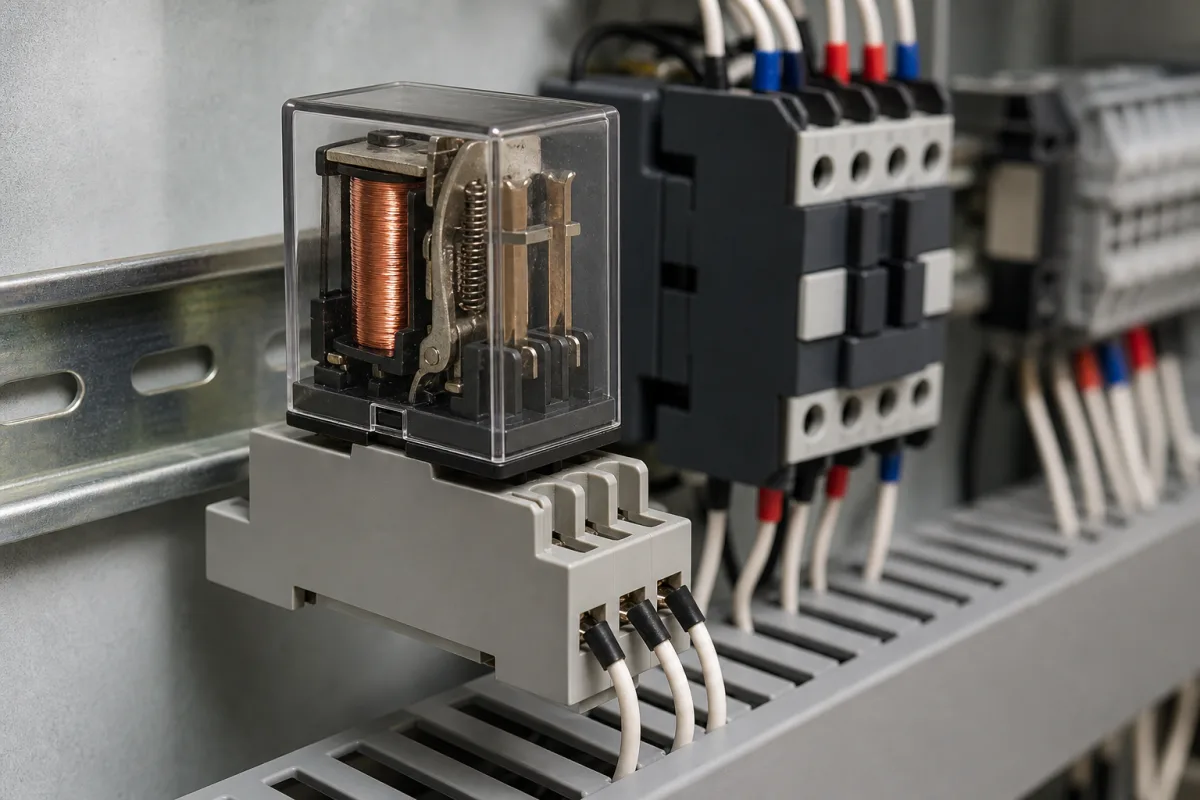
Control Output Relay in a manufacturing environment
Representative product image. Confirm appearance and specifications with the manufacturer.

Product Specifications

Technical details and manufacturing context for Control Output Relay

Definition
The control output relay is a critical component of temperature control systems. It physically connects or disconnects power to heating elements, cooling units, or other thermal regulation devices in response to signals from the controller's processing unit. Serving as the interface between low-voltage control circuits and high-power load circuits, this relay ensures that the control logic can safely manage high-power loads. The relay is typically mounted on a printed circuit board (PCB) or panel within the temperature controller enclosure. Its construction includes a coil, an armature, and one or more contact sets. The contacts are made of silver alloy (AgSnO2 or AgCdO) to ensure reliable switching and long life. The relay is designed to handle rated load currents from 10 to 30 A, with coil voltages of 12 to 24 V DC. Contact configurations range from 1NO to 2NO, providing flexibility for various load connections. Mechanical life is specified at 10^6 to 10^7 cycles, while electrical life under rated load is 10^5 to 10^6 cycles. Contact resistance is initially ≤50 mΩ, and insulation resistance between coil and contacts is ≥100 MΩ at 500 V DC. Dielectric strength is 1500 to 2500 V AC, tested according to IEC 60255-5. The relay operates in ambient temperatures from -40 to 85 °C and in non-condensing humidity from 5% to 95% RH. It offers a degree of protection from IP54 to IP65 per IEC 60529, depending on the enclosure. Typical weight ranges from 30 to 80 g. These parameters are reference ranges; actual values must be confirmed with the manufacturer for the specific model and application. The relay is a replaceable component, and its failure can lead to loss of temperature control, so periodic verification of contact resistance and operation is recommended.
Working Principle
When the temperature controller's processor determines that heating or cooling is needed, it sends a low-voltage signal (12–24 V DC) to the relay coil. This current creates a magnetic field that pulls a mechanical switch, closing the high-power circuit to the connected device. When the setpoint is reached, the signal stops, the magnetic field collapses, and the switch opens, cutting power to the load. This electromechanical action provides a physical isolation between the control circuit and the load circuit, ensuring safe and reliable operation.
Common Materials
Copper, Plastic, Steel, Silver alloy contacts
Technical Parameters
ParameterTypical rangeNotes & selection driver
Rated Load Current10–30 AMaximum current the relay contacts can switchIEC 60947-4-1
Coil Voltage12–24 V DCControl signal voltage to energize the relay
Contact Configuration1NO–2NONumber and type of output contacts
Mechanical Life10^6–10^7 cyclesExpected operations without electrical load
Electrical Life10^5–10^6 cyclesExpected operations under rated load
Contact Resistance≤50 Initial resistance of closed contacts
Insulation Resistance≥100 Between coil and contacts at 500 V DC
Dielectric Strength1500–2500 V ACWithstand voltage between coil and contactsIEC 60255-5
Operating Temperature-40–85 °CAmbient temperature range for reliable operation
Humidity Range5–95 % RHNon-condensing relative humidity
Degree of ProtectionIP54–IP65Protection against dust and water ingressIEC 60529
Contact MaterialAgSnO2–AgCdOSilver alloy for high switching reliability
Weight30–80 gTypical weight for PCB or panel mount relays

Ranges are indicative industry figures for RFQ preparation, not a supplier commitment. Confirm every value and standard with the legal manufacturer before ordering.

Components / BOM
  • Electromagnetic Coil
    Creates magnetic field when energized to move the armature
    Material: Copper wire
  • Armature Part
    Movable iron component that transfers magnetic force to contacts
    Material: Steel
  • Contacts Part
    Conductive surfaces that make or break electrical connection
    Material: Silver alloy
  • Spring Part
    Returns armature to default position when coil is de-energized
    Material: Steel
  • Housing Part
    Protects internal components and provides mounting points
    Material: Plastic

Applied To / Applications

This component is essential for the following industrial systems and equipment:

Industrial Ecosystem & Supply Chain Structure

Complementary Systems
Downstream Applications
Specialized Tooling

Application Fit & Sizing Matrix

Operational Limits
pressure: N/A (atmospheric pressure only)
other spec: Contact rating: 5A at 250VAC/30VDC resistive, Electrical life: 100,000 cycles minimum, Mechanical life: 10,000,000 cycles minimum
temperature: -40°C to +85°C (ambient operating range)
Media Compatibility
✓ Dry air environments ✓ Clean electrical cabinets ✓ Temperature-controlled enclosures
Unsuitable: High humidity or corrosive atmospheres (e.g., chemical processing plants, marine environments)
Sizing Data Required
  • Load current and voltage (AC/DC)
  • Switching frequency (operations per hour)
  • Required contact configuration (SPST, SPDT, etc.)

Reliability & Engineering Risk Analysis

Failure Mode & Root Cause
Contact Welding
Cause: Excessive inrush current or frequent switching of inductive loads causing arcing and material transfer between contacts
Coil Failure
Cause: Overvoltage, overheating due to poor ventilation, or insulation breakdown from moisture ingress or contamination
Maintenance Indicators
  • Audible buzzing or chattering from the relay enclosure
  • Visible discoloration, charring, or melting on the relay housing or adjacent wiring
Engineering Tips
  • Install snubber circuits or surge suppressors to protect contacts from voltage spikes and reduce arcing during switching
  • Implement regular infrared thermography inspections to detect abnormal heating patterns indicating loose connections or overload conditions

Indicative industry ranges for design and RFQ preparation. Confirm the exact figures and applicable standard with the manufacturer before specifying.

Compliance & Manufacturing Standards

Applicable Standards
ISO 13849-1: Safety of machinery - Safety-related parts of control systems ANSI/UL 508: Standard for Industrial Control Equipment DIN EN 61800-5-2: Adjustable speed electrical power drive systems - Safety requirements

Quoted from the published standard.

Manufacturing Precision
  • Contact Resistance: +/- 5% of rated value
  • Actuation Time: +/- 10ms from specified response time
Quality Inspection
  • Dielectric Withstand Test: 1500V AC for 1 minute
  • Mechanical Endurance Test: 1 million operations at rated load

Manufacturers of Control Output Relay

Manufacturer profiles associated with Control Output Relay.

Sourcing Control Output Relay from China?
Tell us your specification and target quantity — we will match it against manufacturer records and come back with the factories that fit.
Request manufacturers We manufacture this

Manufacturer listings support early research and capability understanding. They are not certification, ranking, or transaction guarantees.

Share this page
Technical documentation
Request current drawings, revision history, and a signed specification sheet.
Manufacturing capability
Verify equipment lists, process limits, capacity, and representative production evidence.
Inspection readiness
Confirm test methods, calibrated equipment, sampling plans, and traceable reports.
Supplier transparency
Check the legal entity, factory address, ownership, certifications, and direct contacts.

CNFX does not score or rank suppliers. Buyers must verify all claims and documents with the legal manufacturer before ordering.

Supply Chain Compatible Machinery & Devices

Circuit Breaker Arc Chute

The Circuit Breaker Arc Chute is a critical safety component in electrical circuit breakers, designed to rapidly extinguish electric arcs that form during circuit interruption.

Explore Specs →
Medium Voltage Switchgear Assembly Line

Automated production system for assembling medium voltage electrical switchgear.

Explore Specs →
Motor Terminal Block

A motor terminal block is a standardized electrical component that provides secure, insulated connection points for motor winding leads.

Explore Specs →
PLC Control System

A digital industrial computer control system that monitors inputs, makes decisions based on a custom program, and controls outputs to automate industrial processes.

Explore Specs →

Frequently Asked Questions

What is the function of a control output relay in a temperature controller?

It acts as an electromechanical switch that connects or disconnects power to heating or cooling devices based on control signals from the controller's processor, enabling safe switching of high-power loads.

What are the typical electrical ratings for this relay?

Typical rated load current is 10–30 A, coil voltage is 12–24 V DC, and contact configurations are 1NO to 2NO. These are reference ranges; confirm exact values for your specific model.

How should I verify the relay's performance and safety?

Check contact resistance (≤50 mΩ), insulation resistance (≥100 MΩ at 500 V DC), and dielectric strength (1500–2500 V AC per IEC 60255-5). Also verify mechanical and electrical life ratings. Always consult the manufacturer for model-specific data.

What environmental conditions can the relay withstand?

It operates in -40 to 85 °C ambient temperature and 5–95% RH non-condensing humidity. The degree of protection is IP54–IP65 per IEC 60529, depending on the enclosure. Ensure the application environment is within these ranges.

Data Basis

Editorial classification, named public sources where available, and source-reviewed manufacturer records.

Preliminary Technical Classification
This page supports structured research, RFQ preparation, and supplier evaluation. It does not replace buyer-led supplier qualification, standards review, or technical approval.
Buyer enquiry

Request manufacturing insight for Control Output Relay

Ask for use case, specification boundaries, supplier type, and RFQ preparation information for this product.

Where it goes
Straight to the CNFX editorial desk, and to the manufacturer if this product is linked to a claimed profile. Nothing is broadcast to a supplier list.
Your details stay here
We do not sell or rent enquiry data, and we do not add you to a mailing list. Used only to answer this request.
No commission, no middleman
CNFX is a directory. We take no cut of any order and never negotiate on a supplier's behalf.
What we don't claim
A listing is not an endorsement. Qualify every supplier and verify every figure yourself before ordering.

Your business information is used only to process this request.

Thank you! Your message has been sent. We'll respond within 1–3 business days.
Sorry, we couldn't send your message. Please try again, or email us at [email protected].

Need to Manufacture Control Output Relay?

Compare manufacturer profiles with relevant product and process capability.

Previous Product
Wire Tensioning System
Last Product
Get QuotesChat