Industry-Verified Manufacturing Data (2026)

Temperature Controller

Based on aggregated insights from multiple verified factory profiles within the CNFX directory, the standard Temperature Controller used in the Rubber and Plastic Product Manufacturing sector typically supports operational capacities ranging from standard industrial configurations to heavy-duty production requirements.

Technical Definition & Core Assembly

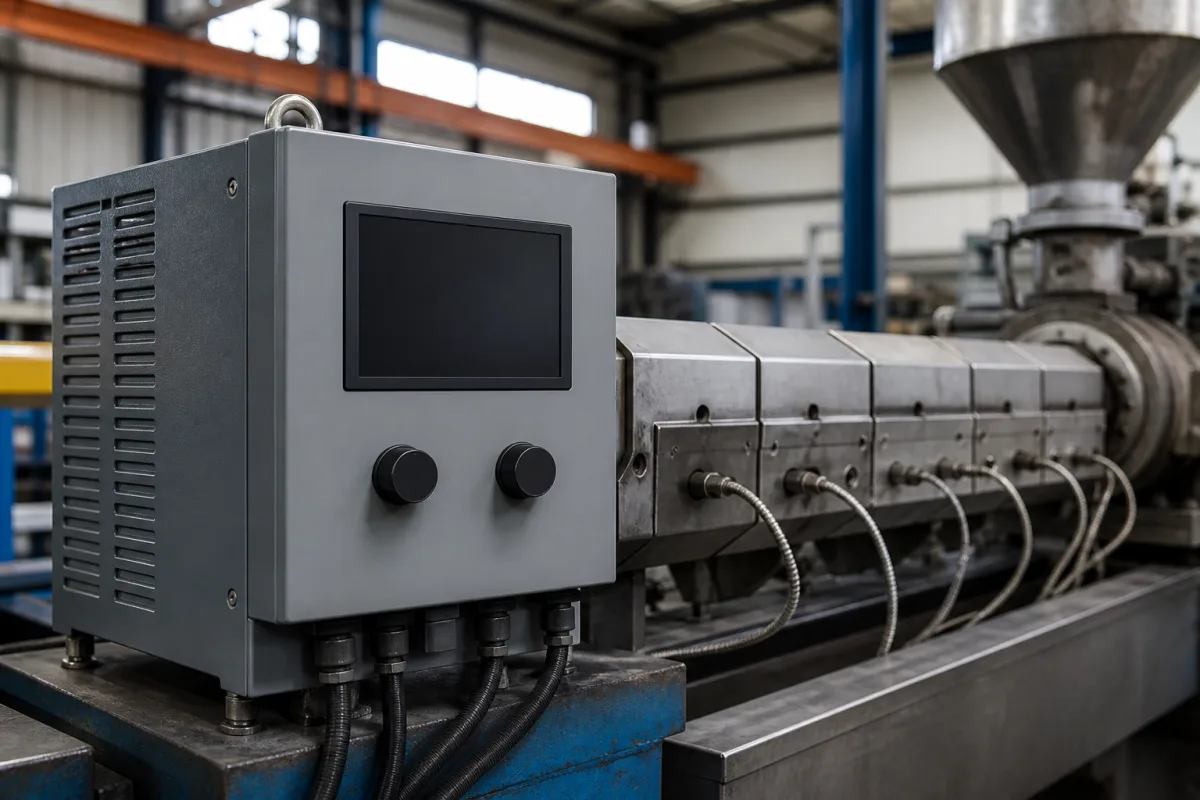
A canonical Temperature Controller is characterized by the integration of Temperature Sensor and Control Unit. In industrial production environments, manufacturers listed on CNFX commonly emphasize Stainless steel housing construction to support stable, high-cycle operation across diverse manufacturing scenarios.

A device that regulates and maintains the temperature within a silicone curing oven to ensure proper curing of silicone materials.
Product Specifications

Technical details and manufacturing context for Temperature Controller

Definition
The temperature controller is a critical component of a silicone curing oven that monitors, regulates, and maintains precise temperature levels throughout the curing process. It ensures consistent thermal conditions for optimal cross-linking and polymerization of silicone compounds, directly impacting product quality, curing time, and material properties.
Working Principle
The temperature controller operates by continuously measuring the oven's internal temperature using sensors (typically thermocouples or RTDs), comparing this reading to a preset target temperature, and adjusting the heating elements (or cooling systems if equipped) through proportional-integral-derivative (PID) control algorithms to maintain stable thermal conditions within specified tolerances.
Common Materials
Stainless steel housing, Electronic circuit boards, Copper wiring, Ceramic insulation
Technical Parameters
  • Temperature control range and accuracy specifications (°C) Per Request
Components / BOM
  • Temperature Sensor
    Measures actual oven temperature and sends signals to the control unit
    Material: Stainless steel probe with thermocouple elements
  • Control Unit
    Processes sensor data, executes PID algorithms, and sends control signals to heating elements
    Material: Electronic circuit board with microprocessor
  • Display Interface
    Shows current temperature, setpoints, and operational status
    Material: LCD screen with protective glass
  • Control Output Relay
    Switches heating elements on/off based on control unit commands
    Material: Electromechanical relay with copper contacts
Engineering Reasoning
20-250°C with ±0.5°C control accuracy
Thermocouple sensor drift exceeding ±2.5°C from calibrated reference at 150°C
Design Rationale: Seebeck coefficient degradation in K-type thermocouple junctions due to prolonged exposure above 300°C, causing electron diffusion and alloy composition changes
Risk Mitigation (FMEA)
Trigger PID control loop integral windup during rapid temperature setpoint changes exceeding 50°C/min
Mode: Overshoot exceeding 15°C above setpoint, causing silicone cross-linking inhibition
Strategy: Implement anti-windup compensation with back-calculation algorithm limiting integrator accumulation to 20% of controller output range
Trigger Solid-state relay contact welding due to inrush currents exceeding 40A during heater element cold-start at 20°C ambient
Mode: Continuous heating beyond setpoint, reaching 280°C thermal runaway threshold
Strategy: Zero-crossing switching synchronization with phase-angle control limiting dI/dt to 5A/ms, plus 25A fast-acting semiconductor fuse

Industry Taxonomies & Aliases

Commonly used trade names and technical identifiers for Temperature Controller.

Applied To / Applications

This component is essential for the following industrial systems and equipment:

Industrial Ecosystem & Supply Chain DNA

Complementary Systems
Downstream Applications
Specialized Tooling

Application Fit & Sizing Matrix

Operational Limits
pressure: Atmospheric to 2 bar (oven environment, non-pressurized)
other spec: Control accuracy: ±1°C, Response time: <30 seconds, Power supply: 24VDC/120-240VAC
temperature: Ambient to 300°C (typical silicone curing range: 100-250°C)
Media Compatibility
✓ Silicone rubber compounds ✓ Epoxy resins ✓ Polyurethane foams
Unsuitable: Corrosive chemical atmospheres (e.g., chlorine, strong acids)
Sizing Data Required
  • Oven chamber volume (m³)
  • Maximum heating/cooling rate required (°C/min)
  • Process temperature setpoint and tolerance (°C)

Reliability & Engineering Risk Analysis

Failure Mode & Root Cause
Sensor Drift/Calibration Loss
Cause: Thermal cycling, aging of sensing elements (thermocouples/RTDs), contamination buildup on sensor surfaces, or electrical noise interference degrading signal accuracy over time
Control Output Failure
Cause: Relay/SSR contact wear or welding from frequent cycling, power supply component degradation (capacitors, transformers), or PID algorithm instability due to improper tuning or software corruption
Maintenance Indicators
  • Oscillating or unstable process temperature despite stable operating conditions
  • Audible chattering/clicking from control relays or visible sparking/burning odor from electrical components
Engineering Tips
  • Implement regular calibration checks using traceable standards and install sensors in thermowells with proper immersion depth to reduce thermal stress
  • Use predictive maintenance tools like vibration analysis on cooling fans, thermal imaging on power components, and monitor cycling frequency to optimize PID settings and reduce relay wear

Compliance & Manufacturing Standards

Reference Standards
IEC 60730-1:2013 (Automatic electrical controls for household and similar use) ISO 9001:2015 (Quality management systems) EN 60730-1:2016 (Automatic electrical controls for household and similar use - CE marking basis)
Manufacturing Precision
  • Temperature setpoint accuracy: +/-0.5°C
  • Control output repeatability: +/-0.2°C
Quality Inspection
  • Calibration verification test against NIST-traceable standards
  • Electrical safety test (dielectric strength and insulation resistance)

Factories Producing Temperature Controller

Verified manufacturers with capability to produce this product in China

✓ 96% Supplier Capability Match Found

P Project Engineer from Australia Feb 06, 2026
★★★★★
"Found 43+ suppliers for Temperature Controller on CNFX, but this spec remains the most cost-effective."
Technical Specifications Verified
S Sourcing Manager from Singapore Feb 03, 2026
★★★★★
"The technical documentation for this Temperature Controller is very thorough, especially regarding technical reliability."
Technical Specifications Verified
P Procurement Specialist from Germany Jan 31, 2026
★★★★★
"Reliable performance in harsh Rubber and Plastic Product Manufacturing environments. No issues with the Temperature Controller so far."
Technical Specifications Verified
Verification Protocol

“Feedback is collected from verified sourcing managers during RFQ (Request for Quote) and factory evaluation processes on CNFX. These reports represent historical performance data and technical audit summaries from our B2B manufacturing network.”

16 sourcing managers are analyzing this specification now. Last inquiry for Temperature Controller from UAE (49m ago).

Supply Chain Compatible Machinery & Devices

Modular Injection Molded Plastic Pallet

Interlocking plastic pallet system for logistics and storage.

Explore Specs →
Multi-Layer Co-Extruded Barrier Film

Plastic film with multiple layers for superior barrier properties.

Explore Specs →
High-Precision Silicone Gasket

Custom-molded silicone seal for industrial equipment.

Explore Specs →
High-Density Polyethylene Storage Container

Industrial-grade plastic container for bulk material storage and transport.

Explore Specs →

Frequently Asked Questions

How does this temperature controller improve silicone curing quality?

It maintains precise temperature stability within ±0.5°C, ensuring uniform curing and preventing defects like under-curing or thermal degradation in silicone products.

What makes this controller suitable for rubber and plastic manufacturing environments?

The stainless steel housing resists chemical exposure and high temperatures, while ceramic insulation protects internal components from industrial oven conditions.

Can this controller integrate with existing curing oven systems?

Yes, it features universal mounting options and standard control outputs compatible with most industrial curing ovens used in rubber and plastic manufacturing.

Can I contact factories directly on CNFX?

CNFX is an open directory, not a transaction platform. Each factory profile provides direct contact information and production details to help you initiate direct inquiries with Chinese suppliers.

Get Quote for Temperature Controller

Request technical pricing, lead times, or customized specifications for Temperature Controller directly from verified manufacturing units.

Your business information is encrypted and only shared with verified Temperature Controller suppliers.

Thank you! Your message has been sent. We'll respond within 1–3 business days.

Need to Manufacture Temperature Controller?

Connect with verified factories specializing in this product category

Add Your Factory Contact Us
Previous Product
Strand Guide System
Next Product
Temperature Sensor Array