Industry-Verified Manufacturing Data (2026)

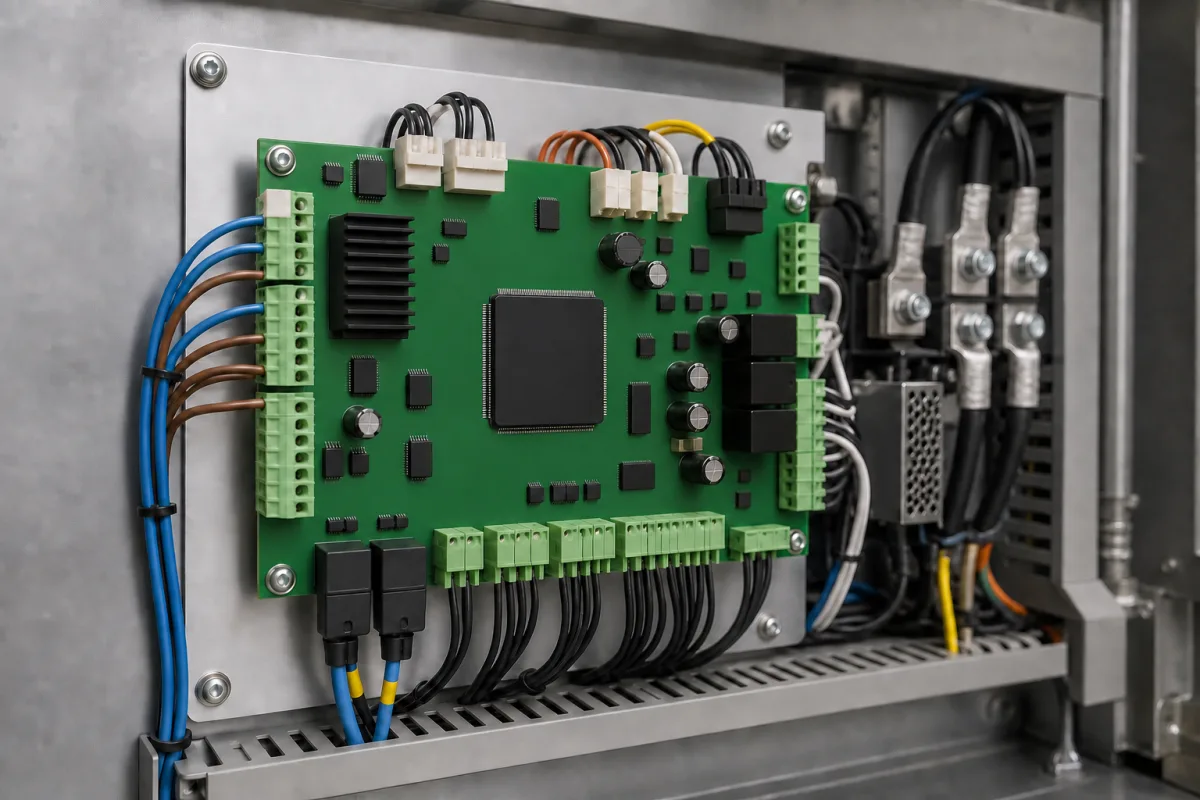
Control Unit (Microcontroller/DSP)

Based on aggregated insights from multiple verified factory profiles within the CNFX directory, the standard Control Unit (Microcontroller/DSP) used in the Electrical Equipment Manufacturing sector typically supports operational capacities ranging from standard industrial configurations to heavy-duty production requirements.

Technical Definition & Core Assembly

A canonical Control Unit (Microcontroller/DSP) is characterized by the integration of Microcontroller/DSP Chip and Memory (Flash/RAM). In industrial production environments, manufacturers listed on CNFX commonly emphasize Semiconductor silicon construction to support stable, high-cycle operation across diverse manufacturing scenarios.

The electronic brain of a programmable power source that executes control algorithms and manages power output.
Product Specifications

Technical details and manufacturing context for Control Unit (Microcontroller/DSP)

Definition
A specialized computing component within a programmable power source that processes input signals, runs control algorithms (typically implemented on a microcontroller or digital signal processor), and generates precise output commands to regulate voltage, current, and power delivery according to programmed parameters and real-time feedback.
Working Principle
Receives user-set parameters and sensor feedback (voltage, current, temperature), processes this data through embedded control algorithms (PID, PWM, etc.), and outputs control signals to power switching components to achieve precise, stable, and programmable power output.
Common Materials
Semiconductor silicon, PCB substrate, Copper traces, Encapsulation resin
Technical Parameters
  • Processing speed of the microcontroller or DSP core (MHz) Customizable
Components / BOM
  • Microcontroller/DSP Chip
    Executes control algorithms and processes data
    Material: Semiconductor silicon
  • Memory (Flash/RAM)
    Stores program code and temporary data
    Material: Semiconductor silicon
  • ADC Circuit
    Converts analog sensor signals to digital values
    Material: Semiconductor components
  • PWM Output Circuit
    Generates pulse-width modulation signals for power control
    Material: Semiconductor components
  • Communication Interface
    Enables communication with external devices (UART, SPI, I2C, etc.)
    Material: Copper traces, connectors
Engineering Reasoning
0-125°C ambient temperature, 1.8-5.5V supply voltage, 0-100% relative humidity (non-condensing)
Junction temperature exceeding 150°C, supply voltage exceeding 6.0V or dropping below 1.6V, electrostatic discharge exceeding 2kV HBM
Design Rationale: Thermal runaway due to silicon junction temperature surpassing semiconductor material limits (Arrhenius equation: failure rate doubles per 10°C increase above 125°C), dielectric breakdown in gate oxide layers at 6.0V (electric field strength >10 MV/cm), latch-up triggered by parasitic PNPN structures
Risk Mitigation (FMEA)
Trigger Electromagnetic interference coupling through power supply lines exceeding 100V/m field strength
Mode: Program counter corruption leading to control algorithm execution failure
Strategy: Pi-filter network with 10μF tantalum capacitor and 100Ω ferrite bead on all power inputs, guard ring shielding around critical analog circuits
Trigger Clock oscillator crystal fracture due to mechanical vibration at 15g RMS acceleration
Mode: System clock failure causing complete loss of timing reference and processor halt
Strategy: Surface-mount AT-cut quartz crystal with 4-point bonding, vibration-damping silicone gel encapsulation, redundant internal RC oscillator with automatic failover

Industry Taxonomies & Aliases

Commonly used trade names and technical identifiers for Control Unit (Microcontroller/DSP).

Applied To / Applications

This component is essential for the following industrial systems and equipment:

Industrial Ecosystem & Supply Chain DNA

Complementary Systems
Downstream Applications
Specialized Tooling

Application Fit & Sizing Matrix

Operational Limits
pressure: N/A (sealed enclosure dependent)
other spec: Humidity: 5-95% non-condensing, Vibration: 5g RMS, EMC: IEC 61000-4 standards
temperature: -40°C to +85°C (industrial grade), optional -40°C to +125°C (extended)
Media Compatibility
✓ Clean dry air environments ✓ Industrial control cabinets with filtered air ✓ Sealed enclosures with desiccant
Unsuitable: Direct exposure to conductive dust, metal shavings, or corrosive chemical vapors
Sizing Data Required
  • Maximum switching frequency required (kHz)
  • Control algorithm complexity (MIPS/MFLOPS)
  • Number of parallel control loops and I/O channels

Reliability & Engineering Risk Analysis

Failure Mode & Root Cause
Thermal stress failure
Cause: Excessive heat generation due to poor cooling, overclocking, or high ambient temperatures leading to solder joint fatigue, material degradation, or thermal runaway.
Electrostatic discharge (ESD) damage
Cause: Accumulation and sudden discharge of static electricity during handling, installation, or operation, causing latent or catastrophic failure of semiconductor components.
Maintenance Indicators
  • Intermittent or erratic system behavior (e.g., random resets, data corruption, or unresponsive peripherals)
  • Audible high-frequency whine or buzzing from the unit, indicating potential capacitor failure or power supply instability
Engineering Tips
  • Implement proper thermal management with adequate heatsinking, forced air cooling, and thermal interface materials, ensuring operating temperatures remain within manufacturer specifications.
  • Establish strict ESD control protocols during all handling phases, including use of grounded workstations, wrist straps, and anti-static packaging, coupled with regular environmental monitoring for static charge buildup.

Compliance & Manufacturing Standards

Reference Standards
ISO 9001:2015 Quality Management Systems IEC 60730-1:2013 Automatic Electrical Controls RoHS Directive 2011/65/EU (CE marking)
Manufacturing Precision
  • Package coplanarity: ≤0.10mm
  • Pin position tolerance: ±0.05mm
Quality Inspection
  • Automated Optical Inspection (AOI) for solder joints and component placement
  • In-Circuit Test (ICT) for electrical functionality and connectivity

Factories Producing Control Unit (Microcontroller/DSP)

Verified manufacturers with capability to produce this product in China

✓ 96% Supplier Capability Match Found

P Procurement Specialist from Australia Jan 15, 2026
★★★★★
"As a professional in the Electrical Equipment Manufacturing sector, I confirm this Control Unit (Microcontroller/DSP) meets all ISO standards."
Technical Specifications Verified
T Technical Director from Singapore Jan 12, 2026
★★★★★
"Standard OEM quality for Electrical Equipment Manufacturing applications. The Control Unit (Microcontroller/DSP) arrived with full certification."
Technical Specifications Verified
P Project Engineer from Germany Jan 09, 2026
★★★★★
"Great transparency on the Control Unit (Microcontroller/DSP) components. Essential for our Electrical Equipment Manufacturing supply chain."
Technical Specifications Verified
Verification Protocol

“Feedback is collected from verified sourcing managers during RFQ (Request for Quote) and factory evaluation processes on CNFX. These reports represent historical performance data and technical audit summaries from our B2B manufacturing network.”

9 sourcing managers are analyzing this specification now. Last inquiry for Control Unit (Microcontroller/DSP) from Brazil (1h ago).

Supply Chain Compatible Machinery & Devices

Transformer Winding Machine

Industrial machine for winding copper wire onto transformer cores

Explore Specs →
Circuit Breaker Trip Unit

Protective control module for electrical circuit breakers

Explore Specs →
Circuit Breaker Arc Chute

Electrical component that extinguishes arcs in circuit breakers

Explore Specs →
Medium Voltage Switchgear Assembly Line

Automated production system for assembling medium voltage electrical switchgear.

Explore Specs →

Frequently Asked Questions

What is the primary function of this control unit in electrical equipment manufacturing?

This control unit serves as the electronic brain of programmable power sources, executing control algorithms to precisely manage power output, regulate voltage/current, and ensure stable operation in industrial applications.

What communication interfaces are typically included in this control unit?

Common interfaces include RS-485, CAN bus, Ethernet, and serial protocols (UART/SPI/I2C) for integration with industrial networks, monitoring systems, and external controllers in manufacturing environments.

How does the ADC and PWM circuitry contribute to power control?

The ADC (Analog-to-Digital Converter) monitors real-time power parameters like voltage and current, while the PWM (Pulse Width Modulation) circuit adjusts power output by controlling switching frequency and duty cycle for precise regulation.

Can I contact factories directly on CNFX?

CNFX is an open directory, not a transaction platform. Each factory profile provides direct contact information and production details to help you initiate direct inquiries with Chinese suppliers.

Get Quote for Control Unit (Microcontroller/DSP)

Request technical pricing, lead times, or customized specifications for Control Unit (Microcontroller/DSP) directly from verified manufacturing units.

Your business information is encrypted and only shared with verified Control Unit (Microcontroller/DSP) suppliers.

Thank you! Your message has been sent. We'll respond within 1–3 business days.

Need to Manufacture Control Unit (Microcontroller/DSP)?

Connect with verified factories specializing in this product category

Add Your Factory Contact Us
Previous Product
Control Switches
Next Product
Control Unit / Thermostat