Industry-Verified Manufacturing Data (2026)

Electric Heating System

Based on aggregated insights from multiple verified factory profiles within the CNFX directory, the standard Electric Heating System used in the Electrical Equipment Manufacturing sector typically supports operational capacities ranging from standard industrial configurations to heavy-duty production requirements.

Technical Definition & Core Assembly

A canonical Electric Heating System is characterized by the integration of Heating Element and Thermocouple / RTD Sensor. In industrial production environments, manufacturers listed on CNFX commonly emphasize Nickel-Chromium Alloy (e.g., Nichrome) construction to support stable, high-cycle operation across diverse manufacturing scenarios.

A heating system that uses electrical energy to generate heat for industrial processes.

Product Specifications

Technical details and manufacturing context for Electric Heating System

Definition
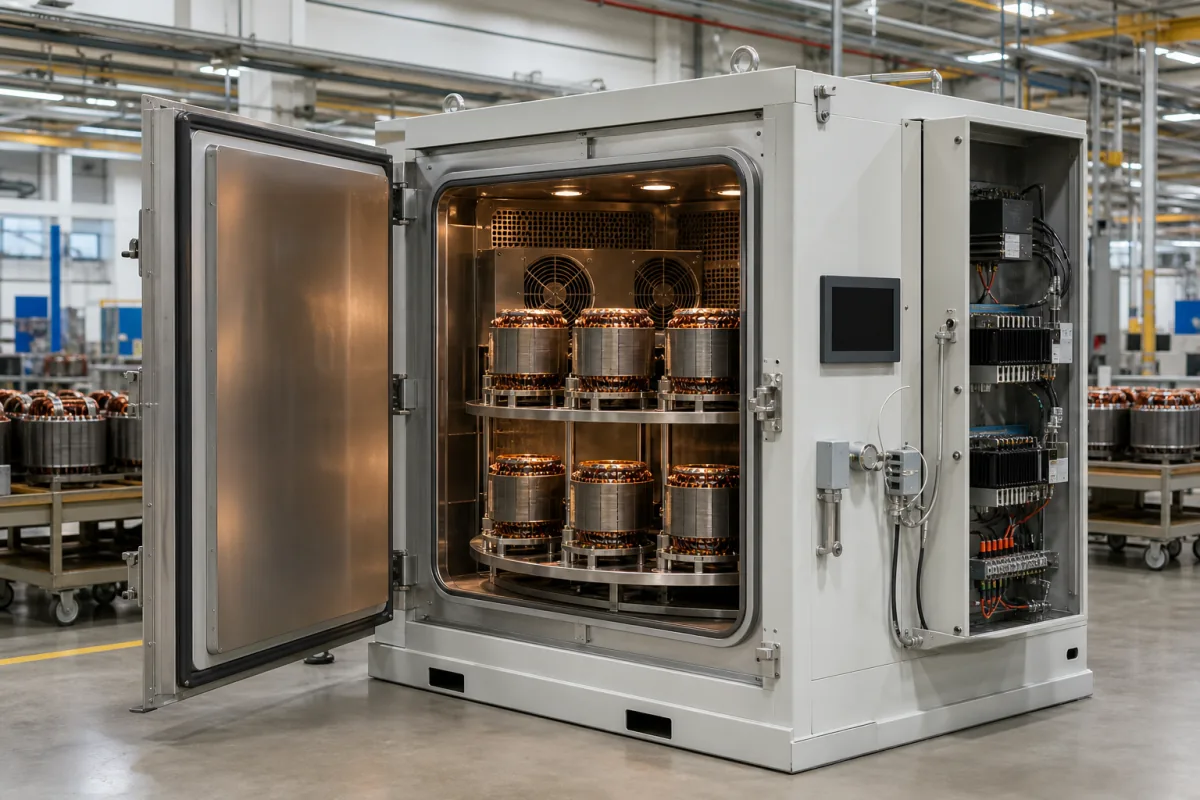
An electric heating system is a critical component within an Electric Motor Coil Impregnation and Curing Oven. It provides the precise and controllable thermal energy required to cure the resin or varnish applied to motor windings, ensuring proper insulation, bonding, and hardening of the impregnation material.
Working Principle
Electrical energy is converted into heat through resistive heating elements (e.g., metal alloy wires, ceramic heaters). A control system regulates the power supplied to these elements based on temperature feedback from sensors, maintaining the oven chamber at the specific temperature profile required for the curing cycle.
Common Materials
Nickel-Chromium Alloy (e.g., Nichrome), Insulating Ceramic (e.g., Alumina), Stainless Steel (housing/support)
Technical Parameters
  • Total heating power output of the system. (kW) Per Request
Components / BOM
  • Heating Element
    Converts electrical energy into heat through resistance.
    Material: Nickel-Chromium Alloy
  • Thermocouple / RTD Sensor
    Measures the temperature within the oven chamber and provides feedback to the controller.
    Material: Stainless Steel (sheath), Platinum/Nickel (sensing element)
  • Power Controller (SSR/PID)
    Regulates the electrical power supplied to the heating elements based on the temperature setpoint and sensor feedback.
    Material: Electronic Components, Aluminum (housing)
  • Insulation & Housing
    Contains the heating elements, directs heat into the oven chamber, and provides electrical and thermal insulation.
    Material: Stainless Steel, Ceramic Fiber
Engineering Reasoning
220-480 V AC, 50-60 Hz, 5-100 kW thermal output
Insulation breakdown at 650°C sheath temperature, element rupture at 1200°C internal temperature
Design Rationale: Joule heating (P=I²R) causing resistive element oxidation and thermal expansion mismatch between sheath and element materials
Risk Mitigation (FMEA)
Trigger Voltage fluctuation exceeding ±10% nominal for >2 seconds
Mode: Resistive element overheating leading to localized melting at 1455°C (nickel-chromium alloy melting point)
Strategy: Solid-state voltage regulator with 0.1% regulation accuracy and thermal cut-off at 600°C sheath temperature
Trigger Cyclic thermal loading exceeding 1000 cycles between 20°C and 800°C
Mode: Thermal fatigue cracking in heating element due to coefficient of thermal expansion mismatch (17.3×10⁻⁶/°C for Incoloy vs 11.7×10⁻⁶/°C for steel)
Strategy: Finite element analysis-optimized element geometry with stress-relief bends and controlled ramp-up rate of 100°C/minute maximum

Industry Taxonomies & Aliases

Commonly used trade names and technical identifiers for Electric Heating System.

Industrial Ecosystem & Supply Chain DNA

Complementary Systems
Downstream Applications
Specialized Tooling

Application Fit & Sizing Matrix

Operational Limits
pressure: Atmospheric to 10 bar (standard), up to 30 bar with pressure-rated housings
flow rate: 0.1 to 100 m³/h (liquid), 10 to 10,000 Nm³/h (gas)
temperature: Up to 600°C (typical), 800°C max with specialized elements
slurry concentration: Up to 40% solids by weight (with erosion-resistant elements)
Media Compatibility
✓ Thermal oils (e.g., Dowtherm, Therminol) ✓ Process water/deionized water ✓ Clean air/nitrogen gas
Unsuitable: Chlorinated or halogenated hydrocarbon environments (risk of corrosion and toxic byproducts)
Sizing Data Required
  • Required heat output (kW)
  • Media flow rate and specific heat capacity
  • Maximum allowable pressure drop across heater

Reliability & Engineering Risk Analysis

Failure Mode & Root Cause
Electrical Insulation Breakdown
Cause: Thermal cycling and moisture ingress degrade insulation materials, leading to short circuits or ground faults.
Heating Element Degradation
Cause: Oxidation and scaling from high temperatures reduce element efficiency and can cause hot spots or burnout.
Maintenance Indicators
  • Unusual buzzing or arcing sounds from electrical components
  • Discoloration or scorch marks on heating elements or connections
Engineering Tips
  • Implement regular thermographic inspections to detect abnormal temperature patterns and prevent thermal runaway.
  • Use corrosion-resistant materials and protective coatings on heating elements to minimize oxidation and scaling.

Compliance & Manufacturing Standards

Reference Standards
ISO 9001:2015 - Quality Management Systems IEC 60335-1 - Safety of Household and Similar Electrical Appliances UL 499 - Electric Heating Appliances
Manufacturing Precision
  • Temperature Uniformity: +/- 5°C across heating surface
  • Insulation Resistance: > 100 MΩ at 500 V DC
Quality Inspection
  • Dielectric Strength Test - 1500 V AC for 1 minute
  • Thermal Imaging Analysis - Detect hot spots and heat distribution

Factories Producing Electric Heating System

Verified manufacturers with capability to produce this product in China

✓ 97% Supplier Capability Match Found

P Project Engineer from Canada Jan 25, 2026
★★★★★
"Found 35+ suppliers for Electric Heating System on CNFX, but this spec remains the most cost-effective."
Technical Specifications Verified
S Sourcing Manager from United States Jan 22, 2026
★★★★★
"The technical documentation for this Electric Heating System is very thorough, especially regarding technical reliability."
Technical Specifications Verified
P Procurement Specialist from United Arab Emirates Jan 19, 2026
★★★★★
"Reliable performance in harsh Electrical Equipment Manufacturing environments. No issues with the Electric Heating System so far."
Technical Specifications Verified
Verification Protocol

“Feedback is collected from verified sourcing managers during RFQ (Request for Quote) and factory evaluation processes on CNFX. These reports represent historical performance data and technical audit summaries from our B2B manufacturing network.”

13 sourcing managers are analyzing this specification now. Last inquiry for Electric Heating System from Brazil (1h ago).

Supply Chain Compatible Machinery & Devices

Circuit Breaker Arc Chute

Electrical component that extinguishes arcs in circuit breakers

Explore Specs →
Medium Voltage Switchgear Assembly Line

Automated production system for assembling medium voltage electrical switchgear.

Explore Specs →
Motor Terminal Block

Electrical connection interface for motor windings

Explore Specs →
PLC Control System

A digital industrial computer control system that monitors inputs, makes decisions based on a custom program, and controls outputs to automate industrial processes.

Explore Specs →

Frequently Asked Questions

What are the main advantages of using nickel-chromium alloy heating elements?

Nickel-chromium alloys like Nichrome offer excellent oxidation resistance, high melting points, and stable electrical resistance at elevated temperatures, making them ideal for industrial heating applications requiring durability and consistent performance.

How does the PID controller improve heating system efficiency?

PID (Proportional-Integral-Derivative) controllers provide precise temperature regulation by continuously calculating and adjusting power output based on feedback from thermocouple/RTD sensors, reducing energy waste and maintaining optimal process temperatures.

What maintenance is required for industrial electric heating systems?

Regular inspection of heating elements for oxidation/damage, checking insulation integrity, verifying sensor calibration, and ensuring proper ventilation around the housing. Most systems require minimal maintenance due to durable materials like stainless steel and ceramic insulation.

Can I contact factories directly on CNFX?

CNFX is an open directory, not a transaction platform. Each factory profile provides direct contact information and production details to help you initiate direct inquiries with Chinese suppliers.

Get Quote for Electric Heating System

Request technical pricing, lead times, or customized specifications for Electric Heating System directly from verified manufacturing units.

Your business information is encrypted and only shared with verified Electric Heating System suppliers.

Thank you! Your message has been sent. We'll respond within 1–3 business days.

Need to Manufacture Electric Heating System?

Connect with verified factories specializing in this product category

Add Your Factory Contact Us
Previous Product
Electric Generator
Next Product
Electric Motor