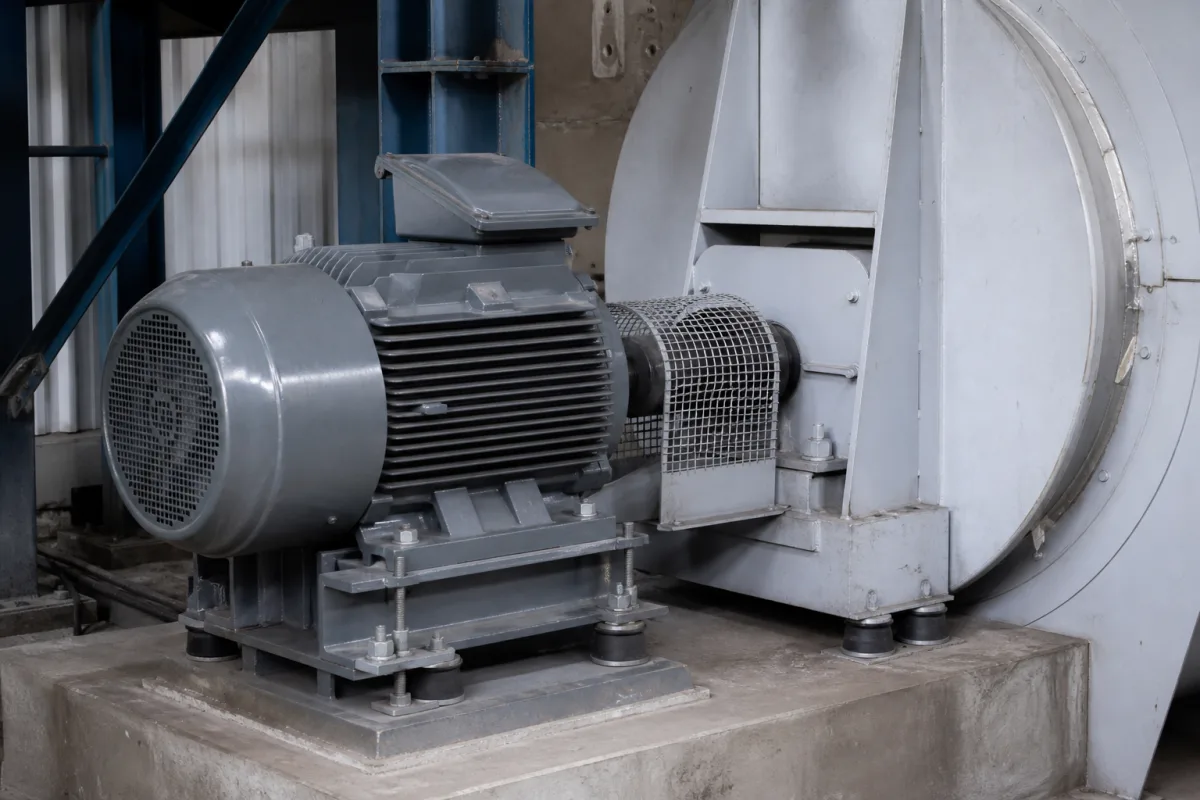
Drives · Right-sized, efficient and fit for the site
Motors are bought by power rating, but they are paid for in electricity. A motor that is too large runs at low efficiency and power factor; one that is too small overheats. Size the motor to the load it will actually carry, then specify the efficiency class, enclosure, voltage and mounting the site needs.
AC induction and permanent-magnet motors for driving pumps, fans, conveyors and machines, single- and three-phase, plus DC motors for mobile and power-unit use. Servo and stepper motors have their own pages.
CNFX editorial research · Sources checked October 12, 2026 · 5 sources
Size the motor for the load it will actually run at
The US Department of Energy's motor fact sheet states that "most electric motors are designed to run at 50% to 100% of rated load" and that "maximum efficiency is usually near 75% of rated load"; a 10 hp motor therefore suits loads of about 5–10 hp. Efficiency drops significantly as load falls into the underloaded range, and DOE says "power factor tends to drop off sooner, but less steeply than efficiency, as load decreases". [1]
Oversizing can come from covering an occasional peak; DOE notes that "far too often motors are mismatched—or oversized—for the load they are intended to serve". DOE suggests two-speed motors, adjustable-speed drives or load management as alternatives for variable loads. [1]
DOE explains service factor: a 10 hp motor with a 1.15 service factor can carry 11.5 hp for short periods without significant damage, but running continuously above rating reduces efficiency and life, and a motor should never be overloaded when voltage is low or cooling is impaired by altitude, high ambient temperature or dirt. [1]
Give the supplier the driven machine's power at its normal and peak duty, starting conditions and hours per year. A nameplate copied from the old motor repeats its sizing mistakes.
02
Check the efficiency class required where the motor will be used
In the European Union, Regulation (EU) 2019/1781 has required, from 1 July 2021, that three-phase 2-, 4-, 6- and 8-pole motors from 0.75 kW to 1,000 kW meet at least IE3, and those from 0.12 kW to below 0.75 kW at least IE2 (Ex eb increased-safety motors excluded). From 1 July 2023 it added IE4 for three-phase 2-, 4- and 6-pole motors from 75 kW to 200 kW (with listed exclusions), and IE2 for single-phase motors of 0.12 kW and above and for Ex eb motors. [2]
Other markets set their own minimum efficiency rules. State the market where the machine or motor will be placed, and ask the supplier for the efficiency class, the tested efficiency at rated load and the test standard on the nameplate and data sheet.
DOE notes that whether a premium-efficiency motor pays back depends on running hours, electricity price and the price premium; it suggests replacing significantly oversized motors at the next opportunity and properly sized standard-efficiency motors when they fail. [1]
03
Measure the load of an existing motor before replacing it
DOE describes three ways to estimate load: measured input power compared with full-load input, a voltage-corrected current ratio, or the slip method. It recommends surveying all motors that run more than 1,000 hours a year. [1]
Current varies roughly linearly with load down to about 50% load; below that, magnetising current makes current a poor guide. Nameplate full-load current applies only at rated voltage, so measured current must be corrected for actual voltage. [1]
The slip method uses speed. An induction motor's synchronous speed depends on supply frequency and pole count (for example 1,800 rpm for 4 poles at 60 Hz), and slip below synchronous speed is roughly proportional to load: at 50% load the speed is halfway between full-load and synchronous speed. As a calculation example only, a 4-pole 60 Hz motor rated 1,750 rpm at full load and measured at 1,775 rpm is running at about (1,800 − 1,775) ÷ (1,800 − 1,750) = 50% load. [1]
04
Match motor type, supply and enclosure to the application
Suppliers linked to this page offer three-phase and single-phase AC motors, DC motors and gear motors, and stainless-steel motors for washdown. [3][4][5]
Hydraflu, for example, lists 12/24 V DC motors for hydraulic power units on mobile machines and single- and three-phase AC motors from 100–120 V to 380–415 V for indoor units. Sunrise lists brushless DC and permanent-magnet DC motors, with gearboxes. [4][5]
Specify supply voltage and frequency, single- or three-phase, the starting method (direct-on-line, soft starter or variable-speed drive), enclosure and IP rating, mounting (foot, flange or both), frame size, duty cycle and ambient temperature and altitude.
05
Trace the motor components
This is a functional reference built from the sources cited; it is not one maker's parts list. Materials and ratings come from the data sheet of the motor you order.
Part
Role
Fix in the order
Stator core and windings
Produce the rotating magnetic field; winding insulation sets thermal limits.
Insulation class, temperature rise and thermal protection.
Rotor
Induction (cage) or permanent-magnet rotor.
Rotor type and suitability for drive operation.
Shaft and bearings
Transmit torque and carry belt or coupling loads.
Shaft dimensions, bearing type and lubrication interval.
Frame and enclosure
House the motor and set protection and cooling; stainless versions for washdown. [3]
Frame size, material, IP rating and cooling method.
Terminal box
Connects supply and accessories.
Voltage connection, cable entries and position.
Controller or drive (where integrated)
Controls speed or commutation in electronically commutated motors. [5]
Control interface and supply.
06
Fill the specification fields with values for your drive
A motor quotation needs drive-specific values. The table explains each field, gives published values where a reviewed source states them, and says what to obtain from the supplier.
Field
What it means and published values
Ask the supplier for
Rated power (kW)
Choose so the normal load is about 50–100% of rating, ideally near 75%. [1]
Rated power and service factor.
Rated voltage (V AC)
Nameplate current applies at rated voltage only. [1]
Explore company information and manufacturing capabilities, then discuss the scope of your project with a relevant supplier.
Share this page
Compiled and source-reviewed by the CNFX editorial team.
Published product pages show what a company offers, not tested performance. Confirm the legal seller, factory and scope for your order. How we source and review
· Page last updated 13 October 2026
Buyer questions
Is a bigger motor safer?
Not for efficiency. DOE notes motors are designed for 50–100% load with peak efficiency near 75%, and efficiency falls sharply below about half load; power factor drops too. [1]
What efficiency class is required in the EU?
Under Regulation (EU) 2019/1781, three-phase 2- to 8-pole motors from 0.75 to 1,000 kW must meet IE3 from 1 July 2021, and 75–200 kW 2-, 4- and 6-pole motors IE4 from 1 July 2023, subject to the regulation's exclusions. [2]
Can I run a motor continuously at its service factor?
DOE explains a 1.15 service factor allows short-term overload, but running continuously above rated load reduces efficiency and life, especially at low voltage or with poor cooling. [1]
Sources and what still needs a direct check
Sources checked 2026-10-12. The DOE fact sheet and EU Regulation 2019/1781 are government sources; the regulation is quoted for the EU market only. Supplier pages describe their own offers. IEC 60034 and NEMA MG 1 were not read for this page.